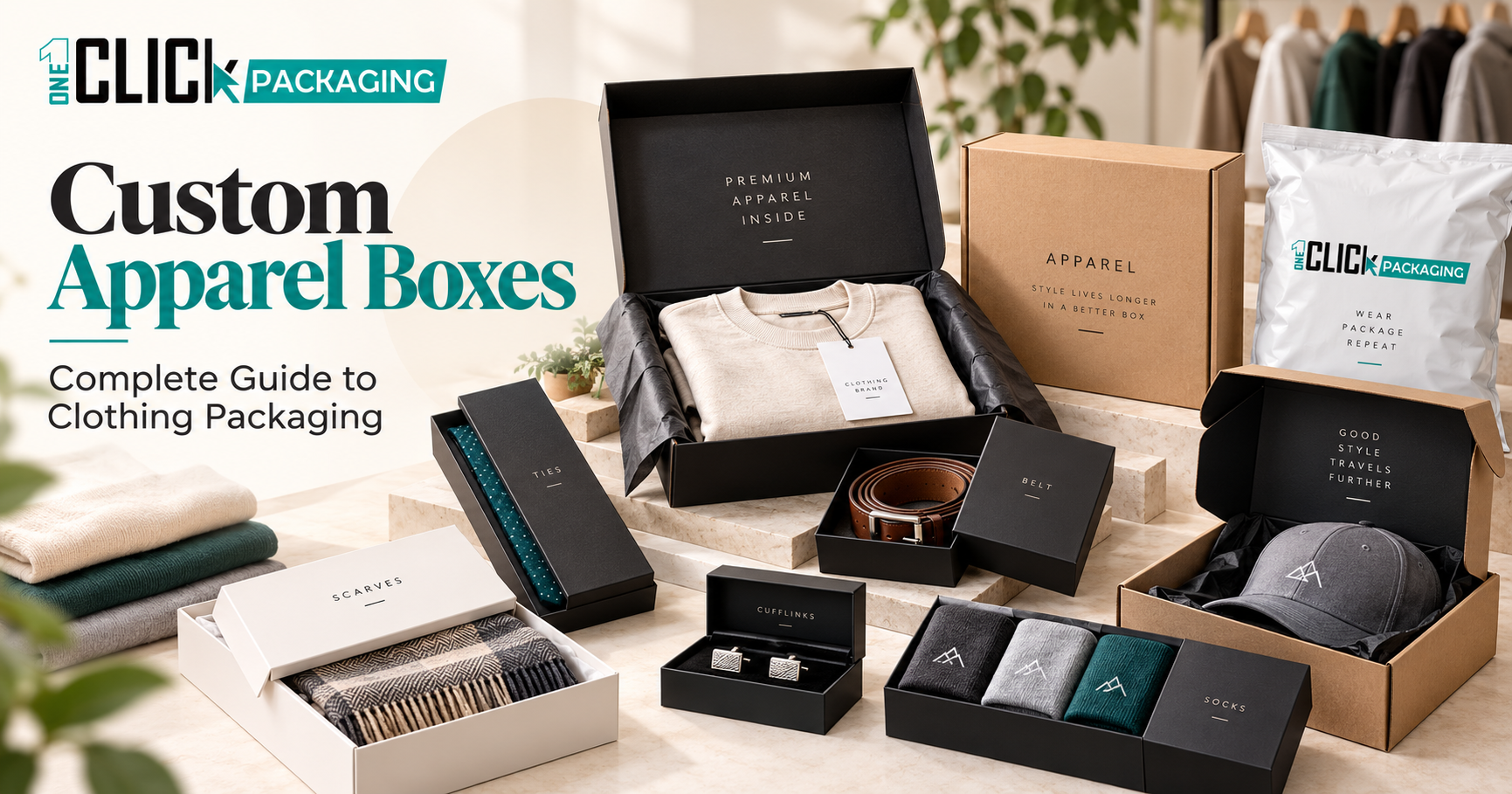

Fashion packaging has to do more than hold a garment.
For clothing brands, ecommerce stores, boutiques, accessory companies, and growing fashion labels, packaging plays a role in product protection, presentation, shipping, storage, and brand recognition.
A luxury belt needs different packaging from a sweatshirt. A hat may require a structured shipping box, while lightweight clothing can often be shipped efficiently in an apparel bag. Smaller accessories such as cufflinks and ties also benefit from packaging designed around their shape.
That is why choosing custom apparel boxes should begin with the actual product.
At One Click Packaging, fashion businesses can explore a complete collection of custom apparel boxes for clothing, fashion accessories, ecommerce fulfillment, gifting, and retail presentation.
This guide covers the main apparel packaging styles and explains where each one fits.
Why Custom Apparel Boxes Matter for Fashion Brands
Clothing is highly visual, so the packaging surrounding it becomes part of the brand experience.
When customers receive an ecommerce order or purchase a premium item in-store, the packaging can influence how professional and considered the product feels.
Well-planned apparel packaging boxes also provide practical benefits.
They can help keep clothing organized, reduce unnecessary movement, create space for branding, and make different product collections easier to identify.
Custom printing can include:
- Brand logos
- Colors
- Product names
- Patterns
- Care messaging
- Campaign artwork
- Social media details
- Promotional messages
However, appearance should come after fit.
A box should be developed around the dimensions, weight, folding method, and distribution requirements of the apparel inside it.
Apparel Bags for Shipping Ecommerce Orders
Apparel Bags for Shipping are useful for ecommerce fashion brands that need lightweight packaging for garments.
They can be suitable for products such as:
- T-shirts
- Shirts
- Leggings
- Lightweight pants
- Activewear
- Hoodies
- Selected fashion accessories
Because apparel bags add less bulk than many traditional boxes, they can be practical when the product does not require rigid structural protection.
However, brands should choose the bag size carefully.
A bag that is significantly larger than the folded garment can create unnecessary material use. On the other hand, a bag that is too tight may make packing difficult.
For branded ecommerce orders, custom printing can also turn basic shipping packaging into part of the customer experience.
Belt Boxes for Premium Accessories
Belt Boxes give fashion and accessory brands a more organized way to present belts.
Belts are often rolled before packaging. Therefore, the internal dimensions should allow the product to sit comfortably without forcing the leather or material into an unnatural shape.
A fitted insert may also help keep a premium belt positioned neatly.
This is particularly useful for:
- Leather belts
- Designer accessories
- Corporate gifts
- Retail displays
- Premium fashion collections
Custom belt boxes can also carry logos, colors, and finishing details that match the wider apparel brand.
For luxury accessories, simple design often works best. A clean logo, restrained typography, and one carefully selected finish can create a more premium appearance than excessive decoration.
Bra Packaging for Lingerie Brands
Bra Packaging requires more attention to internal space than basic folded clothing packaging.
Bras may include molded cups, underwires, padding, lace, or other structural details that should not be unnecessarily compressed.
The packaging should therefore match the product style.
A soft bralette may need less structure than a molded-cup bra.
Brands should consider:
- Cup shape
- Band size
- Product thickness
- Folding method
- Inserts or tissue
- Retail presentation
- Ecommerce shipping
Good lingerie packaging should present the product neatly without creating unnecessary pressure on delicate components.
Custom printing can also help lingerie brands maintain a consistent look across bras, underwear, hosiery, and other products.
Clothing Boxes for Retail and Ecommerce
Clothing Boxes are one of the most versatile forms of custom clothing packaging.
They can be designed for shirts, sweaters, dresses, fashion sets, accessories, and other garments.
A clothing box gives brands more surface area for visual identity than a basic shipping bag.
It can also create a more structured unboxing experience.
For retail or gift-oriented products, clothing boxes can use printed interiors, branded tissue, inserts, or premium finishing where appropriate.
For ecommerce, the box should also be evaluated for shipping.
A presentation box that looks attractive may still need an appropriate outer shipping solution depending on its construction and the delivery environment.
Cufflink Boxes for Small Fashion Accessories
Small accessories can easily feel lost inside oversized packaging.
Cufflink Boxes solve this by creating a compact presentation designed around the product.
Cufflinks are commonly sold as premium gifts, formal accessories, corporate gifts, and luxury fashion products.
The internal presentation matters because the product should remain centered when the box is opened.
A fitted insert can help keep both cufflinks aligned rather than allowing them to move freely.
Because cufflink packaging is relatively small, branding should remain simple.
A logo, subtle color palette, and carefully selected surface finish may be enough to create a polished presentation.
Custom Printed Kraft Apparel Boxes
Custom Printed Kraft Apparel Boxes can suit fashion brands looking for a more natural or understated packaging appearance.
Kraft material works particularly well with:
- Minimalist branding
- Outdoor apparel
- Handmade clothing
- Natural fabrics
- Casual fashion labels
- Sustainable-style branding
Logos and artwork can be printed directly onto the kraft surface.
However, brands should remember that kraft’s natural brown tone affects how printed colors appear.
A color that looks bright on white coated paper may appear more muted on kraft.
Therefore, artwork should be reviewed specifically for the chosen substrate.
Businesses should also avoid assuming that every kraft package is automatically environmentally superior. Coatings, laminates, inks, adhesives, and other components affect the characteristics of the finished packaging.
Custom Printed Tie Boxes
Custom Printed Tie Boxes provide a dedicated presentation format for neckties and other formal accessories.
Ties can wrinkle or move if they are placed loosely inside an oversized package.
A properly sized tie box can keep the product arranged more neatly while creating a premium presentation.
These boxes can work for:
- Men’s fashion brands
- Formalwear stores
- Corporate gifting
- Wedding accessories
- Luxury retailers
- Subscription collections
The internal dimensions should reflect the way the tie will be folded.
Custom inserts can also be considered when the brand wants the tie to remain in a specific position.
For corporate gifting, the packaging may include both the apparel brand and the gifting company’s identity.
Hat Shipping Boxes for Shape Protection
Hats create a different packaging problem because many styles should not be flattened.
Hat Shipping Boxes provide additional structure for hats that need to maintain their shape during storage and transportation.
They may be useful for:
- Baseball caps
- Fashion hats
- Branded headwear
- Promotional hats
- Selected premium styles
The ideal dimensions depend on the shape of the hat and whether products will be stacked or nested.
Oversized packaging should be avoided where possible because additional empty space may allow the product to move during transportation.
If the hat requires additional support, inserts or paper-based cushioning can be considered.
For ecommerce brands, the shipping structure is just as important as the exterior graphics.
The goal is for the product to arrive looking the way it did when it left the fulfillment area.
Pantyhose Boxes for Compact Retail Packaging
Pantyhose Boxes give hosiery brands a compact structure with space for product information and branding.
Because pantyhose can usually be folded into a relatively small area, the package does not need excessive depth.
Instead, attention should be given to presentation and information hierarchy.
The front panel may show:
- Brand
- Product name
- Size
- Color
- Style
Other panels can carry supporting information.
For brands with several hosiery options, maintaining a consistent box structure while changing colors or product identifiers can make the range easier to navigate.
Scarf Boxes for Fashion and Gift Collections
Scarf Boxes can transform a soft fashion accessory into a more gift-ready product.
Scarves are often sold as:
- Fashion accessories
- Holiday gifts
- Corporate gifts
- Luxury items
- Boutique products
Since scarves can be folded in different ways, the internal box dimensions should be planned around the intended presentation.
A shallow box may work for a neatly folded single scarf. Larger sets may need more depth or internal organization.
Tissue paper can also be incorporated into the presentation where appropriate.
For premium collections, the packaging design should support the scarf rather than overpower it.
A simple box with strong brand consistency can create an effective presentation.
Socks Boxes for Retail and Gift Sets
Socks Boxes can be used for individual premium pairs, multipacks, subscription products, and gift sets.
Packaging requirements depend heavily on how many pairs are included.
A single pair needs a different structure from a three-pair gift collection.
Before developing the box, determine:
- Number of pairs
- Folding style
- Product thickness
- Insert requirements
- Retail or ecommerce use
- Gift presentation
Window designs may also be considered when a brand wants customers to see the colors or patterns without opening the package.
However, added components should have a clear purpose rather than being included only for decoration.
Underwear Boxes for Branded Lingerie Packaging
Underwear Boxes give underwear and lingerie brands additional space for presentation compared with basic bags or wraps.
The structure can be designed around briefs, boxers, multipacks, premium sets, and other underwear formats.
As with other apparel products, fit matters.
An oversized box can make the product look smaller than expected, while a box that is too compact can create an untidy presentation.
Brands offering both bras and underwear can use a shared packaging system.
For example, the same typography, colors, and logo position can appear across different box dimensions.
This creates brand consistency without requiring every package to have exactly the same structure.
Choosing Materials for Custom Apparel Boxes
There is no single best material for every fashion product.
Paperboard can work well for lightweight retail cartons and accessory boxes.
Kraft board can support a natural aesthetic.
Corrugated materials may be more appropriate where shipping protection is a priority.
Rigid packaging can be considered for selected premium products and gift sets.
The choice should depend on:
- Product weight
- Product dimensions
- Fragility
- Shipping method
- Retail environment
- Desired presentation
- Printing requirements
- Budget
Start with functional requirements before selecting decorative finishes.
A beautiful package that fails during shipping does not create a premium experience.
Printing and Finishes for Apparel Packaging
Custom apparel boxes with logo can help customers recognize a fashion brand before they see the product inside.
Branding can include colors, typography, artwork, patterns, campaign graphics, and interior printing.
Finishes may also be considered depending on the material and design.
Common options include matte and gloss surfaces, foil accents, embossing, debossing, and selective gloss effects.
However, premium packaging does not require every finish.
One or two carefully selected details can create a cleaner and more intentional result.
For example, a matte clothing box with a small foil logo may communicate more clearly than a design combining multiple competing effects.
Apparel Packaging for Ecommerce Shipping
Retail presentation and shipping packaging are not always the same thing.
A decorative apparel box may look excellent on a store shelf but may require additional protection before entering a parcel-delivery network.
Ecommerce brands should consider:
- Compression during transit
- Moisture exposure
- Movement inside the package
- Shipping labels
- Product weight
- Package dimensions
Lightweight products may work well in shipping bags.
Structured garments, hats, gift sets, and accessories may benefit from boxes.
The right approach depends on what is being shipped and how vulnerable it is to pressure, bending, or movement.
Avoid choosing shipping packaging based only on appearance.
Wholesale Apparel Boxes for Growing Fashion Brands
As a fashion business grows, ordering apparel boxes wholesale can become more practical.
However, a larger order should usually follow successful testing of the structure and artwork.
Before increasing volume, confirm:
- Product dimensions
- Box dimensions
- Material
- Printing
- Insert requirements
- Finishing
- Quantity
- Storage requirements
Seasonal fashion brands should also consider how long a packaging design will remain usable.
Ordering a large quantity with a campaign date or temporary collection name can create unnecessary leftover inventory.
Evergreen packaging can offer more flexibility when product collections change frequently.
Build a Consistent Apparel Packaging System
The strongest fashion packaging systems do not require every box to look identical.
Instead, they use consistent visual rules.
A brand might ship T-shirts in lightweight apparel bags, present belts in structured boxes, package ties in narrow cartons, and send hats in protective shipping boxes.
The structures are different because the products are different.
However, consistent typography, colors, logos, and artwork can make every package recognizable as part of the same brand.
This is especially valuable for fashion companies expanding into multiple apparel and accessory categories.
Instead of redesigning the entire packaging system with every product launch, the brand already has a visual framework to follow.
How to Choose the Right Custom Apparel Boxes
Begin with the actual garment or accessory.
Measure it in the way it will be folded or presented.
Then consider how it will reach the customer.
A retail-only belt box has different requirements from a hat traveling through an ecommerce delivery network.
Next, select the appropriate structure and material.
Finally, develop the artwork and finishing details.
Before requesting pricing, prepare the product dimensions, weight, quantity, preferred packaging style, logo files, artwork, printing requirements, finishing preferences, and desired delivery date.
This gives the packaging team enough information to recommend a more appropriate solution.
Create Better Apparel Packaging for Your Brand
The best custom apparel boxes combine product fit, protection, presentation, and consistent branding.
Apparel shipping bags can keep lightweight ecommerce packaging efficient. Belt, tie, scarf, cufflink, and sock boxes can improve accessory presentation. Bra and underwear packaging can create a coordinated lingerie collection, while structured hat boxes can provide additional support for products that should retain their shape.
The key is choosing packaging around the actual product instead of trying to make one box style work for everything.
Explore the complete Apparel Boxes collection from One Click Packaging to compare packaging options for clothing, fashion accessories, retail, and ecommerce.
When your product specifications are ready, request a custom packaging quote with your dimensions, quantity, material preferences, printing requirements, and finishing options.
You can also book a packaging consultation to discuss your apparel packaging project before moving forward.
Frequently Asked Questions
What are custom apparel boxes?
Custom apparel boxes are packaging structures designed around clothing or fashion accessories. The dimensions, materials, printing, artwork, and finishes can be selected according to the product and brand requirements.
What packaging is best for shipping clothes?
The best option depends on the garment. Lightweight clothing may work well in apparel shipping bags, while products that need more structure may benefit from boxes or corrugated shipping packaging.
Can I print my logo on apparel boxes?
Yes. Custom apparel packaging can include logos, colors, patterns, typography, and other brand artwork.
What products can use apparel packaging boxes?
Apparel packaging can be designed for shirts, dresses, underwear, bras, socks, scarves, ties, belts, hats, cufflinks, and other clothing or fashion accessories.
Are kraft apparel boxes suitable for fashion brands?
Kraft apparel boxes can work particularly well for brands seeking a natural, minimal, or understated appearance. Printing and finishing should be selected with the natural kraft surface in mind.
Can I order custom apparel boxes wholesale?
Businesses can request larger quantities of custom apparel packaging. The appropriate quantity depends on the structure, dimensions, printing, materials, expected demand, and available storage.
What information should I provide when requesting an apparel packaging quote?
Provide your product dimensions, weight, desired quantity, preferred box or bag style, material preferences, logo and artwork, printing requirements, finishing options, and required delivery date.