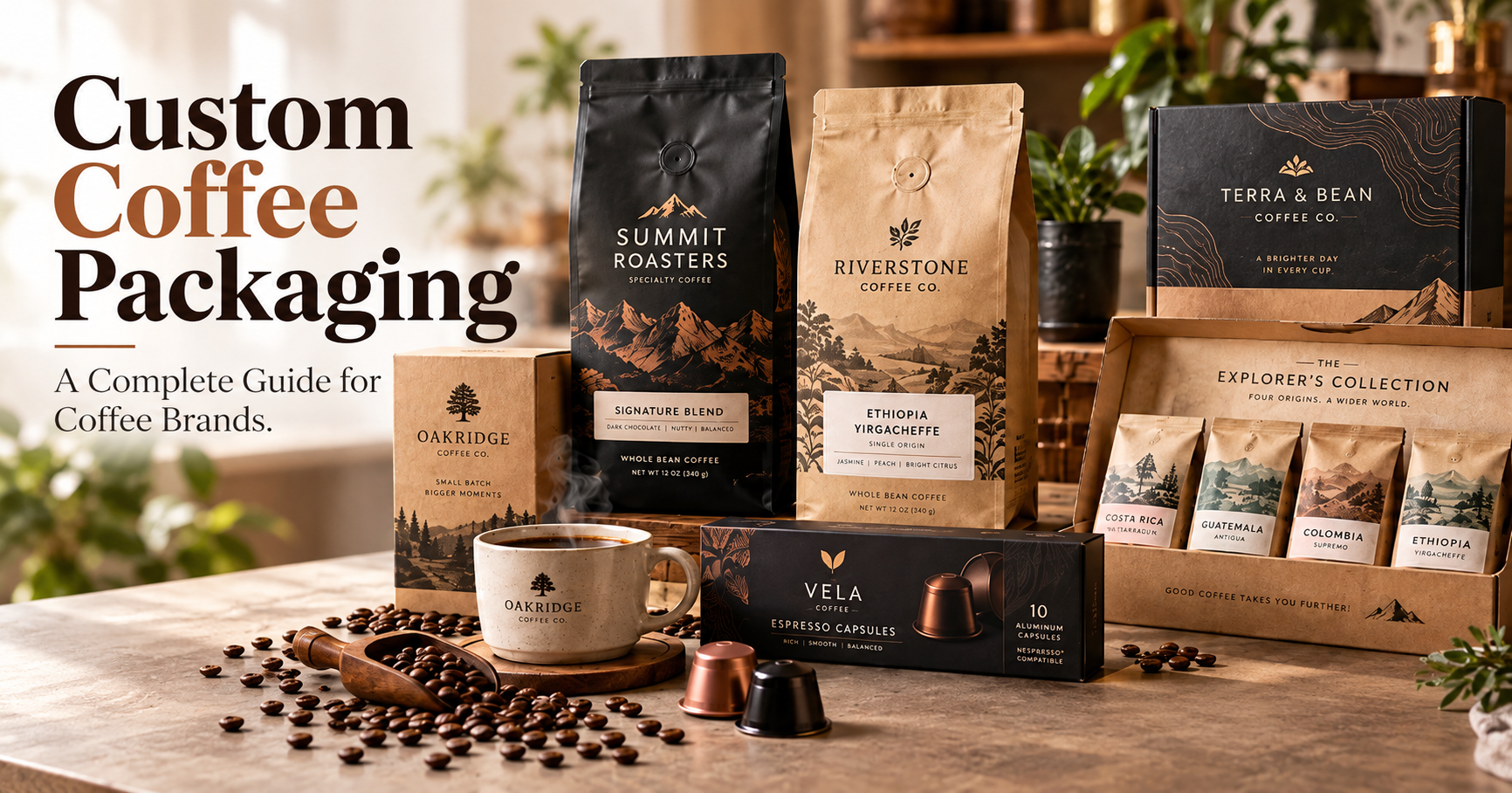

Coffee packaging has to do more than look attractive.
For coffee roasters, cafés, ecommerce businesses, subscription brands, and specialty coffee companies, packaging helps protect the product, communicate important information, and create a recognizable brand experience.
Customers may choose coffee based on origin, roast level, flavor profile, brewing method, or price. However, the package is often the first thing they notice.
That makes custom coffee packaging an important part of both product presentation and brand strategy.
Whole beans, ground coffee, coffee pods, sampler packs, and gift collections all have different packaging requirements. Therefore, the right solution should begin with the actual product rather than a generic box.
At One Click Packaging, coffee businesses can explore Custom Printed Coffee Boxes along with a wider range of custom food packaging for retail, ecommerce, gifting, and subscription products.
This guide explains how to choose coffee packaging that balances protection, presentation, branding, and practical usability.
Why Custom Coffee Packaging Matters
Coffee is a highly competitive retail category.
When several products are displayed together, packaging helps customers quickly understand the difference between brands and individual coffees.
Well-designed custom coffee packaging can communicate:
- Brand identity
- Coffee name
- Roast level
- Origin
- Flavor profile
- Brewing information
- Net quantity
- Product details
- Brand story
However, good packaging is not only about graphics.
The structure must also fit the product properly.
An oversized coffee box may waste material and allow the inner package to move. A carton that is too tight can make fulfillment difficult or damage the inner coffee pouch.
For that reason, packaging dimensions should be based on the final filled product.
Coffee Bags and Coffee Boxes Perform Different Jobs
One important distinction is the difference between the primary coffee package and the outer carton.
Coffee is sensitive to oxygen, moisture, light, and environmental odors.
Therefore, the pouch or bag directly containing the coffee normally performs most of the freshness-related work.
The outer coffee packaging box has a different role.
It can provide additional structure, protect the inner pouch from handling pressure, create more room for branding, organize multiple products, and improve retail presentation.
This distinction matters because a printed cardboard box should not be treated as a replacement for an appropriate primary coffee package.
For the strongest result, design the coffee bag and outer box as one packaging system.
Custom Printed Coffee Boxes for Retail Brands
Custom Printed Coffee Boxes give coffee businesses more control over how products appear on shelves and during unboxing.
The exterior can include logos, roast names, colors, illustrations, origin information, and other brand elements.
A consistent system is especially valuable for brands selling several coffees.
For example, the box structure and logo placement could remain the same across the range while accent colors change according to roast or origin.
A light roast might use one visual identity, while medium and dark roasts use different accents.
Customers can then distinguish the individual coffees without losing recognition of the main brand.
Custom printed coffee boxes with logo can also help maintain a consistent appearance across cafés, retail stores, online orders, and subscription deliveries.
Packaging Whole Bean and Ground Coffee
Whole bean and ground coffee may use similar outer packaging, but both should be measured in their final packed form.
Filled coffee pouches do not have the same dimensions as empty flat bags.
Gussets expand. Seals add height. Valves and folded tops may also affect the final dimensions.
Therefore, measure a fully filled coffee bag before approving the outer carton.
This can prevent common problems such as:
- Boxes that are difficult to close
- Excessive empty space
- Crushed pouches
- Poor shelf presentation
- Inefficient shipping dimensions
Ground coffee can also have different primary packaging needs because more of the coffee’s surface area is exposed after grinding.
The outer box should complement the primary package rather than being relied upon as the main freshness barrier.
Coffee Pod and Capsule Packaging
Coffee pods require a different structure from bags of beans or ground coffee.
Instead of holding one flexible package, the carton may need to organize multiple individual units.
Custom inserts, trays, or compartments can help keep pods arranged inside the package.
Before designing the box, determine how many pods each package will contain.
A six-pod sampler requires a different structure from a larger retail pack.
The opening experience also matters.
Customers should be able to understand the contents and remove individual pods easily without damaging the rest of the package.
For subscription and ecommerce brands, the box should also be designed with shipping efficiency in mind.
Coffee Sample and Variety Pack Packaging
Sampler packs allow customers to experience several coffees without purchasing a full-size bag of each one.
They are also useful for gifting and subscription businesses.
A custom sampler box might organize coffees by:
- Geographic origin
- Roast level
- Flavor profile
- Processing method
- Seasonal collection
- Brewing style
The packaging should make the relationship between the products immediately clear.
Dividers or fitted sections can help organize smaller packs and reduce movement.
Interior printing can also provide space for tasting notes, brewing suggestions, or short origin stories.
This makes custom coffee boxes part of the overall tasting experience.
Coffee Subscription Packaging
Subscription customers receive packaging repeatedly, so consistency becomes particularly important.
The experience should feel recognizable each time without creating unnecessary layers of material.
If the coffee is already protected inside an appropriate primary pouch, the outer subscription box can focus on shipping structure, organization, and branding.
The inside of the box can also be used creatively.
A short brand message, brewing guide, or introduction to that month’s coffee can sometimes be printed directly inside rather than added as a separate insert.
This can create a cleaner unboxing experience.
Choosing Materials for Coffee Packaging Boxes
Material selection should be based on what the packaging actually needs to do.
Paperboard can work well for retail coffee cartons because it provides a smooth surface for printing.
Kraft board can support a natural or craft-oriented appearance.
Corrugated material may be more appropriate for ecommerce shipping, subscription boxes, or larger coffee sets that need additional structure.
Premium gift collections may use heavier structures where appropriate.
Before choosing a material, consider:
- Product weight
- Box dimensions
- Primary coffee package
- Shipping method
- Retail environment
- Printing requirements
- Desired appearance
- Storage conditions
The strongest material is not automatically the best choice.
The goal is to use enough structure for the product without creating unnecessary packaging.
Kraft Coffee Packaging for Artisan Brands
Kraft packaging is popular among specialty coffee roasters because its natural appearance can work well with craft-oriented branding.
However, printing on kraft requires different design considerations than printing on white paperboard.
Colors may appear more muted because of the brown surface.
Instead of fighting against the material, the design can incorporate it.
Minimal typography, dark printing, simple illustrations, and carefully positioned logos often work particularly well on kraft.
Brands should also avoid assuming that kraft automatically means the complete package is environmentally friendly.
The environmental profile depends on the full structure, including coatings, laminates, adhesives, windows, inserts, and the primary coffee pouch.
Designing Coffee Packaging Customers Can Understand
Coffee packaging can quickly become overcrowded.
Brands may want to include origin, roast level, altitude, processing method, flavor notes, brewing suggestions, certifications, company information, and brand storytelling.
Trying to place everything on the front panel makes the package difficult to scan.
Instead, create an information hierarchy.
The front should focus on the information most useful during the buying decision.
That may include:
Brand Name
Coffee Name
Origin or Blend
Roast Level
Net Quantity
Supporting panels can then carry flavor notes, brewing information, company details, storage guidance, and other relevant information.
Any legally required information should be considered before the artwork is finalized rather than being squeezed into leftover space later.
Coffee Boxes with Logo for Better Brand Recognition
A strong coffee brand should remain recognizable even when individual products change.
Coffee boxes with logo help create that consistency.
The same logo position, typography, and visual framework can connect several coffee products while still allowing each one to have its own personality.
For example, a roaster could use different illustrations for Ethiopia, Colombia, and Brazil while keeping the same box layout.
Seasonal blends could use temporary colors without abandoning the overall brand system.
This approach also makes future product launches easier because the business already has a packaging framework to follow.
Printing and Finishing Options for Coffee Boxes
Printing transforms a plain carton into branded packaging.
Depending on the design and material, coffee brands may consider options such as:
- Matte finishes
- Gloss finishes
- Foil stamping
- Embossing
- Debossing
- Spot UV
- Interior printing
- Die-cut windows
- Custom inserts
However, premium packaging does not require every available finish.
A simple design with one well-chosen effect can often look more refined than a package with several competing treatments.
For example, a matte black coffee box with a small foil logo may create stronger visual impact than a carton using several finishes at once.
The finishing strategy should support the brand rather than distract from it.
Sustainable Coffee Packaging Starts with the Whole System
Sustainability should be considered across the complete package.
A coffee product may contain an inner pouch, valve, label, outer carton, adhesive, coating, and insert.
Changing only the outer box does not automatically make the entire packaging system sustainable.
A useful first step is reducing unnecessary material.
Correctly sized boxes can reduce empty space, paper usage, storage requirements, and shipping volume.
Businesses may also consider simpler paper-based structures and fewer mixed-material components where they meet the product’s functional requirements.
Environmental claims should always reflect the actual packaging specification rather than relying only on words such as “kraft,” “green,” or “natural.”
Food Contact Considerations
Brands should determine whether coffee will directly touch the packaging material.
If the coffee is sealed inside a separate pouch, the outer box generally performs a secondary packaging role.
If a component will directly contact food, the material and relevant inks, coatings, adhesives, and other components should be appropriate for their intended use.
This should be established before production begins.
Packaging for food products should always be developed around the exact product and intended use rather than assuming every material is suitable for direct food contact.
Coffee Packaging for Ecommerce
Packaging designed for a retail shelf does not automatically provide enough protection for parcel shipping.
Ecommerce coffee businesses should consider what happens during transportation.
Packages may experience stacking, vibration, compression, and routine fulfillment handling.
A lightweight retail carton may therefore require an outer shipping box.
Subscription collections containing several products may work better in a structured mailer.
At the same time, unnecessary overpackaging should be avoided.
The goal is to provide suitable protection while keeping package dimensions efficient.
Wholesale Coffee Packaging for Growing Brands
As sales increase, businesses may begin ordering coffee packaging wholesale.
Before increasing the order quantity, make sure the structure and artwork have already been tested.
Confirm:
- Filled product dimensions
- Box fit
- Material
- Printing
- Barcode placement
- Inserts
- Finishes
- Assembly method
Inventory planning also matters.
Coffee businesses often introduce seasonal blends, limited editions, new origins, and updated artwork.
Ordering a very large quantity of highly specific packaging may create unused inventory if the product changes.
The most practical wholesale quantity balances unit economics with expected demand and available storage.
Coffee Gift Packaging
Coffee is frequently purchased as a gift.
Holiday collections, corporate gifting, customer appreciation programs, and special occasions create opportunities for more premium packaging.
A gift box may contain:
- Several coffee varieties
- Coffee and a mug
- Coffee and brewing accessories
- Sample packs
- Coffee and confectionery
- Branded merchandise
When products have different shapes, internal organization becomes particularly important.
Dividers or inserts can help prevent products from moving freely and create a cleaner presentation when the recipient opens the box.
The structure should be finalized before decorative finishes are selected.
Packaging Coffee and Tea Under One Brand
Many beverage companies sell both coffee and tea.
Those products do not necessarily need identical packaging, but they can share the same visual language.
Typography, logo placement, color systems, and general design principles can connect the range while each structure is adapted to the product.
Businesses expanding their beverage collection can also explore Custom Printed Tea Boxes from One Click Packaging.
This creates a more consistent product family across coffee and tea without forcing both products into the same packaging structure.
What to Prepare Before Ordering Coffee Packaging
A good packaging project begins with accurate information.
Before requesting a quote, prepare your:
- Filled coffee package dimensions
- Product weight
- Coffee format
- Desired quantity
- Preferred material
- Artwork files
- Logo files
- Printing requirements
- Insert requirements
- Finishing preferences
- Desired delivery date
If your coffee is packed inside a pouch, measure the fully filled pouch rather than relying only on its flat dimensions.
For pod packaging, specify how many units need to fit inside each box.
For gift sets, provide the dimensions of every product included.
These details make it easier to develop packaging around the actual product.
Build Better Custom Coffee Packaging
Effective custom coffee packaging brings together product fit, protection, clear information, and recognizable branding.
The primary pouch should address the freshness requirements of the coffee. The outer box can then provide additional structure, presentation, organization, and valuable branding space.
Custom printed coffee boxes can work for beans, ground coffee, pods, subscription packs, sampler collections, retail products, and premium gift sets.
Kraft packaging can support an artisan look, while printed paperboard and premium finishing can create a more polished retail presentation.
Most importantly, the box should be developed around the actual coffee product rather than forcing that product into a generic carton.
Explore Custom Printed Coffee Boxes or browse the wider Food Boxes collection from One Click Packaging to compare packaging options.
When your product specifications are ready, request a custom packaging quote with your dimensions, quantity, material preferences, artwork, and finishing requirements.
Prefer to discuss your project first? Book a packaging consultation with One Click Packaging to discuss your coffee packaging requirements.
Frequently Asked Questions
What is custom coffee packaging?
Custom coffee packaging is packaging developed around a coffee product’s size, format, branding, retail requirements, and distribution method. It may include printed coffee boxes, primary coffee pouches, inserts, subscription packaging, shipping boxes, and gift packaging.
Do cardboard coffee boxes keep coffee fresh?
An outer cardboard box can provide additional protection from light and handling, but the primary coffee pouch normally performs most of the oxygen and moisture barrier work. Freshness should therefore be considered across the complete packaging system.
Can I print my logo on coffee boxes?
Yes. Custom printed coffee boxes can feature logos, colors, illustrations, roast information, origin details, and other brand elements.
What material should I use for coffee boxes?
The best material depends on the product and distribution method. Paperboard can work well for retail cartons, kraft can support a natural appearance, and corrugated packaging can provide additional structure for shipping and larger product sets.
Can coffee packaging include inserts or windows?
Custom coffee boxes can be developed with inserts, dividers, compartments, or die-cut windows when those features support the product and presentation requirements.
Can custom coffee boxes be used for subscription packaging?
Yes. Custom boxes can be designed for single bags, multiple coffees, pods, sampler packs, and recurring subscription deliveries. The final structure should also account for shipping conditions.
Can I order coffee packaging wholesale?
Businesses can request larger packaging quantities. The appropriate order size depends on the dimensions, material, printing, finishing, demand, storage capacity, and how often the product or artwork changes.
What information do I need for a coffee packaging quote?
Provide the filled product dimensions, weight, coffee format, desired quantity, preferred material, artwork, printing requirements, inserts, finishing preferences, and required delivery date.