Packaging does not always have to be disposable.
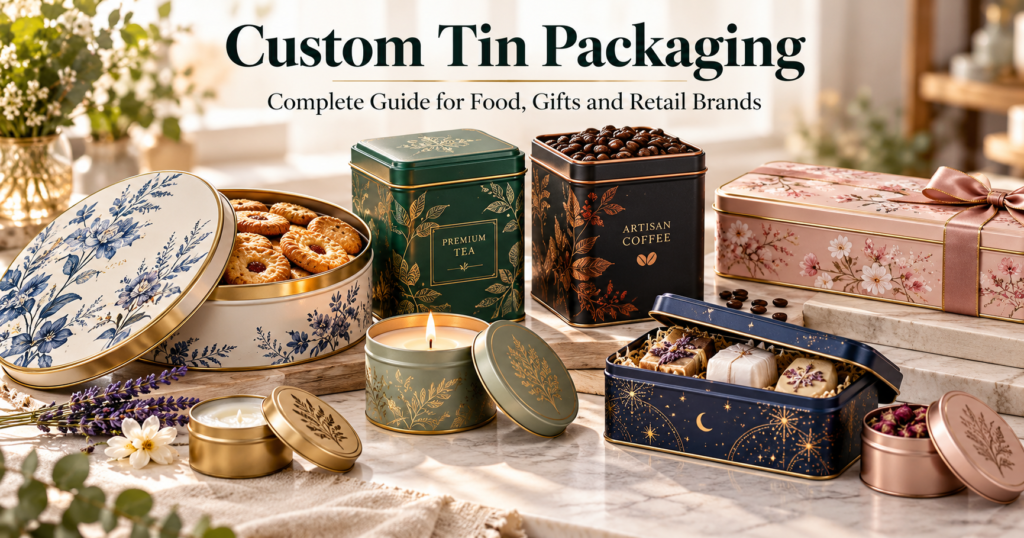
For food brands, candle makers, cosmetic companies, gift businesses, coffee roasters, tea brands, and premium retailers, custom tin packaging can become part of the product experience long after the original item has been used.
Unlike ordinary folding cartons, metal tins provide a rigid structure and a distinctive appearance. They can also be customized with colors, logos, artwork, embossing, and different shapes.
This makes tin packaging useful for brands that want durability and presentation in the same package.
At One Click Packaging, businesses can explore a dedicated range of Custom Tin Packaging for food, gifts, cosmetics, candles, promotional products, and other retail applications.
This guide explains where tin packaging works best, how to choose the right structure, and what to consider before ordering.
What Is Custom Tin Packaging?
Tin packaging usually refers to rigid metal containers manufactured for product storage, presentation, or retail sale.
Many commercial tins use tinplate, which is steel with a thin tin coating. The exact construction can vary depending on the product and intended use.
Custom tin packaging allows brands to control elements such as:
- Size
- Shape
- Lid style
- Exterior artwork
- Brand colors
- Logo placement
- Embossing or debossing
- Interior configuration
- Labels
- Inserts
That makes tins suitable for products that need something more substantial than a standard paperboard carton.
However, the package should still be designed around the actual product.
A cookie tin, candle tin, tea container, and cosmetic gift tin may all use metal, but their structural requirements are very different.
Why Brands Choose Custom Tin Boxes
One of the biggest advantages of custom tin boxes is their rigid construction.
The container does not collapse in the same way as a lightweight folding carton. This can create a more substantial presentation for selected products.
Tin packaging can also provide strong branding opportunities.
The exterior may carry:
- Company logos
- Product artwork
- Patterns
- Brand colors
- Instructions
- Promotional graphics
- Limited edition designs
Another advantage is reuse.
A well designed tin may remain useful after the original product is gone. Customers may use it to store small items, accessories, tea, stationery, or keepsakes.
As a result, a branded tin can remain visible longer than packaging that is immediately discarded.
Custom Tin Packaging for Food Products
Food is one of the most familiar applications for metal tins.
Brands commonly use tins for products such as:
- Cookies
- Biscuits
- Confectionery
- Tea
- Coffee
- Spices
- Mints
- Dry snacks
However, food packaging requires careful specification.
If food will directly contact the tin, the complete container should be appropriate for the intended food contact application. This includes relevant coatings, liners, printing systems, closures, and other components.
Do not assume that every decorative metal tin is automatically suitable for direct food contact.
For additional food-specific formats, brands can explore One Click Packaging’s Custom Food Boxes.
Cookie and Biscuit Tins
Cookies and biscuits work particularly well with tin packaging because the container can become part of the gift or retail presentation.
Round and rectangular tins are common choices.
The correct size depends on:
- Number of cookies
- Cookie diameter
- Product thickness
- Internal arrangement
- Liners or dividers
- Gift presentation
An oversized tin can allow products to move unnecessarily.
Therefore, determine the final product arrangement before selecting the container dimensions.
Tea and Coffee Tin Packaging
Tea and coffee brands often use metal packaging because it provides a premium visual identity and a reusable container.
However, the packaging system still needs to match the product.
For example, the lid and closure design can influence how the container performs during storage.
If freshness or aroma retention is critical, the complete package should be tested for that specific product instead of assuming every tin provides the same barrier performance.
Custom artwork can help distinguish:
- Tea varieties
- Coffee origins
- Roast levels
- Seasonal products
- Gift collections
For premium beverage products, restrained design often works well.
A simple logo, clear typography, and carefully selected color palette can make a tin feel more refined than a heavily crowded design.
Tin Packaging for Candles
Metal tins are also popular with candle brands.
They can provide a compact container format while giving the exterior enough space for branding.
Candle companies may combine a printed or labeled tin with additional outer packaging depending on the desired customer experience.
Brands that also use cartons can explore One Click Packaging’s Custom Candle Boxes for complementary outer packaging options.
When developing candle tins, the container should be selected around the actual candle formulation, wick system, fill weight, and intended use.
Safety and performance testing should be completed with the final candle and container combination.
Custom Tin Packaging for Cosmetics
Beauty brands can also use tins for selected products, kits, and promotional collections.
Possible applications include:
- Balms
- Solid products
- Gift sets
- Sample collections
- Limited edition beauty kits
- Small accessories
The metal surface can support a clean premium identity.
Cosmetic businesses using several packaging formats can also connect their tins visually with the wider Custom Cosmetic Boxes range.
For example, a cosmetic carton and matching tin could use the same logo placement, typography, and color palette.
This helps different packaging formats feel like part of the same brand.
Tin Gift Boxes for Premium Presentation
Tin gift boxes can turn the package itself into something worth keeping.
This makes them useful for:
- Holiday gifts
- Corporate gifting
- Promotional products
- Limited editions
- Collectibles
- Product launches
- Anniversary collections
For a gift application, the interior deserves just as much attention as the exterior.
If several products will be included, consider how they will remain organized.
Custom inserts or dividers may help prevent products from moving while creating a cleaner presentation.
Brands comparing different premium structures can also explore Custom Gift Boxes and One Click Packaging’s guide to luxury packaging materials.
Round, Square and Rectangular Tin Boxes
Shape affects both presentation and practical use.
Round Tin Boxes
Round tins are commonly associated with cookies, confectionery, candles, tea, and gift products.
They can create a traditional or premium appearance depending on the artwork.
Square Tin Boxes
Square tins can use shelf and storage space efficiently.
Their flat panels also provide straightforward surfaces for branding and product information.
Rectangular Tin Boxes
Rectangular tins can work well for elongated products, gift sets, stationery, confectionery, and selected retail products.
The best shape depends on the item inside.
Do not choose a round or unusual structure only because it looks different.
Product fit should come first.
Choosing the Right Tin Lid
The lid affects both usability and presentation.
Different tin packaging projects may use different closure styles depending on the product.
A gift tin may prioritize opening experience, while a food product may have different storage requirements.
Before selecting the closure, consider:
- How often the customer will open it
- Whether the container will be reused
- Product protection requirements
- Retail presentation
- Transportation
- Required sealing performance
If the product requires a specific level of barrier or tamper evidence, confirm that requirement during packaging development.
Choose the lid and closure based on how the tin will be used, stored, and transported not on appearance alone.
Custom Printed Tin Packaging
One of the strongest advantages of metal packaging is the large branded surface.
Custom printed tins can use colors, artwork, illustrations, product information, and logos to transform a plain container into recognizable retail packaging.
Brands can create designs for:
- Everyday product lines
- Seasonal collections
- Limited editions
- Collaborations
- Corporate gifts
- Promotional campaigns
However, artwork should remain easy to understand.
Use a clear hierarchy.
The logo and product name should usually remain the strongest elements. Supporting information can then be placed on secondary areas.
This helps the package look intentional instead of overcrowded.
Embossed and Debossed Tin Packaging
Printing is not the only way to add branding.
Embossing can raise selected parts of the metal surface, while debossing creates a recessed effect.
These techniques can work especially well for:
- Logos
- Brand marks
- Product names
- Decorative patterns
A small embossed logo can create a premium tactile detail without adding more printed graphics.
Again, restraint is useful.
A tin does not need multiple decorative techniques to feel premium.
One strong visual feature may be more effective than several competing effects.
Personalized Tin Packaging for Promotions
Personalized tins can work particularly well for events and branded campaigns.
Businesses may use them for:
- Corporate gifts
- Weddings
- Product launches
- Influencer mailers
- Customer appreciation
- Seasonal promotions
Before ordering event specific packaging, think carefully about quantity.
A tin printed with a specific date or campaign name may be difficult to reuse after the event.
If flexibility matters, keep the main tin design evergreen and customize labels, sleeves, or inserts for individual campaigns.
Tin Packaging and Sustainability
Metal has the potential for reuse and recycling, but sustainability should always be discussed carefully.
The complete package matters.
Decorative coatings, inserts, labels, adhesives, secondary packaging, and other components can affect the overall packaging system.
One advantage of a durable tin is that customers may reuse it.
However, Brands should use specific, verifiable sustainability claims based on the actual materials, coatings, and components used in the final tin package.
A more useful approach is to focus on practical design choices.
For example:
- Choose an appropriate size
- Avoid unnecessary secondary components
- Use inserts only when needed
- Design for reuse where practical
- Provide accurate disposal information
These steps can support a more considered packaging strategy without relying on vague environmental claims.
Custom Tin Packaging vs Cardboard Boxes
Tin and cardboard packaging serve different purposes.
Paperboard is lightweight, versatile, and often efficient for folding-carton applications.
Tin is more rigid and may provide a longer lasting presentation.
Therefore, the decision should depend on the product and customer experience.
Tin packaging may make more sense when:
- The package is part of the gift
- The product benefits from a rigid container
- Reuse is important
- Premium presentation matters
- A collectible format supports the brand
Paperboard may be more practical when lower packaging weight, flat storage, or simple retail presentation is the priority.
Some brands may even combine both.
For example, a premium tin could sit inside a printed sleeve or presentation box.
Wholesale Tin Packaging for Growing Brands
As product demand increases, businesses may consider wholesale tin packaging.
Larger orders can help maintain consistency across product lines.
However, brands should finalize the specification before increasing quantity.
Confirm:
- Tin dimensions
- Shape
- Lid type
- Artwork
- Product fit
- Interior requirements
- Printing
- Embossing
- Label requirements
- Shipping configuration
Inventory planning also matters.
Custom printed tins take up physical storage space. Highly specific artwork can also become outdated if branding, product information, or a seasonal campaign changes.
Therefore, order quantities should reflect realistic demand instead of focusing only on the lowest unit price.
How to Choose Custom Tin Packaging
Start with the product.
Measure its exact dimensions and weight.
Then decide what the container needs to accomplish.
Is it primarily a retail package?
Does it need to work as a gift?
Will customers reuse it?
Will it directly contact food?
Does it need an insert?
Will it be placed inside another shipping box?
Once those questions are clear, choose the shape, size, closure, artwork, and internal configuration.
The right custom tin packaging should fit the product first and support the brand second.
Create Custom Tin Packaging with One Click Packaging
The best custom tin packaging combines durable structure, accurate sizing, and clear branding.
Round tins can work well for cookies, candles, tea, and confectionery. Square and rectangular tins can provide practical storage and strong printing surfaces. Gift tins can create a reusable presentation, while personalized metal tins can support promotions and limited edition collections.
Most importantly, the package should be designed around the actual product.
Explore the complete Tin Packaging collection from One Click Packaging to compare options for food, gifts, cosmetics, candles, and retail products.
You can also explore related Custom Food Boxes, Custom Cosmetic Boxes, Custom Candle Boxes, and Custom Gift Boxes when building a wider packaging system.
When your specifications are ready, request a custom packaging quote with your product dimensions, quantity, preferred tin shape, artwork, and printing requirements.
Prefer to discuss the project first? Book a packaging consultation with One Click Packaging to discuss the right tin packaging solution for your product.
Frequently Asked Questions
What is custom tin packaging?
Custom tin packaging is metal packaging produced around a product’s size, shape, branding, and presentation requirements. Brands can customize dimensions, artwork, colors, lid styles, embossing, labels, and other features.
What products can be packed in tins?
Tin packaging can be considered for cookies, confectionery, tea, coffee, candles, cosmetics, gifts, promotional products, and other suitable retail items.
Can I print my logo on tin boxes?
Yes. Custom tin boxes can feature logos, brand colors, illustrations, patterns, product information, and promotional artwork.
Can tin packaging be used for food?
Tin packaging can be used for food when the complete container, coating, closure, and other relevant components are suitable for the intended food contact application. Confirm the specification for your exact product before production.
Are custom tins reusable?
Many metal tins are durable enough for customers to reuse for storage or other purposes. Actual reuse depends on the container design and its original application.
Can tin boxes be embossed?
Yes. Selected designs may use embossing or debossing to add raised or recessed branding elements such as logos and product names.
Can I order custom tin packaging wholesale?
Businesses can request larger quantities of custom tin packaging. The appropriate quantity depends on dimensions, structure, printing, customization, product demand, and available storage.
What information should I provide for a tin packaging quote?
Provide your product dimensions, weight, desired quantity, preferred tin shape, closure requirements, artwork, printing needs, interior requirements, and intended product use.