Good packaging should protect the product, make it easy to handle, and help customers recognize the brand.
That is why custom tuck boxes are used across so many industries.
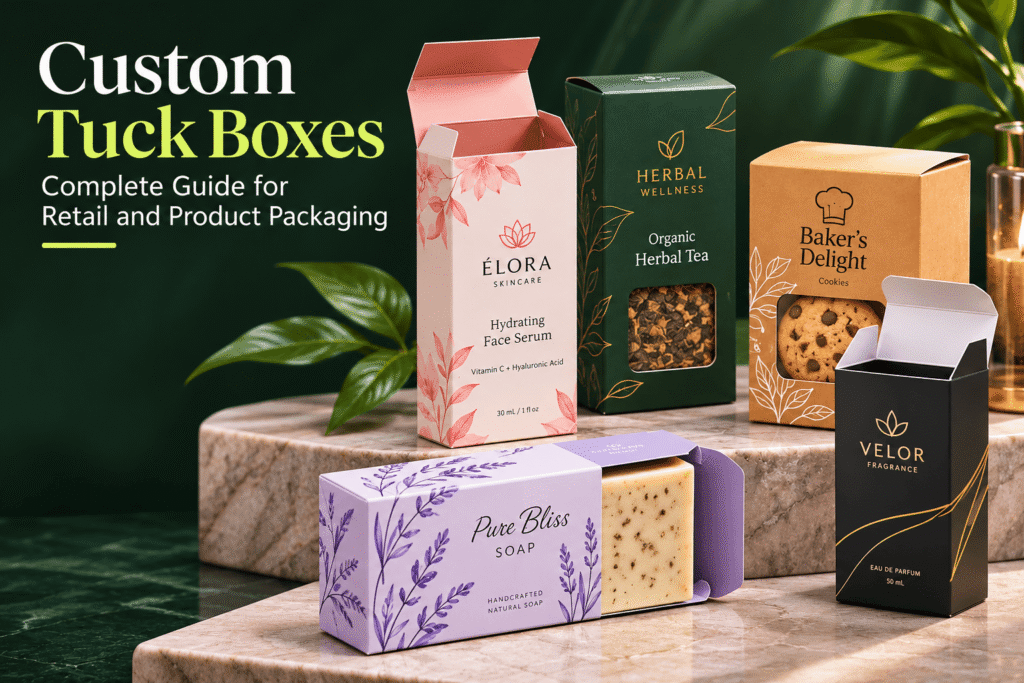
Their folding design is simple, practical, and easy to customize. Brands can add logos, colors, product information, windows, inserts, and premium finishes without making the structure overly complicated.
Tuck boxes are especially useful for cosmetics, skincare, candles, food products, small electronics, apparel accessories, wellness products, and many other retail items.
At One Click Packaging, businesses can create tuck packaging in custom sizes, materials, printing styles, and finishes.
This guide explains the main tuck box styles, their uses, material choices, printing options, and what to consider before placing an order.
What Are Custom Tuck Boxes?
Tuck boxes are folding cartons that use flaps that tuck into the box to close it.
The structure is simple, but it can be adapted for many products.
Custom tuck boxes are made around the size, weight, and branding needs of a specific product.
Brands may customize:
- Box dimensions
- Paperboard material
- Printing
- Brand colors
- Logo placement
- Window cutouts
- Inserts
- Interior printing
- Finishes
- Closure style
Because the boxes can usually ship flat before assembly, they can also be practical for businesses that need efficient storage.
One Click Packaging currently offers custom packaging in materials such as SBS paperboard, kraft paperboard, corrugated board, and rigid chipboard, with printing and finishing options available across many box styles.
Why Brands Choose Tuck End Boxes
Tuck end boxes are popular because they balance simplicity with flexibility.
They can create a clean retail presentation without using a bulky structure.
The flat panels also provide plenty of room for branding.
Brands can add:
- Product names
- Logos
- Ingredients
- Usage instructions
- Barcodes
- QR codes
- Regulatory information
- Promotional artwork
Tuck packaging can also be adapted with inserts when a product needs extra support.
For example, One Click Packaging uses tuck-end structures for tincture bottles and offers bottle inserts when additional product stability is needed.
Custom Printed Tuck Boxes
Custom printed tuck boxes can turn a simple folding carton into recognizable branded packaging.
Businesses can use full-color artwork, Pantone matching, patterns, illustrations, or minimal logo-based designs.
However, a good box does not need every panel covered with text.
Keep the most important information easy to find.
The front panel should usually focus on the brand and product name.
Secondary information can appear on the side or back panels.
This creates a cleaner design and improves readability.
For businesses comparing additional retail packaging, One Click Packaging also offers custom printed boxes across many product categories and box styles.
Straight Tuck Boxes
A straight tuck box has top and bottom closure flaps that tuck in from the same direction.
This structure can provide a clean front and back appearance.
Straight tuck boxes may work well for:
- Cosmetics
- Skincare products
- Small electronics
- Fragrance
- Health products
- Retail accessories
The clean panel arrangement can also make branding easier to plan.
However, the exact structure should still be selected around the size and weight of the product.
Reverse Tuck Boxes
A reverse tuck box uses top and bottom flaps that close from opposite directions.
This structure is widely used for lightweight retail products.
It can be practical because it is easy to assemble and works well with standard folding carton production.
Reverse tuck packaging may suit:
- Soap
- Cosmetics
- Small bottles
- Personal care products
- Accessories
- Lightweight retail items
The best choice between straight tuck and reverse tuck depends on the product, artwork layout, assembly process, and box dimensions.
Tuck Top Boxes
Tuck top boxes use a top flap that tucks into the body of the carton.
They are commonly used when easy opening and closing are important.
Tuck top structures can be useful for bakery products, retail goods, and product kits.
For example, One Click Packaging currently recommends tuck-top structures for selected bakery packaging, including cookies, brownies, pastries, and other treats.
Brands needing bakery-specific packaging can also explore Custom Food Boxes.
Custom Tuck Boxes for Cosmetics
Cosmetics are one of the most common applications for tuck packaging.
Products such as lip gloss, mascara, eyeliner, foundation, and skincare items often need a lightweight carton with enough space for branding and product information.
A tuck box can provide that structure without making the package unnecessarily heavy.
For example, One Click Packaging currently uses small tuck-end boxes for several beauty products, including lip gloss and eyeliner packaging.
Beauty businesses can also explore Custom Cosmetic Boxes for more product-specific options.
Custom Tuck Boxes for Bottles
Small bottles often need packaging that keeps the product upright and reduces unnecessary movement.
A tuck end carton can work well when paired with a properly designed insert.
This is especially useful for:
- Tincture bottles
- Essential oils
- Serums
- Small sprays
- Roller bottles
The insert should match the bottle rather than using a generic opening.
Correct sizing helps improve both presentation and protection.
For tincture packaging, One Click Packaging currently recommends tuck-end boxes with bottle inserts for common dropper, roller, spray, serum, and oil formats.
Tuck Boxes for Apparel and Accessories
Tuck packaging can also work for selected apparel products and accessories.
Small garments, scarves, belts, socks, underwear, ties, and similar products may not require rigid packaging.
A folding carton can provide enough structure while still keeping the package compact.
One Click Packaging currently lists tuck-end boxes among the recommended styles for selected clothing and apparel products.
Brands can also browse Custom Apparel Boxes for more clothing-focused packaging.
Tuck Boxes with Window
A window can make tuck packaging more useful when customers need to see the product before opening the box.
This can work well for:
- Bakery products
- Cosmetics
- Soap
- Accessories
- Small gift products
- Retail items
The window should show enough of the product without weakening the overall presentation.
It should also leave enough room for the logo and essential product information.
For food packaging, the window material and any other components should be appropriate for the intended application.
Kraft Tuck Boxes
Kraft tuck boxes can create a simple and natural-looking presentation.
The brown surface works especially well with minimal branding.
A one-color logo, label, or simple printed pattern may be enough to create a strong look.
Kraft tuck packaging may suit:
- Handmade products
- Soap
- Candles
- Natural products
- Apparel accessories
- Food products
- Small gifts
Brands that prefer this style can also explore Custom Kraft Boxes.
White Cardboard Tuck Boxes
White paperboard creates a clean surface for printing.
It can work well for brands that use bright colors, photography, detailed artwork, or a minimal premium design.
White tuck boxes are commonly used for cosmetics, healthcare products, electronics, retail accessories, and other consumer products.
The light surface also helps printed colors stand out clearly.
However, strong branding does not require covering the entire box.
Simple designs often look more polished.
Tuck Boxes with Inserts
Some products need more than an outer carton.
An insert can hold the product in position and improve presentation.
This may be useful for:
- Glass bottles
- Cosmetics
- Small electronics
- Gift sets
- Multi-product kits
The insert should be built around the actual product dimensions.
A poorly sized insert may provide little benefit.
When possible, test the full packaging system with the real product before approving a larger order.
Choosing the Right Material
The best material depends on what will go inside the box.
Lightweight products may work well with SBS paperboard or kraft paperboard.
Heavier products may need thicker board or a stronger packaging structure.
Before selecting the material, consider:
- Product weight
- Product size
- Retail environment
- Shipping method
- Printing requirements
- Finish
- Insert requirements
One Click Packaging currently offers cardstock and SBS paperboard, kraft paperboard, corrugated board, rigid chipboard, and other packaging materials across its custom packaging range.
Choosing the Right Tuck Box Size
Correct sizing improves both appearance and performance.
A box that is too large may leave unnecessary empty space.
This can allow the product to move around and make the package feel poorly designed.
A box that is too small may put pressure on the product or make assembly difficult.
Measure the product in its final packed form.
If you are using an insert, include it in the measurements.
Also consider accessories, instructions, samples, or other items that will be placed inside.
The goal is a secure fit without wasting space.
Printing and Finishing Options
Printing can completely change the appearance of a tuck box.
Brands can choose full color printing, matched brand colors, or simple one-color artwork.
Finishing options can add extra detail.
These may include:
- Matte lamination
- Gloss lamination
- Soft-touch finishes
- Foil details
- Spot UV
- Embossing
- Debossing
One Click Packaging currently offers CMYK printing, Pantone matching, matte, gloss, soft-touch, foil, spot UV, embossing, debossing, and inside printing across its custom packaging range.
Choose finishes that support the brand.
A natural product may only need simple printing.
A premium cosmetic box may benefit from foil or soft-touch finishing.
Custom Tuck Boxes vs Rigid Boxes
Tuck boxes and rigid boxes can both create strong retail packaging, but they serve different needs.
Tuck boxes are foldable, lightweight, and practical for many everyday retail products.
Rigid boxes are heavier and usually focus more on premium presentation.
For example, a serum bottle may work well in a printed tuck carton.
A luxury gift set may benefit more from a rigid presentation box.
Businesses considering premium packaging can also explore Rigid Boxes.
Custom Tuck Boxes vs Mailer Boxes
Tuck boxes are often designed for individual retail products.
Mailer boxes are usually better suited to ecommerce shipments, subscription products, or products that need more structural protection.
A small cosmetic product may use a tuck box as its primary retail package.
Several units can then be placed inside a stronger mailer or shipping box.
For ecommerce-focused packaging, explore Custom Mailer Boxes.
Tuck Boxes for Retail Packaging
Retail packaging needs to work from several angles.
It should protect the product, display clearly, and give customers the information they need.
Custom retail tuck boxes can support all three goals.
The front panel can establish the brand.
Side panels can hold supporting information.
The back can carry instructions, ingredients, barcodes, or other details.
This structure makes tuck boxes especially useful for products displayed on store shelves.
Businesses can also explore Custom Retail Boxes for more packaging options.
Wholesale Tuck Boxes
Growing businesses may eventually need wholesale tuck boxes.
Before increasing order quantity, make sure the packaging has been fully tested.
Confirm:
- Box dimensions
- Material
- Printing
- Product fit
- Artwork
- Inserts
- Finishes
Also consider how quickly the packaging will be used.
Ordering more boxes may improve unit economics, but printed packaging can become outdated if branding, product information, or dimensions change.
The best quantity should match realistic demand.
How to Choose Custom Tuck Boxes
Start with the product.
Measure its size, weight, and shape.
Then decide how it will be sold.
A retail shelf product may have different needs from an ecommerce product.
Next, choose the box structure.
Decide whether straight tuck, reverse tuck, or another tuck style fits the product best.
Then select the material, printing, inserts, and finishes.
Finally, review the dieline and proof before approving production.
This process can help you create custom tuck boxes that look professional and work well.
Create Custom Tuck Boxes with One Click Packaging
The best custom tuck boxes combine practical structure, accurate sizing, clear branding, and the right material.
Straight tuck boxes can provide clean presentation.
Reverse tuck boxes can work well for many lightweight retail products.
Tuck top boxes can offer easy access for suitable products.
Windows can improve product visibility, while inserts can provide extra support.
The right choice depends on what you are packaging and how customers will receive it.
Explore custom packaging options from One Click Packaging and compare available box styles in the One Click Packaging shop.
You can also explore Custom Cosmetic Boxes, Custom Kraft Boxes, Custom Apparel Boxes, and Custom Food Boxes when comparing packaging for specific products.
When your specifications are ready, request a custom packaging quote with your product dimensions, quantity, box style, material, and printing requirements.
Prefer to discuss your packaging first?
Book a packaging consultation with One Click Packaging to discuss the right tuck box structure for your product.
Frequently Asked Questions
What are custom tuck boxes?
Custom tuck boxes are folding cartons with flaps that tuck into the box to close it. They can be customized by size, material, printing, color, inserts, and finishes.
What are tuck boxes used for?
Tuck boxes can be used for cosmetics, skincare, small bottles, apparel accessories, food products, candles, electronics, wellness products, and many other retail items.
What is a straight tuck box?
A straight tuck box has top and bottom closure flaps that tuck in from the same direction. It can provide clean front and back panels for branding.
What is a reverse tuck box?
A reverse tuck box has closure flaps that tuck from opposite directions. It is commonly used for lightweight retail products.
Can tuck boxes have windows?
Yes. Custom tuck boxes can include window cutouts when product visibility is important.
Can I print my logo on tuck boxes?
Yes. Custom printed tuck boxes can include logos, colors, artwork, product information, and other branding elements.
Can tuck boxes include inserts?
Yes. Inserts can help hold bottles, cosmetics, electronics, or other products securely inside the box.
Are kraft tuck boxes available?
Yes. Kraft paperboard can be used for tuck packaging when a brand prefers a more natural or minimal appearance.
Can tuck boxes be used for ecommerce?
Yes, but the outer shipping package should still provide enough protection for the delivery process. A tuck box may serve as the product carton inside a stronger mailer or shipping box.
How do I choose the right tuck box size?
Measure the product in its final packed form. Include any inserts, instructions, accessories, or other items that will go inside.
Can I order wholesale tuck boxes?
Yes. Larger quantities can be ordered once the size, material, artwork, printing, and other specifications are finalized.
What information should I provide for a tuck box quote?
Provide the product dimensions, weight, quantity, preferred tuck style, material, artwork, printing needs, and any window or insert requirements.
You can request a quote from One Click Packaging or book a packaging consultation when your specifications are ready.