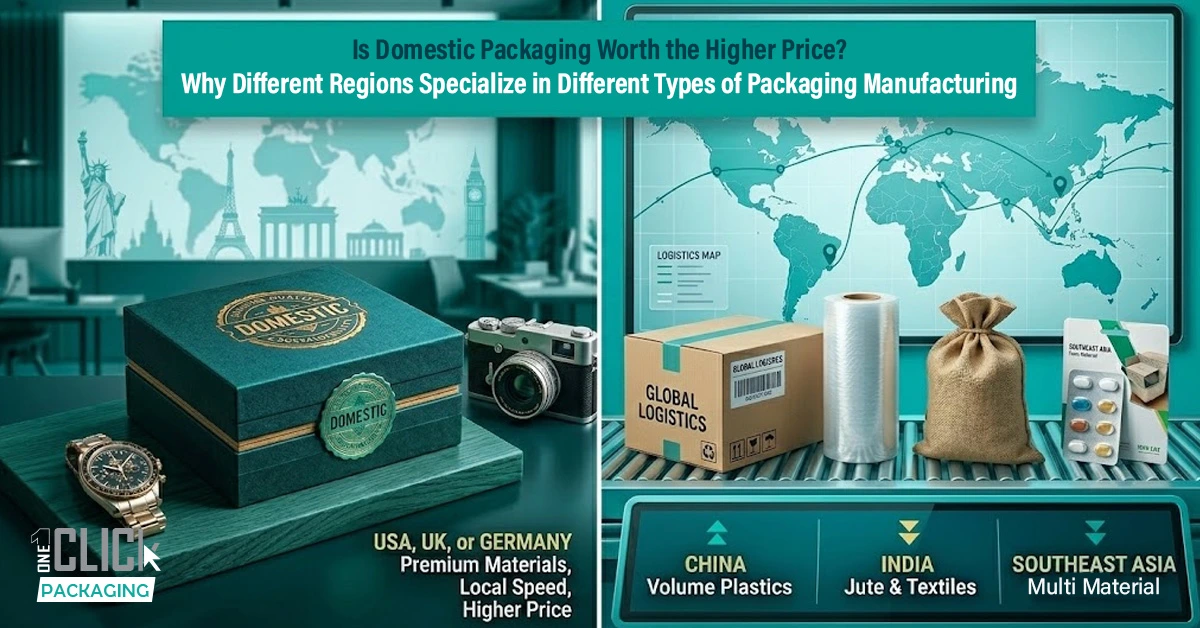

The $40,000 Question That Almost Broke My Business
In early 2022, I was sitting across from my operations manager staring at two quotes for custom folding cartons. One came from a domestic printer in Ohio. The other landed from a Shenzhen supplier our freight forwarder had recommended. The price gap was not subtle. Domestic was $41,200. Overseas was $17,800.
I picked the cheaper option. Six weeks later, I had 50,000 boxes with a Pantone color that was visibly off from our brand standard, and a customer presentation coming up in three days. That mistake cost me more than the price difference I thought I was saving.
That experience forced me to actually understand what drives packaging costs and why some types of packaging almost always make sense to source domestically, while others are genuinely better produced overseas.The answer in most sourcing cases for modern box packaging solutions has nothing to do with patriotism or politics. It comes down to labor economics, raw material access, infrastructure investment, and supply chain risk.
Here is what I learned, and what most sourcing guides never bother to explain.
| Key takeaway: Domestic packaging is not universally more expensive per unit. For certain formats, order volumes, and quality requirements, it is actually the more cost-efficient choice once you account for full landed cost, lead time risk, and rework potential. |
Why Does Packaging Geography Even Matter?
Most buyers think about packaging cost in isolation. They compare per-unit price and stop there. That framing misses everything that actually determines whether a sourcing decision was smart.
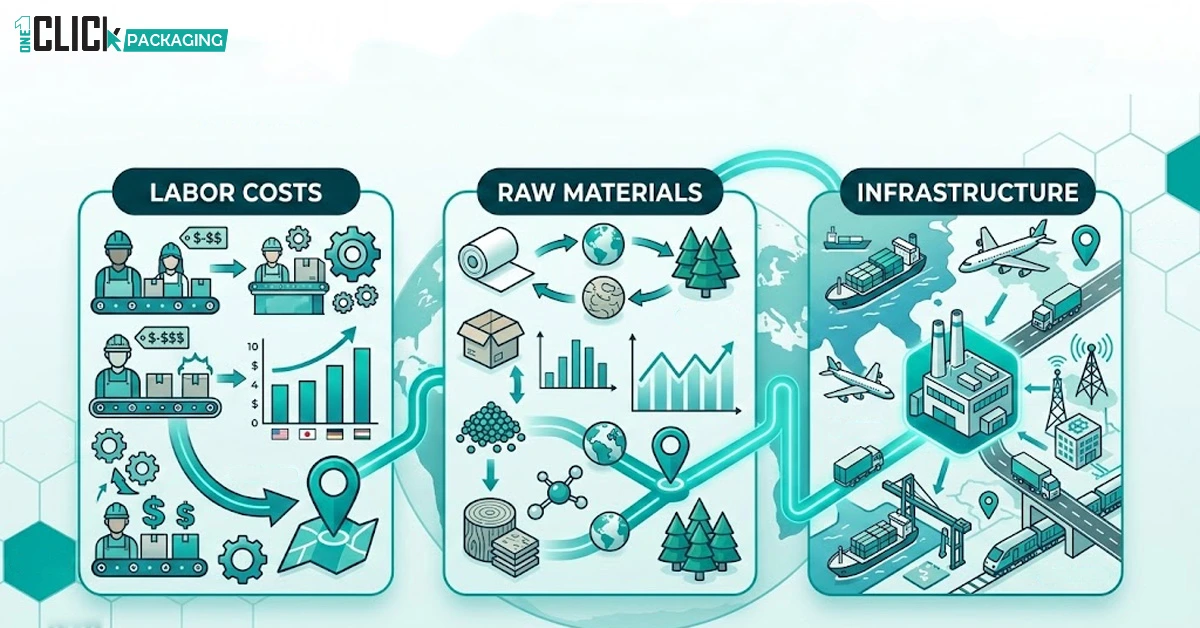
Regional specialization in packaging manufacturing for products like custom coffee boxes exists because of four converging forces that are deeply structural, not accidental. Understanding these forces is what separates experienced sourcing managers from people who keep getting burned by offshore decisions that looked good on paper.
These patterns become clearer when you look at the real factors behind regional manufacturing decisions.
[See — How Labor Costs, Raw Materials, and Infrastructure Decide Where Packaging Is Produced]
Labor Cost Structures Are Not Static
In 2010, labor cost arbitrage between US and Chinese packaging facilities was enormous. That gap has compressed significantly. Average factory wages in China’s manufacturing hubs have risen by over 200 percent since 2005, according to data from the National Bureau of Statistics of China. Meanwhile, US automation investment has reduced the labor content of many packaging formats dramatically.
Rigid box assembly for luxury packaging boxes is still highly labor-intensive globally. But offset printing for folding cartons? Modern US facilities run those jobs with minimal human touchpoints. The cost advantage of cheap labor shrinks when the process does not need much labor.
Raw Material Proximity Decides Certain Outcomes
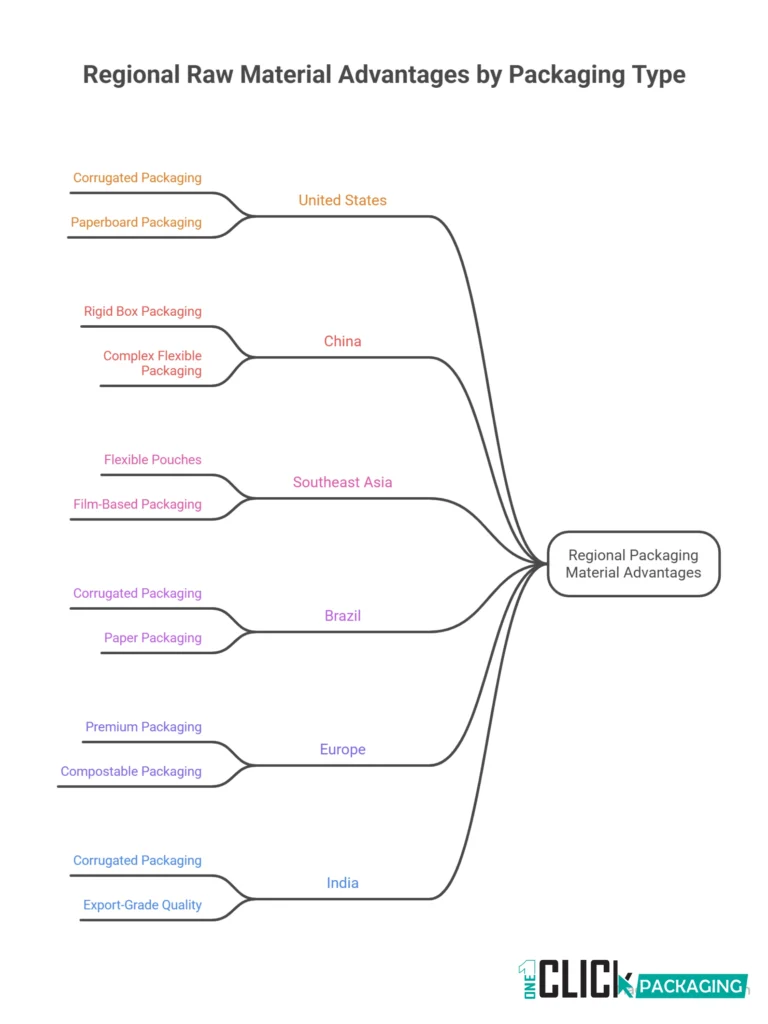
Corrugated packaging manufacturers in the US benefit from some of the lowest pulp and containerboard costs in the world, driven by abundant timber supply and efficient domestic paper mills. Brazilian corrugated producers have a similar advantage for slightly different reasons. Southeast Asian flexible packaging converters sit close to petrochemical feedstocks that make polyethylene and polypropylene film extremely cost-competitive.
You cannot ship raw materials around the world efficiently and still beat a manufacturer producing bulk cereal boxes who sources them locally. This is why corrugated is almost always domestically sourced in any mature market, while flexible packaging for commodity products often routes through Asia.
What Types of Packaging Are Genuinely Best Made Domestically?
This is where I want to push back against the conventional wisdom that domestic always costs more. For specific packaging categories, domestic manufacturing is not just competitive. It is the only rational choice.
Corrugated Shipping Boxes and Retail-Ready Packaging
If you are sourcing corrugated boxes for domestic distribution, importing them from overseas is almost never economically rational. Corrugated is heavy, low-density, and expensive to ship. The freight cost alone typically wipes out any per-unit savings within three container loads.
Beyond freight, corrugated has legitimate lead time requirements tied to your inventory and distribution cadence. A US corrugated plant can typically turn custom orders for retail display boxes in 10 to 15 business days. An offshore supplier adds 25 to 35 days in ocean transit before you even start counting production time. For brands managing lean inventory, that lead time differential creates carrying cost and stockout risk that dwarfs any unit price advantage.
For small brands, balancing unit cost with supply chain risk is often the harder decision.
Folding Cartons for FDA-Regulated Products
Here is an area where I have seen small brands make expensive mistakes repeatedly. If your product is subject to FDA oversight, whether food, pharmaceutical, cosmetic, or dietary supplement, your packaging supplier needs to meet specific compliance standards.
Domestic folding carton converters producing vitamin packaging operate under established US regulatory frameworks.Many carry BRC, SQF, or AIB certifications that are immediately recognizable to your QA team and retail buyers. Auditing an overseas supplier for FDA-equivalent compliance is possible, but it requires resources, site visits, and third-party certification costs that most small and mid-size brands cannot absorb efficiently.
The regulatory friction of offshore sourcing for regulated categories is a real cost that rarely appears in the quote comparison.
Short-Run and Custom Structural Packaging
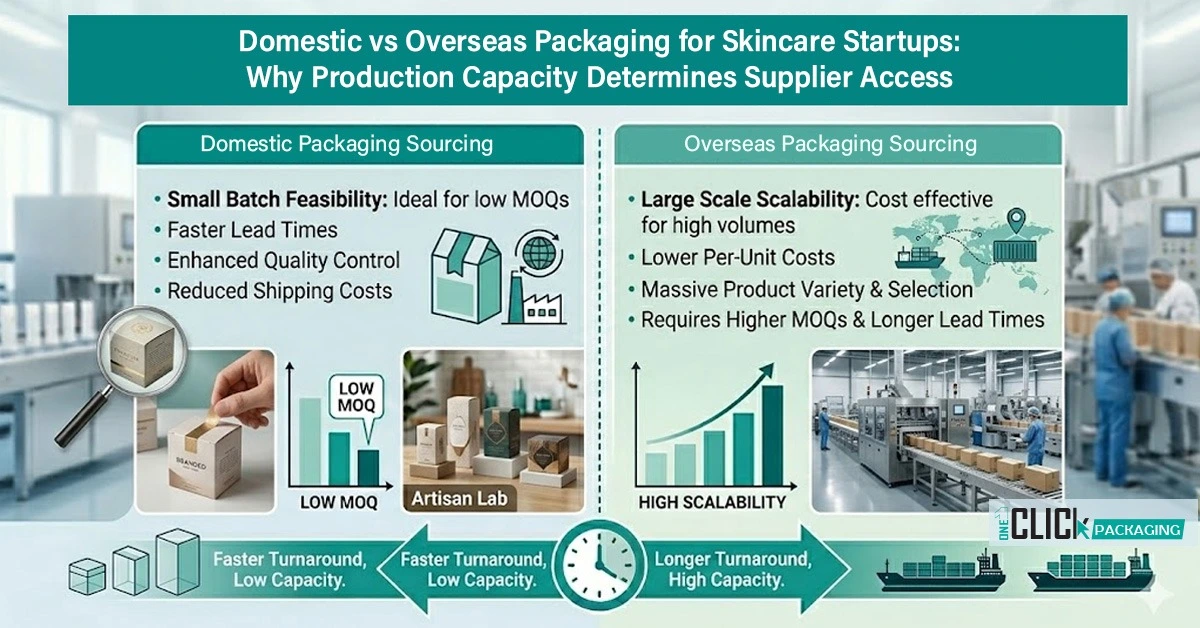
Digital printing technology has transformed the economics of short-run domestic packaging including best custom mailer boxes in the past five years. Suppliers like Pakible, BoxUp, and several regional converters now offer minimum order quantities as low as 50 units with full custom print for folding cartons and mailer boxes.
That is a market segment where offshore sourcing does not compete. Minimum order quantities for Chinese suppliers typically start at 500 to 1,000 units for custom work. Add in sampling lead times, shipping, and the cost of holding inventory for slow-moving SKUs, and domestic short-run production wins decisively on total cost.
| Real example: A skincare brand I worked with in 2023 was sourcing custom folding cartons offshore at a MOQ of 2,000 units. They carried 60 days of average inventory at a carrying cost of roughly 28 percent annually. Switching to a domestic digital printer at 300-unit runs reduced their working capital tied up in packaging by over $18,000 per year despite a 22 percent higher per-unit price. |
Where Does Offshore Packaging Manufacturing Actually Win?
I want to be honest here, because the answer is not zero. There are real categories where offshore sourcing makes rational economic sense, and pretending otherwise would be intellectually dishonest.
Rigid Boxes and Premium Gift Packaging
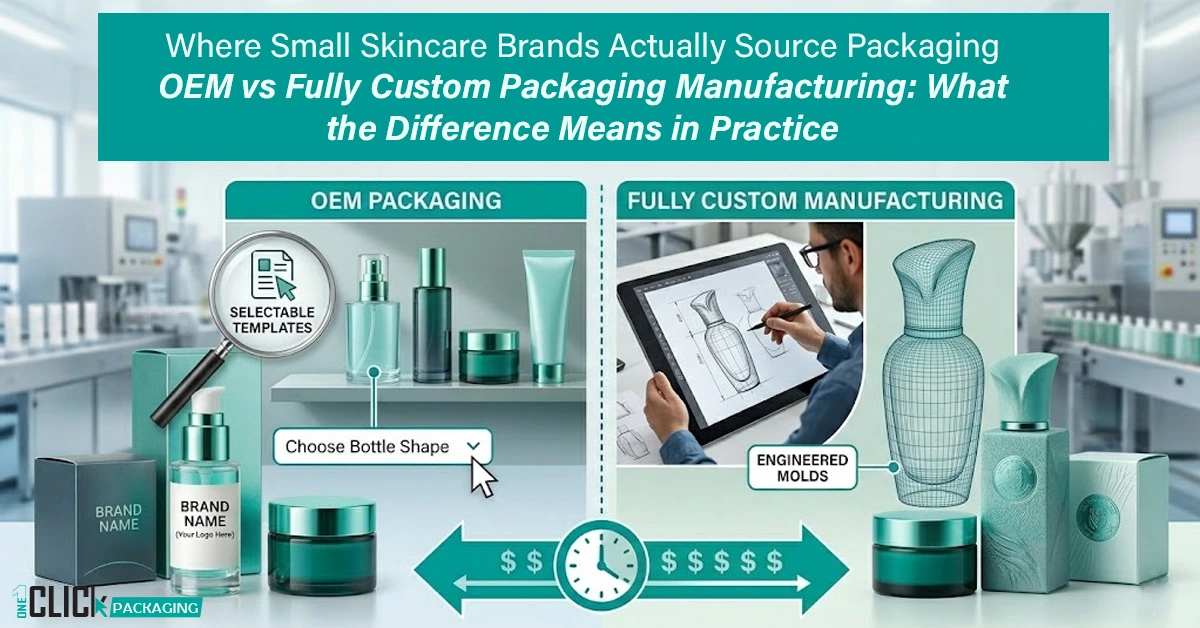
Two-piece rigid setup boxes, magnetic closure boxes, and high-end gift packaging remain heavily labor-intensive. The finishing techniques that premium brands want, foil stamping, spot UV, embossing, ribbon pulls, and magnetic closures, require skilled hand-assembly that is genuinely cost-prohibitive in domestic labor markets.
For this category of gift packaging boxes, the manufacturing ecosystem in Guangdong province in China, and to a growing extent in Vietnam, has no equivalent globally. The concentration of specialized suppliers, skilled labor, and finishing vendors in that region creates quality and cost outcomes that domestic producers simply cannot match at scale.
The tradeoff is lead time. A rigid box order from a top-tier Guangdong supplier will take 60 to 90 days from approval to your dock. Brands that plan properly, which means forecasting seasonal demand with enough lead time, can make this work financially.
To understand whether overseas sourcing actually makes sense, brands need to compare the full landed cost.
[INTERNAL LINK — US vs China Packaging Manufacturing: Real Differences in Cost, Speed, Reliability, and Quality]
Flexible Packaging at High Volume
High-volume flexible packaging, stand-up pouches, spouted pouches, rollstock for VFFS lines, remains cost-competitive from Southeast Asian converters for brands running production quantities above 100,000 units per SKU. Suppliers in Vietnam, Thailand, and Malaysia have invested heavily in modern gravure and flexographic printing equipment, and their output quality for commodity flexible formats is genuinely good.
The quality conversation has shifted significantly in the past decade. The assumption that offshore flexible packaging means inferior quality is outdated. I have seen Vietnamese converter output for snack food brands that was indistinguishable from what US converters produce, at 30 to 40 percent lower unit cost.
| Packaging Type | Domestic Advantage | Offshore Advantage | Best Fit Decision |
| Corrugated Boxes | Freight cost, speed, custom runs | Unit cost only at massive scale | Almost always domestic |
| Folding Cartons (regulated) | Compliance, audit access, short runs | Volume cost above 50,000 units | Domestic unless high volume |
| Folding Cartons (standard) | Lead time, color control | Unit cost, MOQ flexibility | Evaluate by volume |
| Rigid/Gift Boxes | Speed, sampling access | Labor-intensive finishing, unit cost | Offshore for most brands |
| Flexible Pouches (high vol.) | Lead time, domestic audit | Unit cost, converter ecosystem | Offshore above 100K units |
| Flexible Pouches (short run) | MOQ, speed, regulatory | N/A at small volumes | Domestic almost always |
| Labels and Sleeves | Digital short-run, speed | Offset volume runs | By volume and run size |
The Hidden Costs That Make Domestic Packaging Worth It
When someone tells me domestic packaging is too expensive, I ask them one question: expensive compared to what number exactly? Most people are comparing against a quote, not against total landed cost.
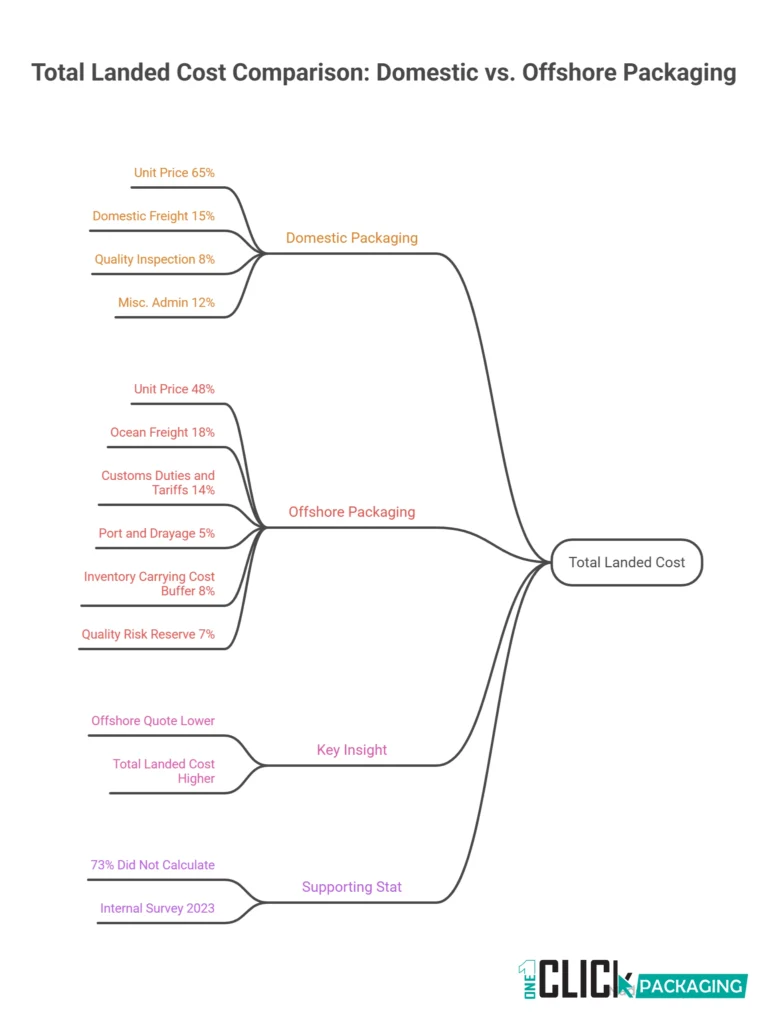
Total landed cost is the only number that matters. It includes ocean or air freight, customs duties and tariffs, port handling fees, domestic drayage, carrying cost of additional inventory buffer needed to cover lead time uncertainty, quality inspection costs, rework or reprint expenses from color or spec variances, and the opportunity cost of management time spent managing overseas supplier relationships across time zones.
I ran this analysis for a mid-size supplement brand in 2023 that was sourcing folding cartons from a Guangzhou printer. Their offshore quote was $0.14 per unit. After full landed cost analysis, the actual cost per unit was $0.21. Their domestic option quoted $0.18. Domestic was cheaper, and they did not even know it until we did the math properly.
Tariff Exposure Is a Real Variable Right Now
This is time-sensitive context that matters in 2025. Section 301 tariffs on Chinese goods remain in place across a broad range of product categories, including many packaging inputs. Brands sourcing packaging from China are exposed to tariff variability that can change their cost model with little warning. The 2018 to 2019 tariff escalation cycle caught dozens of brands I know mid-contract with no ability to pass through cost increases quickly.
Domestic sourcing eliminates that exposure entirely. For brands with thin margins, tariff certainty is worth something real, even if it is hard to put a precise number on it in advance.
How Regional Specialization Shapes the Global Packaging Map
Here is a framework I use when advising brands on sourcing decisions. Think of global packaging manufacturing across formats like retail packaging boxes as a set of regional ecosystems, each with genuine competitive strengths that are not easily replicated elsewhere.
United States: Speed, Compliance, and Digital Innovation
The US packaging manufacturing base is strongest in corrugated, folding carton, digital print short-run production, and paperboard-based formats. The infrastructure here supports fast turnarounds, strong quality audit culture, and robust material science for food-contact and pharmaceutical applications.
Where the US lags is in labor-intensive assembly and finishing work. Rigid box construction, hand-applied ribbon and specialty closures, and complex multi-layer laminate structures are not cost-competitive to produce domestically.
China: Scale, Specialization, and Finishing Craft
China remains the dominant global supplier for rigid boxes, specialty printing with complex finishing, large-volume flexible packaging, and injection-molded packaging components. The supplier ecosystem in the Pearl River Delta and Yangtze River Delta regions has depth and specialization that took decades to build.
The honest limitation of Chinese supply chains in 2025 is lead time and quality variability at lower price tiers. First-rate Chinese converters produce world-class output. Second-tier suppliers produce inconsistent results. Knowing how to evaluate and select the right tier is a skill that takes real experience to develop.
Southeast Asia: The Emerging Alternative
Vietnam, Thailand, and Malaysia have invested heavily in flexible packaging conversion capacity over the past decade. These markets benefit from lower labor costs than China, growing raw material access, and improving logistics infrastructure. Several large global packaging brands have built regional facilities in Vietnam specifically to serve European and North American brands wanting to diversify away from pure China dependency.
For flexible packaging at mid-to-high volume, Southeast Asian converters deserve serious evaluation. The quality conversation has matured, and the supply chain diversification benefit is real.
Europe: Sustainability Leadership and Specialty Materials
European packaging manufacturers, particularly in Germany, the Netherlands, and Scandinavia, lead global development in sustainable packaging materials. If you are building a packaging program around compostable substrates, advanced recyclable barrier materials, or paper-based alternatives to plastic, European converters are often at the frontier.
For US brands, European sourcing adds transatlantic logistics complexity. It makes most sense for premium products where material innovation is a genuine differentiator and cost sensitivity is lower.
How to Decide What to Source Where: A Practical Framework
After years of getting this wrong and then gradually getting it right, here is the decision framework I actually use.
Step 1: Calculate True Landed Cost First
Before you compare any quotes, build a landed cost model. Use a spreadsheet that accounts for freight, duties, carrying cost, and a risk reserve for quality issues. If you have not done this calculation before, you will be surprised how often it changes the answer.
For small businesses, this decision framework becomes much clearer when broken down step by step.
Step 2: Identify Your Non-Negotiables
Regulatory compliance requirements, minimum order flexibility, lead time constraints, and sustainability commitments are non-negotiables for some brands. Identify yours before you evaluate any supplier. If FDA compliance is mandatory, your supplier shortlist just got much shorter regardless of price.
Step 3: Match Format to Regional Strengths
Use the regional specialization map described above. Corrugated goes domestic almost by default. Rigid gift boxes go offshore almost by default. Everything in between requires the landed cost model to make the right call.
Step 4: Test Before You Commit
Never place a full production order for candle packaging boxes with a new overseas supplier based on digital proofs alone. Request a physical sample run, ideally a short press proof, before committing. The cost of a sample run is always lower than the cost of a full reprint.
For domestic suppliers, physical press approvals are standard practice. Insist on the same standard from any offshore supplier regardless of what they tell you about their quality systems.
The Real Answer to Whether Domestic Packaging Is Worth It
The question is not whether domestic packaging costs more per unit. Sometimes it does. Sometimes it does not. The real question is whether the full decision, including risk, compliance, lead time, and tariff exposure, makes domestic sourcing the smarter total investment.
In my experience, brands that do this analysis honestly end up splitting their sourcing. They source corrugated and short-run cartons domestically because the economics demand it. They source rigid boxes and high-volume flexible packaging offshore because the economics equally demand that.
The mistake is treating this as a binary choice or defaulting to the cheaper quote without running the real numbers. Regional specialization exists for real structural reasons that are not going away. Smart sourcing means understanding those reasons and letting them guide your decisions, not just reacting to the price on a quote sheet.
The brands that get packaging sourcing right through a well planned customized packaging solution treat it as a supply chain design problem, not a procurement problem. That mindset shift is worth more than any single sourcing decision you will ever make.
What packaging formats are you currently sourcing, and have you done a real landed cost analysis on any of them? I would genuinely like to hear where you landed.
Frequently Asked Questions
Is domestic packaging always more expensive than importing from China?
No. When you factor in freight, tariffs, carrying cost, and quality risk, domestic sourcing is cheaper for corrugated boxes, short-run folding cartons, and any format where freight-to-value ratio is high. The per-unit price comparison is only the starting point.
What is the minimum order quantity difference between domestic and offshore suppliers?
Domestic digital printers now accept runs as low as 50 to 100 units for custom folding cartons. Domestic corrugated converters typically start at 250 to 500 units. Most Chinese suppliers require 500 to 2,000 units minimum for custom work, plus the cost of dies and plates.
How do tariffs affect packaging sourcing decisions in 2025?
Section 301 tariffs on Chinese goods remain in effect and apply to many packaging categories. Effective tariff rates range from 7.5 to 25 percent depending on the product classification. This cost significantly changes the landed cost model for offshore packaging and must be included in any comparison.
Can offshore packaging meet FDA food contact compliance standards?
Yes, but it requires deliberate supplier selection, third-party audit investment, and ongoing compliance monitoring. It is achievable for large brands with dedicated QA resources. For smaller brands, the overhead cost of managing offshore compliance often makes domestic sourcing more economical total.
How much longer are offshore lead times compared to domestic?
Typical domestic lead times for custom folding cartons including cosmetic packaging boxes run 10 to 21 business days. Offshore orders including ocean freight typically require 60 to 90 days from approval. Air freight can cut offshore transit to 7 to 10 days but dramatically increases landed cost, often eliminating the unit price advantage entirely.
What packaging types are best sourced domestically without exception?
Corrugated shipping boxes, retail-ready packaging, and any regulated packaging subject to FDA or USDA audit requirements are almost universally best sourced domestically for US-based brands. Short-run custom folding cartons under 1,000 units are also nearly always domestic by economic logic.