
Here is a situation that plays out more often than anyone in the industry will admit publicly. A founder spends six months perfecting a vitamin C serum. The formula is genuinely good. A dermatologist friend tested it. Three rounds of stability testing passed. The brand name is locked. The logo is done. Then she goes to source the dropper bottle and everything grinds to a halt.
The minimum order quantities are higher than expected. The supplier she found on Alibaba ships a sample that leaks. A custom mold quote comes back at $4,200 just for the dropper tip. And a competitor launched last week in a nearly identical amber glass bottle.
This is not a sourcing problem. It is a decision-making problem many founders face when choosing the right custom packaging solutions for their skincare products. Specifically, it is the result of not understanding the two fundamentally different packaging supply chains available to small skincare brands, and which one to use at what stage of growth.
OEM and white-label packaging on one side. Fully custom manufactured packaging on the other. Both have real advantages. Both will hurt you if you choose the wrong one for your current situation. This article explains exactly how each works, where to find suppliers for both, what it actually costs, and how to avoid the most expensive mistakes founders make in the first two years.
What OEM and White-Label Packaging Actually Means for Skincare Brands
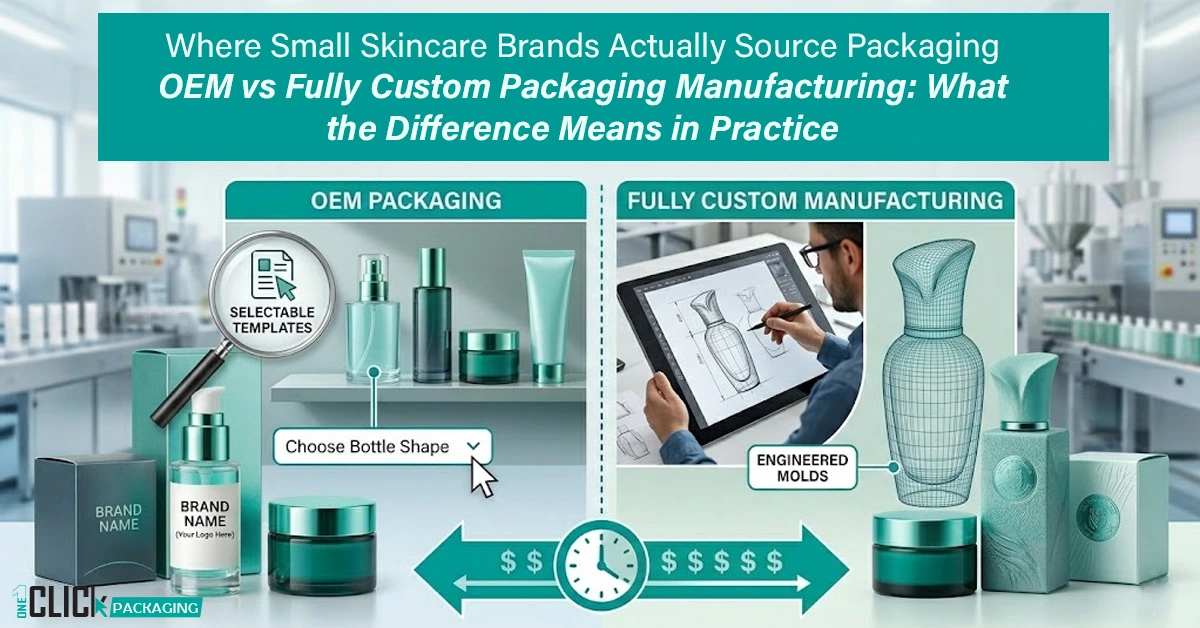
OEM stands for original equipment manufacturer. In the packaging context, it means you are buying a product that already exists, produced by a factory that makes that same component for many different brands. White-label is slightly different in terminology but works the same way in practice: the manufacturer made it, you put your brand on it.
The practical reality is that most early-stage skincare brands start here using OEM containers and custom paper stickers for labeling., even if they do not realize it. That 30ml airless pump bottle you found on Alibaba? OEM. The frosted glass jar with a bamboo lid available from a trade show supplier with a 500-unit minimum? Also OEM. The manufacturer already owns the tooling and molds. They have been running that same component for years. You are renting access to their infrastructure without paying to build it.
Why This Actually Makes Sense for Most Launches
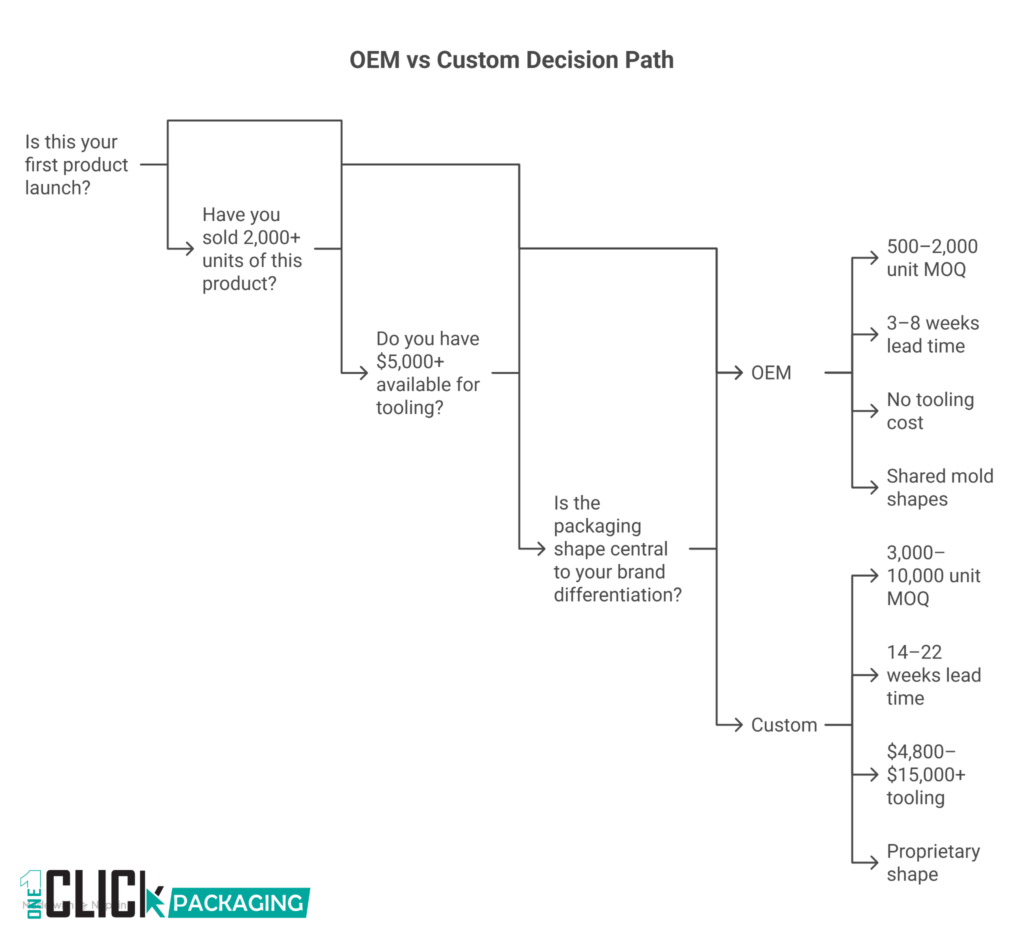
The real advantage of OEM packaging is speed and capital preservation. You are not paying for mold creation, which typically runs from $800 to $8,000 per component depending on complexity and the country of manufacture. You are not waiting 12 to 20 weeks for a new mold to be cut and sampled. You order, you wait 3 to 8 weeks for production, and product ships.
For a brand testing its first SKU, this is the right approach. I have spoken with brand founders who spent $22,000 on custom molds before they had validated a single product in the market. Two of them ended up discontinuing that product line within 14 months. The mold cost became a sunk cost that distorted every subsequent decision.
The limitation is differentiation, especially when many brands rely on standard containers and custom eyeshadow boxes for product presentation.
If 40 other brands are using the same airless pump bottle shape, You will need to work much harder on label design, secondary packaging like luxury cosmetic packaging boxes, and brand storytelling to stand out. That is doable, but it is a real constraint you should price into your strategy.
If you are still planning your packaging sourcing strategy, the guide below explains how to evaluate suppliers and manage production decisions.
How Fully Custom Packaging Manufacturing Works
Fully custom manufacturing means you own the design and the tooling, similar to how brands develop mushroom packaging for niche product categories. You work with a manufacturer to produce a packaging component that does not exist yet, or to significantly modify an existing shape to create something proprietary. The factory cuts molds to your specifications. Those molds belong to you or are held exclusively for your production runs.
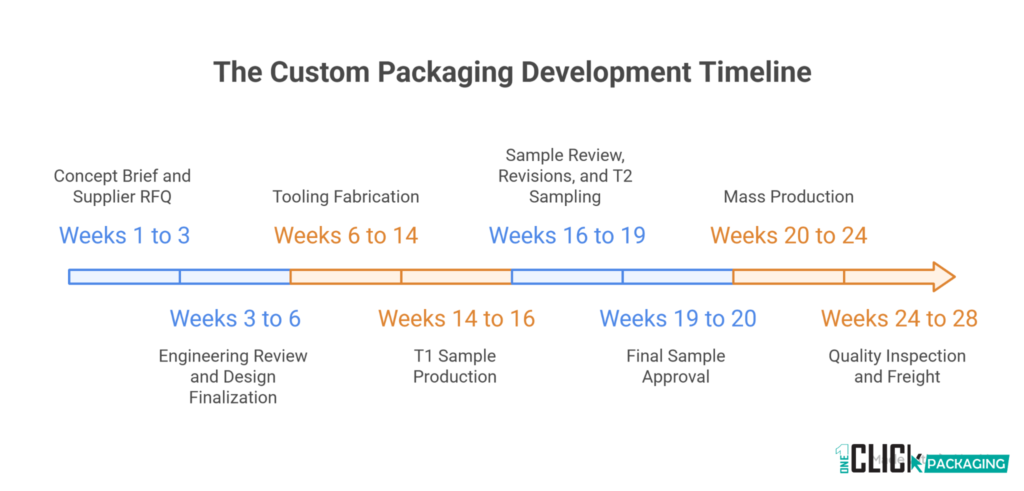
This is a different supply chain entirely. The process typically starts with a 3D rendering or sketch of your concept, moves through engineering review, then tooling fabrication, then sampling, then mass production. From initial brief to first production units, budget 14 to 22 weeks minimum. For complex components with tight tolerances, 26 weeks is realistic.
The financial commitment is front-loaded. You pay for mold creation before any product ships. Mold costs for a single component range from roughly $1,200 for a simple cap to over $15,000 for a complex pump mechanism with multiple parts. Most finished packaging items involve two to four separate components, each requiring its own mold.
Who Actually Needs Fully Custom Packaging
Fully custom manufacturing makes economic sense when three conditions are met. First, you have validated the product. You know it sells. You have repeat customers and understand your retention rate. Second, you are producing at a volume where the tooling cost is spread across enough units to stop being painful. Generally this means you are moving at least 3,000 to 5,000 units per SKU per year. Third, the packaging shape is a core part of your brand identity and you need to own it, not rent it from a shared mold when developing cosmetic packaging boxes that reflect your brand.
Here is the honest reality: most brands that move to fully custom packaging do so at Series A or after 18 months of strong direct-to-consumer sales. Attempting it at launch is possible, but it requires either significant investor capital or a very specific niche where premium packaging is the central brand promise from day one.
OEM vs Fully Custom: Side-by-Side Comparison
The table below covers the decision factors that matter most for a small skincare brand in its first three years. Use it as a quick reference before the deeper analysis below.
| Factor | OEM / White-Label | Fully Custom Manufacturing |
| Minimum Order Qty | Usually 500–2,000 units | Often 1,000–10,000+ units |
| Lead Time | 2–8 weeks | 12–20 weeks (first run) |
| Unit Cost | Lower per piece | Higher per piece initially |
| Tooling / Mold Cost | None (shared tooling) | $800–$8,000+ per component |
| Brand Differentiation | Limited — shared shapes | Total ownership of design |
| Risk Level | Low | Medium to High |
| Best For | Startups, testers, MVPs | Scaling brands, hero SKUs |
| Supplier Type | Alibaba, trade shows, agents | Specialist manufacturers |
Where to Actually Find OEM Packaging Suppliers
This is where a lot of founders lose weeks chasing the wrong sources. There are four main channels worth understanding.
Alibaba and Global Trade Platforms
Alibaba is the most accessible starting point, but it requires discipline. The platform hosts thousands of packaging suppliers from China, Korea, Vietnam, and increasingly India. The challenge is signal-to-noise. You will see the same bottle photographed under 200 different supplier listings.
When evaluating Alibaba suppliers for OEM packaging, look for verified gold suppliers with at least three years of trading history and a minimum of 50 completed transactions. Request the factory audit report if available. Ask specifically whether the components you are ordering use shared molds or proprietary tooling, because this determines your exclusivity situation. Many suppliers will not disclose this unless you ask directly.
Practical note: always order samples before committing to any production run, regardless of how polished the listing looks. Sample quality and production quality can diverge significantly. Budget $150 to $400 for a proper sampling exercise across three to five supplier shortlisted candidates.
Trade Shows: Cosmoprof and Beyond
Cosmoprof Worldwide Bologna and Cosmoprof North America in Las Vegas are the two events that matter most for skincare packaging. The Bologna show runs in March each year. Las Vegas runs in July. Both attract hundreds of packaging suppliers showing physical samples including cosmetic display boxes you can handle and test on the spot.
The advantage of trade shows is relationship-building. You get face time with supplier sales representatives. You can negotiate terms in person. You also see what other brands are gravitating toward, which gives you real-time competitive intelligence on which OEM shapes are becoming oversaturated.
If you cannot attend in person, most major suppliers from these shows maintain digital catalogs and will ship sample kits upon request. Suppliers like Quadpack, Berlin Packaging, and Baralan all do this routinely for qualified inquiries.
Domestic Packaging Distributors
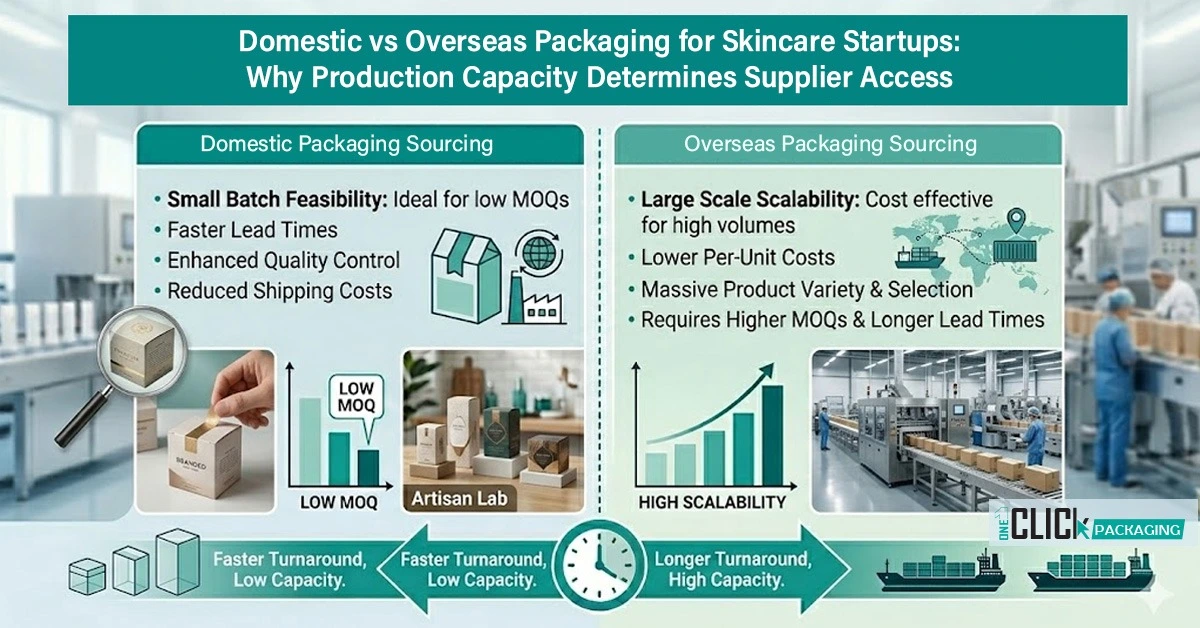
For US-based brands, working with a domestic distributor such as SKS Bottle and Packaging, Alibaba’s US-focused subsidiary Tundra, or ABA Package has real advantages around minimum order quantities, lead times, and communication. You are often looking at minimums of 100 to 300 units for standard glass and plastic components, compared to 1,000 or more from overseas factories.
The trade-off is cost. Domestic distributor pricing for basic components often runs 40 to 80 percent higher than direct factory pricing from overseas. For brands in their first year where cash flow is tight, that premium is hard to justify unless speed-to-market or domestic sourcing for marketing purposes is a priority.
Where to Find Fully Custom Packaging Manufacturers
Custom manufacturing sourcing is a more targeted exercise. You are not browsing a marketplace. You are finding a manufacturing partner capable of executing your specific concept.
Specialist Packaging Manufacturers in China and South Korea
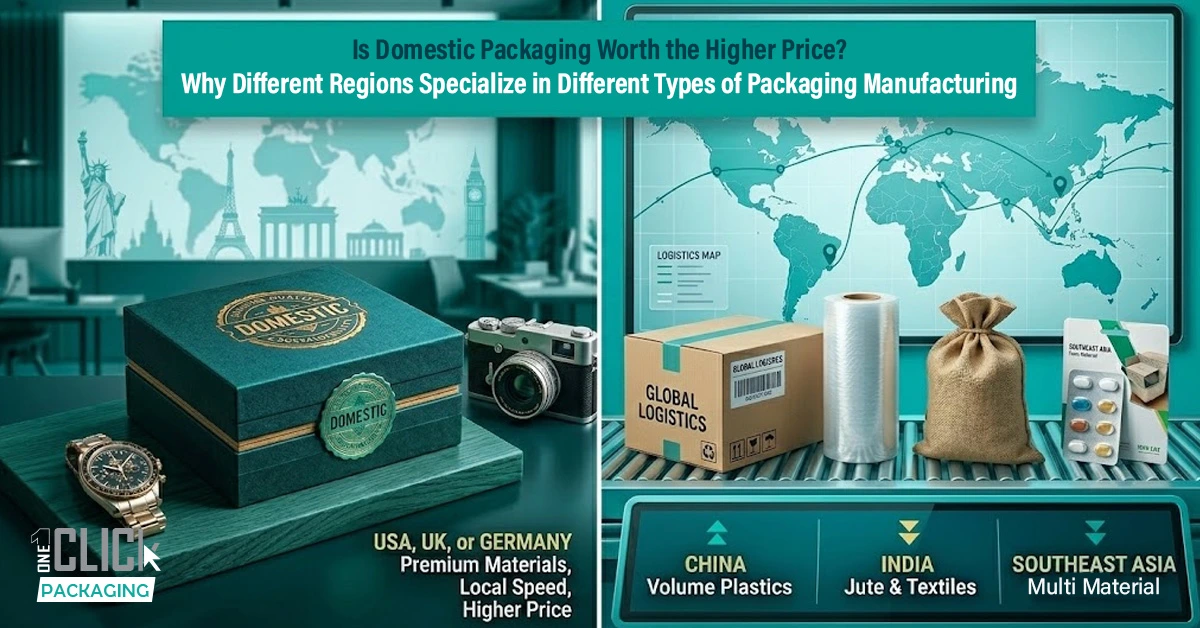
China remains the dominant geography for custom skincare packaging manufacturing. Factories in Guangzhou, Shenzhen, and the Yiwu region have deep experience in cosmetic components specifically. South Korea is the premium tier, particularly for airless pump mechanisms and high-end glass work. Korean suppliers tend to have stricter quality controls and faster sampling cycles, at a cost premium of roughly 25 to 40 percent over comparable Chinese production.
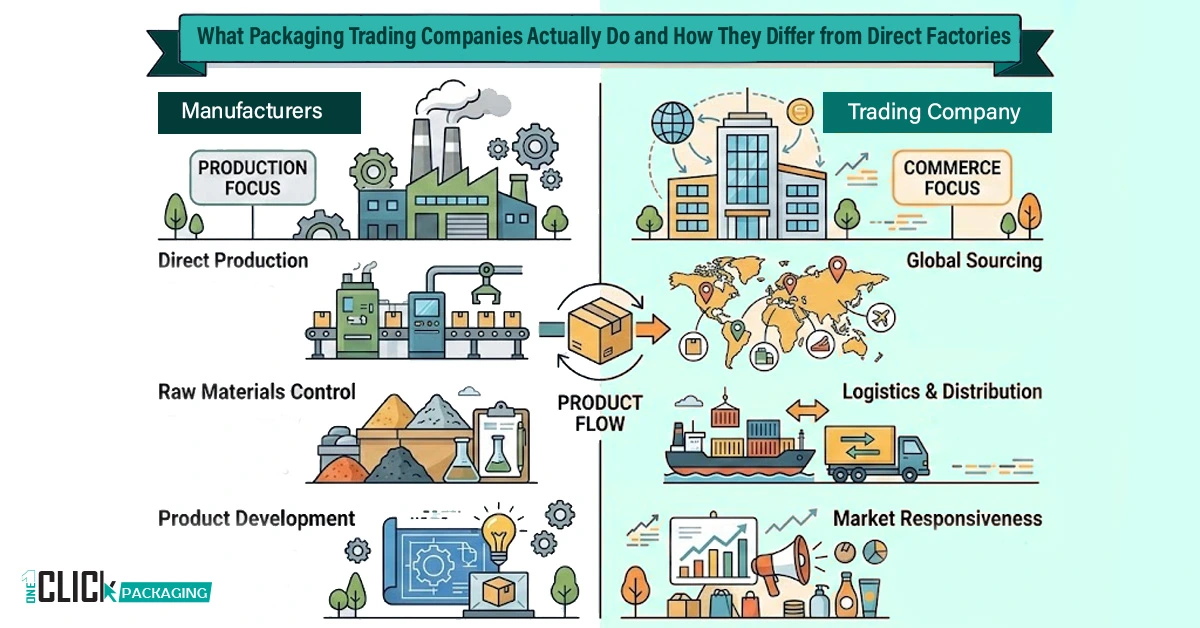
Finding these suppliers requires more legwork than Alibaba browsing. Industry platforms like Alibaba’s RFQ function, Made-in-China.com, and specialized sourcing agents add value here. If your budget allows, working with a sourcing agent who has established factory relationships in the packaging category will typically save you two to four months of prospecting time and significantly reduce the risk of selecting a manufacturer who misrepresents their capabilities.
Using a Packaging Development Agency
For brands with budget but limited sourcing bandwidth, packaging development agencies bridge the gap between brand vision and factory capability. Firms like Pi Global, Marks and Marks, and various boutique consultancies in Los Angeles and New York work with brands to develop custom packaging concepts and then manage the supplier qualification and tooling process on their behalf.
This is not a cheap option. Agency fees typically run from $8,000 to $35,000 for a full custom packaging development project, depending on scope. But for a brand where packaging differentiation is central to the proposition, the cost can be justified when measured against the alternative: spending that same budget making expensive mistakes directly with manufacturers who have no incentive to educate you.
The Real Cost Breakdown: What to Budget for Each Path
Numbers matter here, and vague ranges are useless. Below is a realistic cost model based on actual production scenarios, not aspirational estimates from supplier sales sheets.
OEM Packaging Cost Model for a 1,000-Unit Batch
Take a standard 30ml glass dropper bottle with aluminum cap as an example. Sourcing OEM from a verified Alibaba supplier, you are looking at $0.45 to $0.85 per unit for the bottle, $0.20 to $0.35 per unit for the dropper insert, and $0.10 to $0.20 per unit for the cap. Add freight, customs duty (typically 3.5 to 6.5 percent for cosmetic packaging from China under current tariff schedules as of early 2025), and domestic freight to your fulfillment center, and your landed per-unit packaging cost lands between $1.10 and $2.00 depending on your specifics.
At 1,000 units, total packaging spend sits between $1,100 and $2,000. That is manageable for a small brand. Compare that to the same exercise at 500 units, where your landed cost per unit typically rises to $1.60 to $2.80 due to freight inefficiency and supplier MOQ premiums.
Fully Custom Packaging Cost Model
Custom gets more complicated because tooling is a fixed cost that sits on top of per-unit production costs. Using the same 30ml dropper bottle concept but with a fully custom shape, a realistic budget looks like this: bottle mold $2,500 to $4,000, dropper assembly mold $1,500 to $3,500, cap mold $800 to $1,800. Total tooling investment before a single unit ships: $4,800 to $9,300.
Per-unit production costs for custom glass components typically run 15 to 30 percent higher than OEM equivalents due to lower production volumes and more complex setup. So your landed per-unit cost on a 3,000-unit run might be $1.40 to $2.20 for the components themselves, plus your amortized tooling cost on top.
If you amortize $7,000 in tooling across 3,000 units, you add $2.33 per unit in tooling amortization. Your total packaging cost per unit for a fully custom bottle in that scenario is $3.73 to $4.53. For context, that is 2.5 to 3 times the OEM cost at the same volume. This math only works if your retail price supports that packaging investment or if your brand equity justification is strong enough.
How Import Documentation Changes When You Go Custom
This is an area most brand founders do not think about until it causes a problem. Import documentation requirements differ between OEM and custom packaging in ways that can delay your shipments if you are unprepared.
For OEM components, your supplier typically has existing documentation on hand: material safety data sheets, composition certificates, and compliance declarations for common regulatory frameworks like California Proposition 65 and EU Cosmetics Regulation 1223/2009. They have answered these questions many times before.
For fully custom packaging, particularly if you introduce novel materials, coatings, or mechanisms, your supplier may be producing documentation for the first time. Ensure your contract specifies documentation deliverables including country-of-origin certificates, material composition reports, and any required third-party testing certifications before tooling payment is released.
The Mistakes That Cost Brands the Most Money
After speaking with over a dozen independent skincare founders about their packaging sourcing experiences, these are the failure modes that came up repeatedly.
Ordering Samples But Not Testing Compatibility
A sample that looks beautiful means nothing if your formula degrades the packaging material over 12 weeks. Emulsions with high water activity can corrode certain metal components. High-concentration vitamin C serums interact poorly with some plastics and certain pump mechanisms. Always run a real-world compatibility test with your actual formula before committing to any production run, OEM or custom. This takes 8 to 12 weeks and costs almost nothing compared to destroying a production batch.
Confusing Lead Time With Availability
OEM does not mean immediate. A supplier quoting you a 3-week lead time is typically quoting production time only. Add 2 to 5 weeks for ocean freight from Asia, customs clearance, and domestic logistics, and you are at 5 to 10 weeks total. Brands that do not account for this run out of packaging inventory and halt sales. Build a 10-week replenishment cycle assumption into your inventory planning from day one.
Going Custom Too Early
This one carries the highest financial risk. A founder who invests $12,000 in custom tooling before validating the product in the market has locked $12,000 into a component that only works for a specific product they may end up reformulating or discontinuing. Custom tooling does not transfer to other products. If the product fails, the tooling cost is not recoverable. Validate first. Customize second.
The Hybrid Approach Most Successful Brands Actually Use
Here is what nobody says out loud in the supplier strategy discussions I have been part of: the most commercially successful small skincare brands do not choose between OEM and custom. They use a staged hybrid model that maps packaging investment to product maturity.
The approach works like this. Launch your first one to three SKUs using OEM packaging and branded Custom Printed Cream Boxes .with strong label and secondary packaging investment. You are validating the product, building customer data, and generating revenue. Once a product demonstrates consistent sell-through over two to three quarters, you identify which one or two SKUs are your genuine hero products and invest in custom tooling for those specifically.
This concentrates your custom investment on proven products where the tooling cost has a clear return on investment path. It protects you from the capital destruction of customizing products that do not earn their place in your line.
Making the Right Call at the Right Time
The founder at the beginning of this article, the one staring at a $4,200 mold quote for a dropper tip, made the right call. She sourced an OEM amber glass dropper bottle, invested the savings into custom box packaging and a bespoke label finish, and launched. Twelve months later, with 4,200 units sold and a clear bestseller identified, she commissioned custom tooling for that one product.
That sequencing is the actual playbook. OEM to validate. Custom to consolidate. Not the other way around.
The packaging supply chain for small skincare brands is genuinely complex when choosing the right custom packaging manufacturer, but the decision framework is not. Know your stage, know your volume, know what you can afford to lose, and match the manufacturing model to those realities rather than to what looks most impressive on a shelf.
The brands that build unshakeable packaging supply chains do not do it by making bolder choices. They do it by making better-timed ones.
What packaging decision is your brand facing right now? Whether you are sourcing your first OEM sample or evaluating a custom tooling proposal, the considerations above should give you a clearer framework for the conversation. Drop your specific scenario in the comments and I will share what the data and experience say about your situation.
Frequently Asked Questions
Can I get custom printing on OEM packaging without going fully custom?
Yes. Most OEM suppliers offer surface decoration services including screen printing, hot stamping, UV coating, and labeling. These are not structural customizations and do not require new tooling. They are the most cost-effective way to differentiate an OEM component within your budget. Screen printing a logo directly onto a bottle typically adds $0.15 to $0.45 per unit at 1,000-unit volumes.
What MOQ should I expect when approaching a custom manufacturer for the first time?
For a first-time custom manufacturing engagement, expect minimum order quantities of 3,000 to 10,000 units per component depending on the factory and the complexity of the piece. Some manufacturers, particularly in Korea, will work with lower minimums of 1,000 to 2,000 units if you are willing to accept longer lead times and higher per-unit pricing. Always negotiate MOQ as part of your initial conversation, not after you have committed to tooling.
How do I verify that a supplier’s molds actually belong to me?
This must be addressed in the manufacturing agreement before any payment is made. Your contract should specify that all tooling paid for by your company is your intellectual property, held by the factory on a bailee basis. The agreement should grant you the right to remove or transfer the molds upon reasonable notice, typically 30 days. Request a mold registration certificate from the factory once tooling is complete. Without this paperwork, your legal claim to the molds becomes difficult to enforce, particularly with overseas suppliers.
Is sustainable or eco-friendly custom packaging significantly more expensive?
In most cases, yes, though the gap is closing. Post-consumer recycled (PCR) resins typically cost 20 to 40 percent more than virgin plastic equivalents as of 2025. Bioplastic components can run 50 to 100 percent higher. For glass, the sustainability cost differential is smaller since glass itself is already highly recyclable. The business model implication is that sustainable packaging often requires a higher retail price point or acceptance of lower margins, both of which have strategic consequences.
Do I need a sourcing agent, or can I handle supplier relationships directly?
For OEM sourcing via platforms like Alibaba, most small brands can manage supplier relationships directly if they are willing to invest the time in proper due diligence. For fully custom manufacturing, a sourcing agent with existing factory relationships significantly reduces risk and typically pays for itself through better pricing, faster problem resolution, and avoiding the most common quality and documentation pitfalls. The agent fee is usually 5 to 12 percent of FOB value or a flat project fee.
What happens if my OEM supplier discontinues the component I depend on?
This is a real and underappreciated risk of the OEM model. Suppliers discontinue components when demand falls below their production efficiency threshold. The mitigation strategy is to maintain a 90-day safety stock of critical packaging components and to identify at least one alternative supplier who carries a compatible component before you are in a crisis. Document your packaging specifications in enough detail that switching suppliers is a manageable transition rather than an emergency.