
You place what feels like a perfectly reasonable sample order. A few hundred custom mailer boxes. The supplier replies within hours, speaks fluent English, shows you a beautiful catalog, and quotes you a price that makes the whole thing feel almost too easy.
Three weeks later, a box arrives. The color is off. The printing is thin. The flaps do not lock the way your spec sheet described. And the supplier, when you push back, says the factory “made a minor adjustment” due to material availability.
Here is the part nobody told you: that supplier was not a factory. It was a trading company acting as one. And the gap between those two things is where a lot of sourcing problems start.
This is not a warning against trading companies. That would be too simple, and honestly, wrong. Trading companies serve a real and useful purpose as a customized packaging solution in global packaging supply chains. The problem is opacity: buyers rarely know which model they are dealing with, or what the difference actually means for lead times, quality control, customization, and cost.
I have sourced packaging from both models across different product categories and markets. I have had excellent results from trading companies and frustrating experiences with direct factories. The relationship is more nuanced than most sourcing guides admit. What matters is knowing exactly what each model offers so you can choose the right fit for your stage of business.
What Is a Packaging Trading Company?
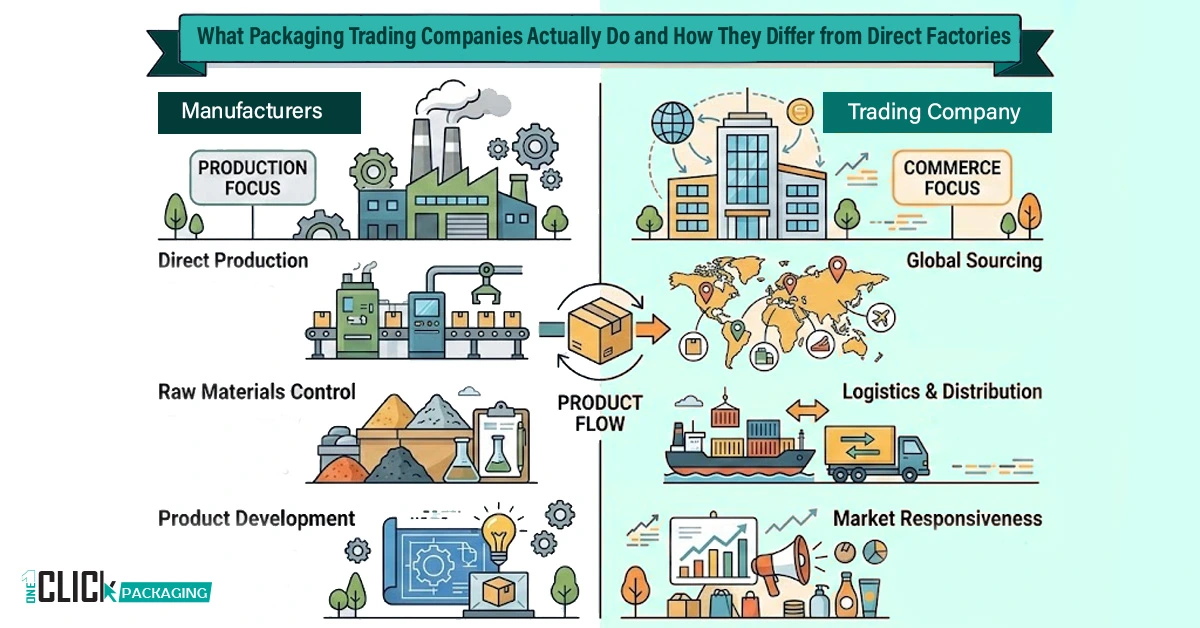
A packaging trading company is a business that sells packaging products it does not manufacture itself. Instead, it sources those products from one or more factories, often consolidates orders, manages logistics, and acts as a go-between for international buyers and domestic Chinese manufacturers.
The term “trading company” comes from the Chinese business classification system. On Alibaba and similar platforms, suppliers are tagged as either “Manufacturer” or “Trading Company.” In practice, the reality is often blurrier than that binary suggests, and many suppliers operate as hybrids.
What a trading company actually does day to day varies depending on its size and specialization. But most of them handle a few core functions that factories typically will not touch.
• They aggregate products from multiple factories, giving buyers access to a wider range than any single manufacturer offers.
• They handle export paperwork, English communication, and customs documentation that smaller factories often lack the capacity for.
• They warehouse stock domestically and can ship faster than factories running on production schedules.
• They absorb minimum order quantity requirements, like poly bags wholesale, by combining orders from multiple buyers for the same product run.
• They take on financial risk by pre-purchasing inventory, so buyers do not need to commit to large production runs.
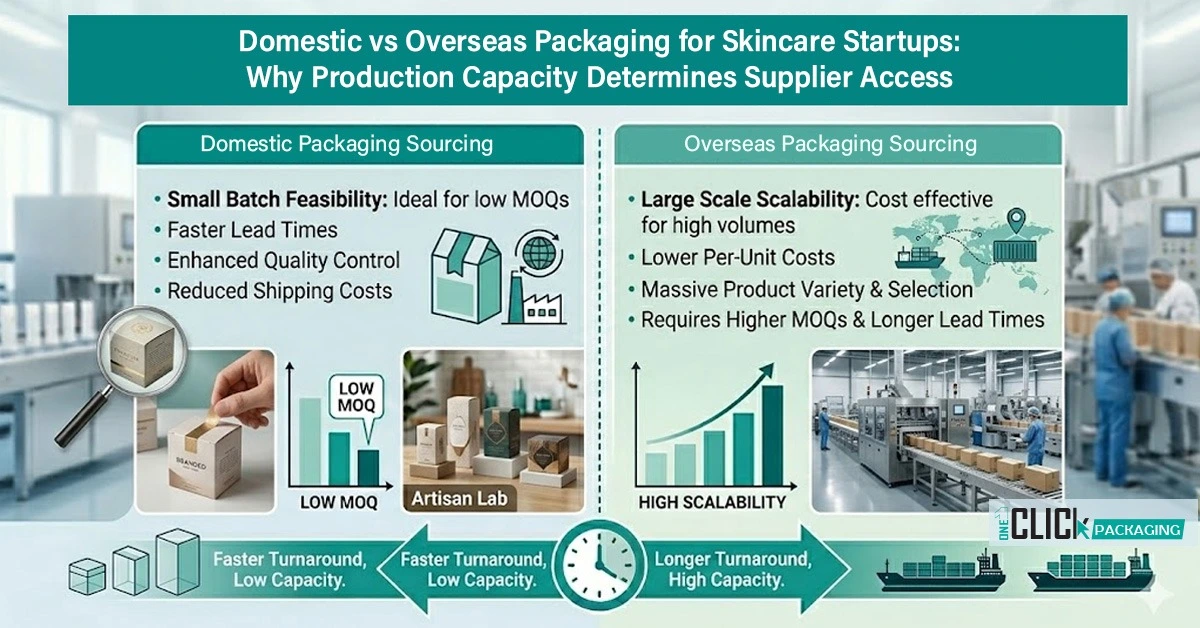
For a small business ordering 200 custom boxes for the first time, a trading company is often the only viable entry point. Factories usually want production-run volume, especially for products like tea packaging boxes.
For small brands, understanding the right sourcing strategy is just as important as choosing the right supplier.
The Structure Behind the Catalog
Here is what most buyers never see: behind that slick trading company website is usually a network of 5 to 15 factories with whom the trading company maintains ongoing supplier relationships. Some of those supplier relationships are exclusive, especially for specialized products like luxury jewelry packaging boxes. Many are not.
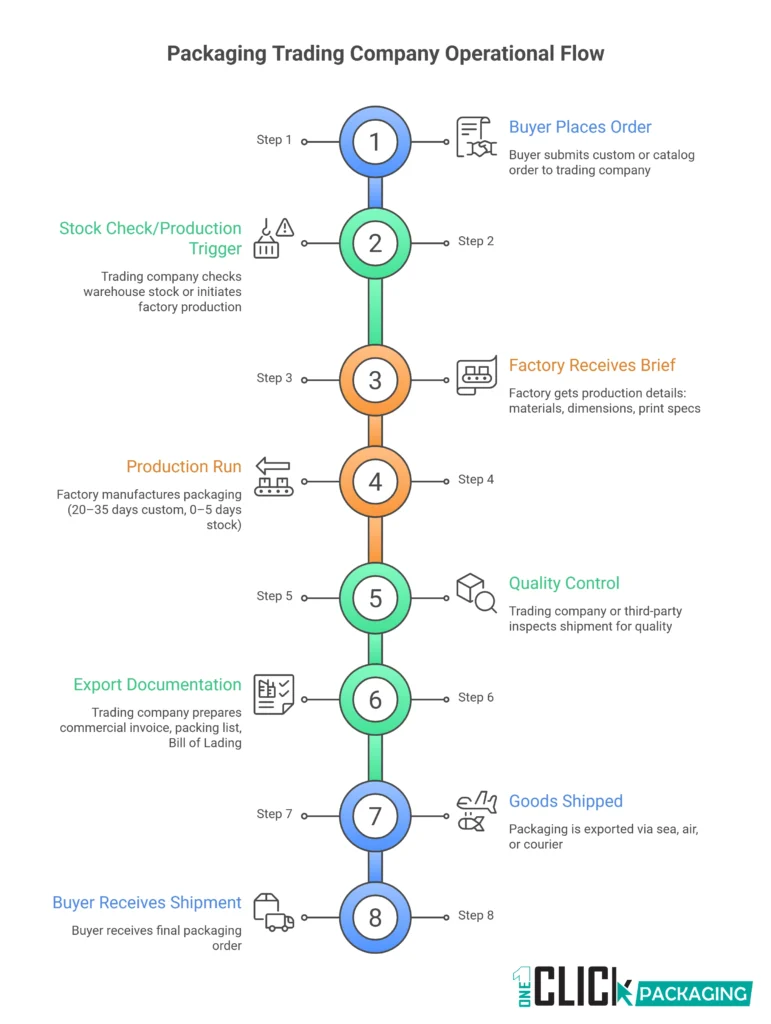
When you place an order, the trading company does one of three things. It pulls from existing warehouse stock. It places a production order with its preferred factory for that product type. Or, if volume is large enough, it takes bids from multiple factories and chooses the best margin.
This last scenario is where quality can drift. The trading company is optimizing for margin on your order. If their usual cardboard factory is backed up, they may shift your order to a secondary supplier without telling you. This is not malicious, but it is the structural reason why quality inconsistency is a more common complaint with trading companies than with direct factories.
That said, established trading companies with strong reputations run tight factory networks with documented QC processes. I have worked with Shenzhen-based trading companies that conduct monthly factory audits and share full inspection reports with buyers. Their pricing was higher than going direct, but the process reliability was worth it during early product development phases when I could not afford a failed shipment.
What a Direct Factory Actually Offers
A direct factory is a manufacturing facility that produces packaging materials on-site. When you work with them, you are placing a production order directly onto their floor, specifying materials, dimensions, finishes, and quantities, and waiting while it is made.
The case for going direct is compelling once you hit a certain order volume. Per-unit costs drop significantly. You have direct control over specifications. You can visit the facility, build a relationship with the production manager, and get your packaging made exactly the way you want it.
But the requirements are real. Most packaging factories in China set MOQs between 1,000 and 5,000 units depending on the product complexity. Custom rigid boxes can run 500 units minimum. Corrugated mailers often start at 1,000 to 2,000. Specialty printing finishes like soft-touch lamination or foil stamping may require 3,000 units to justify the setup cost.
Lead times are longer. A factory running on a production schedule is not going to bump your 2,000-unit order above a 50,000-unit repeat buyer. Standard lead times for custom packaging run 20 to 35 days from approved sample, and that does not include shipping. Compare that to a trading company pulling from warehouse stock for products like small pillow boxes, where turnaround can be as fast as 5 to 10 days.
Communication is another practical consideration. Not all factories maintain English-speaking export teams. The ones that do are often the larger exporters who have evolved into hybrid models anyway. Smaller, more specialized manufacturers may require a sourcing agent or translator to work with effectively.
Head-to-Head: Trading Company vs Direct Factory
The comparison is not just about price. It is about matching the supplier model to your actual situation: your order size, your timeline, your customization requirements, and your tolerance for supply chain complexity.
| Feature | Packaging Trading Company | Direct Factory |
| MOQ (Min. Order) | Low to Medium (can negotiate) | High (production run minimums) |
| Product Range | Wide — multiple categories | Narrow — their own lines only |
| Lead Time | Faster (stock on hand) | Longer (production schedule) |
| Pricing | Higher per unit | Lower per unit (at scale) |
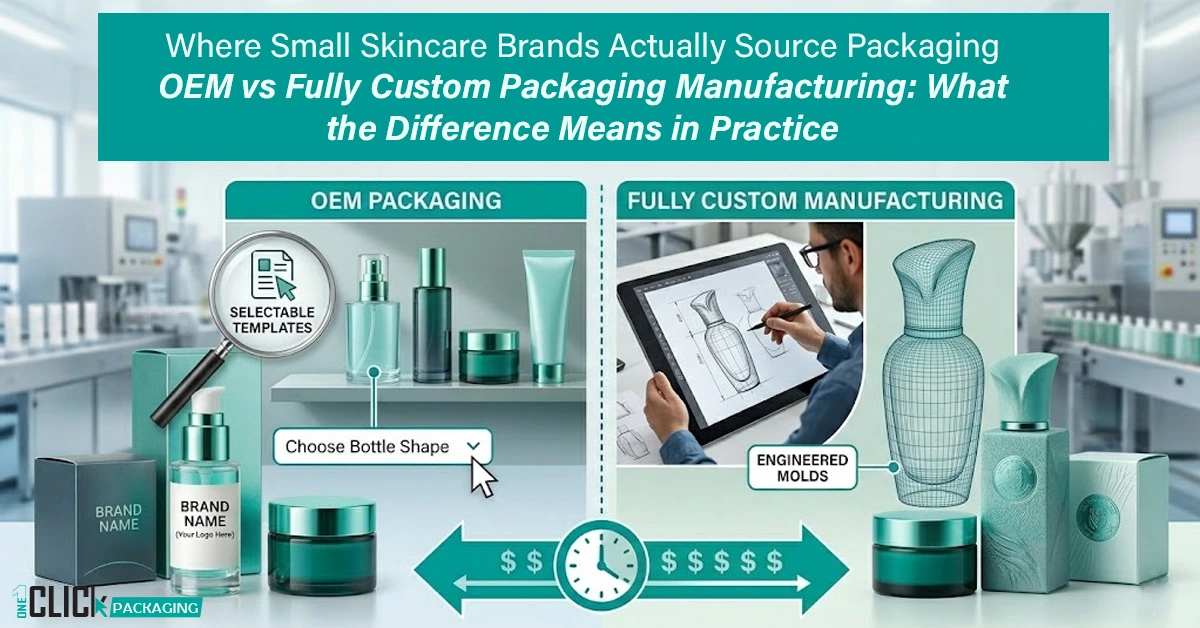
| Customization | Limited or via factory partner | Full customization available |
| Communication | English-speaking reps common | Language barriers possible |
| Quality Control | Depends on their vetting process | Direct factory oversight |
| Payment Terms | Often flexible, PayPal/T/T | Usually strict T/T or L/C |
| Sample Speed | Fast (existing stock) | Slower (custom production) |
| Risk Level | Lower for small buyers | Lower once relationship is built |
| Related Reading: direct factory vs trading company risk comparison → Direct Factory vs Trading Company: Which Supplier Model Carries Less Risk |
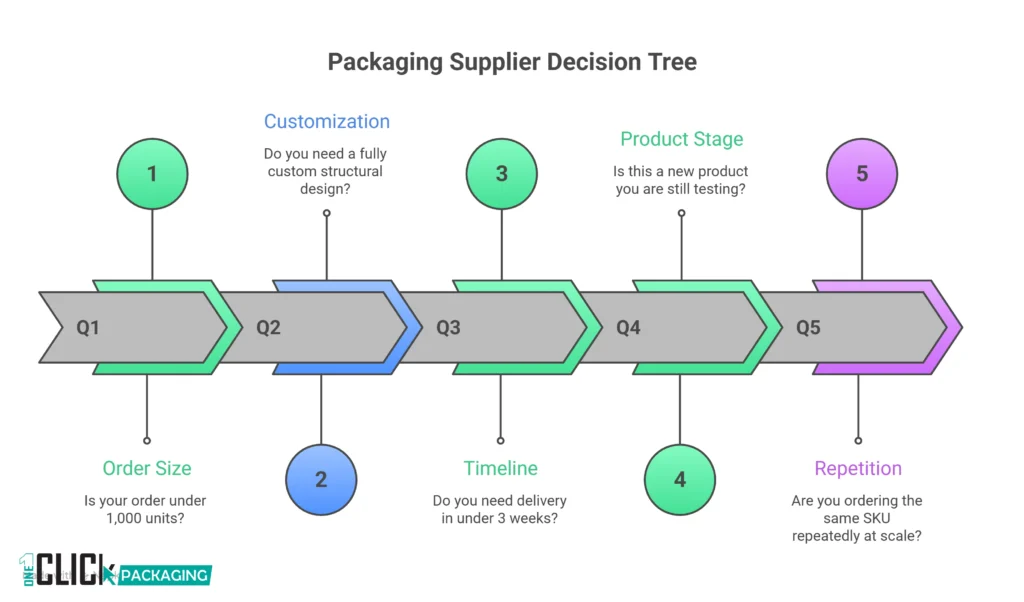
The table above gives you the framework, but the real decision depends on where you are in your business. A brand launching its first 300-unit run of custom candle boxes has fundamentally different needs than an e-commerce company reordering 10,000 shipping mailers every month.
When a Trading Company Is the Right Call
Trading companies are not the fallback for buyers who cannot find a factory. For many purchasing scenarios, they are genuinely the smarter choice.
You need small or mixed quantities
If you are ordering fewer than 1,000 units, or mixing product types in one shipment, a trading company’s warehouse model is built for you. Factories do not want small runs. Trading companies do. They make their margin by consolidating buyer demand, so your 300-unit order is part of a larger batch they are running anyway.
You are in the sampling and iteration phase
Early-stage brands often go through multiple packaging revisions, especially when developing products like cream packaging boxes before landing on a final design.Trading companies typically carry samples from existing molds and stock SKUs, which means you can test a version quickly without waiting for a full production run. I spent three months iterating on a folding carton design with a Guangzhou trading company before going direct. The sample speed alone saved significant time.
You need consolidated logistics
If your business requires packaging sourced from different product categories, say a corrugated shipper, a tissue paper insert, a poly mailer, and custom packaging labels, a trading company can consolidate those items into a single shipment. Coordinating four separate factories for a single order is a logistics headache most small buyers cannot manage efficiently.
You want managed communication without a sourcing agent
Good trading companies serve as professional intermediaries. Their export teams handle shipping schedules, customs documents, and proactive updates. This is not something you typically get from a direct factory relationship until you become a priority account.
When a Direct Factory Relationship Pays Off
At some point, if your volumes grow, the economics of direct factory sourcing become hard to ignore. The per-unit cost difference on a 10,000-unit run can be meaningful enough to justify building the relationship even if it requires more effort upfront.
The crossover point varies by product type. For relatively standard corrugated mailers, direct factory pricing often becomes competitive at around 3,000 to 5,000 units. For custom rigid boxes with specialty finishes, the economics shift sooner because setup costs are being amortized across fewer units.
Beyond cost, direct factory relationships offer something trading companies cannot: full production transparency. You see the material specs, the press setup, the quality inspection process. When something goes wrong, you have a direct line to the production manager rather than a customer service rep who is also managing the issue from a distance.
The brands I have watched make this transition most successfully did it gradually. They kept their trading company for small, urgent, or experimental orders while building a direct factory relationship for their core, high-volume SKU. The two supplier models ran in parallel rather than competing.
How to Tell If You Are Talking to a Factory or a Trading Company
On Alibaba and similar platforms, the business type is listed on every profile. But that does not tell the whole story. Many factories have trading arms, and many trading companies have factory floors for their core product lines. The classification is rarely binary.
Here are the questions that actually reveal the model.
• Ask for a factory audit report or ISO certification tied to a specific manufacturing address. Trading companies either cannot produce this or will produce a document from their supplier factory.
• Ask about their MOQ and then push it down by 50%. Factories generally hold firm or explain production minimums. Trading companies often have more flexibility because they are managing inventory, not production runs.
• Request a video walk-through of the production floor. A real factory can provide this without hesitation. A trading company will either redirect you to a stock facility or delay.
• Ask which factory produces your specific product. A trading company sourcing from multiple manufacturers may hedge on this question or give a vague answer.
• Examine the breadth of their product catalog. A single factory specializes. A catalog with 50 different packaging categories almost certainly belongs to a trading company.
None of this means you should only work with factories. It means you should know what you are working with so your expectations align with what that supplier model can actually deliver.
The Hybrid Model: When the Line Disappears
The distinction between trading company and factory is cleaner in theory than in practice. The sourcing landscape has evolved significantly in the past decade, and the most capable suppliers have often evolved into hybrid models that blur the line deliberately.
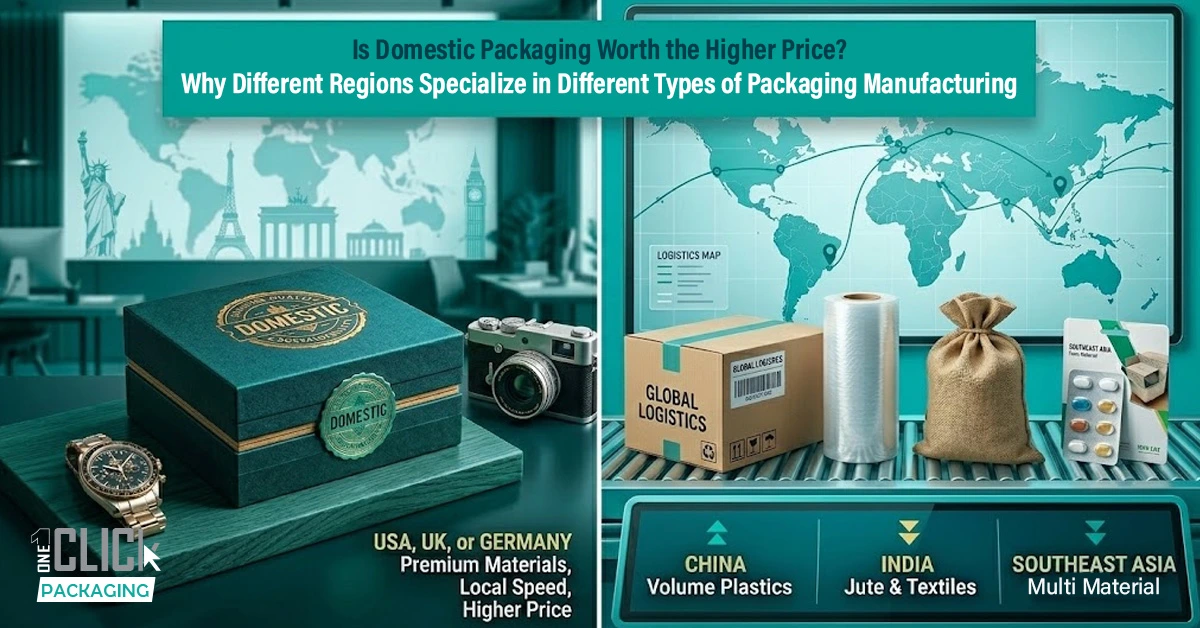
A packaging company that started as a trading operation may have acquired or invested in a factory facility to control quality on their highest-volume product lines. Their core offering is still trading, but they manufacture select items in-house. This is common among the larger Yiwu and Shenzhen-based packaging suppliers.
Conversely, factories that started as pure manufacturers have built export trading arms to reach international buyers directly without relying on separate trading companies as distributors. They have English-speaking sales teams, online catalogs, and the ability to handle small custom orders alongside large production runs.
When you find one of these hybrid suppliers, you often get the best of both models: factory-level pricing on larger runs, trading company flexibility on smaller ones, and a single point of contact who can handle both. They are worth searching for specifically, even if it takes longer to qualify them.
Price Differences and What They Actually Mean
The common assumption is that trading companies are expensive and factories are cheap. The reality is more qualified than that.
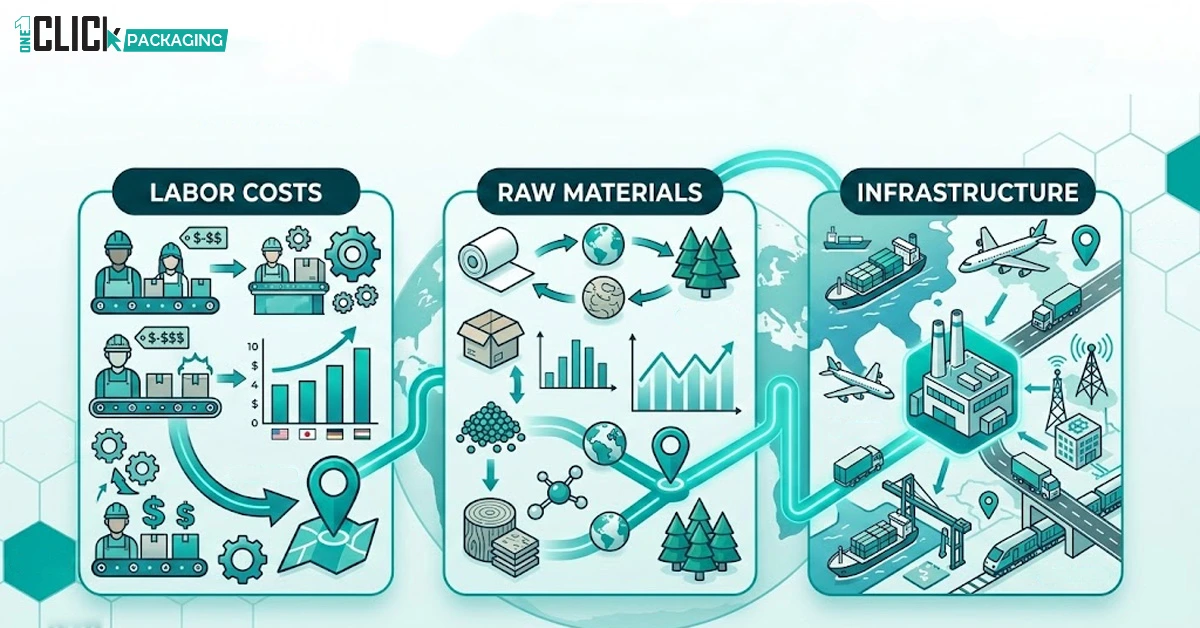
On a like-for-like product at scale, yes, a direct factory will typically undercut a trading company by 10 to 25 percent. That margin is the trading company’s markup for aggregation, inventory holding, export handling, and margin. On a 10,000-unit order, that difference is real money.
But the cost comparison changes when you factor in the full picture. Trading companies may offer faster lead times, which reduces the working capital tied up in transit. They often include quality inspection in their process. Their consolidated shipping can reduce per-unit freight costs. And their lower MOQs mean you carry less inventory risk on a new product.
I ran a cost analysis on two identical packaging orders in 2024: one through a Shenzhen trading company, one through a direct factory in Dongguan. The factory price per unit was 18 percent lower. But the minimum was 5,000 units compared to 500 through the trading company. At 500 units, the factory was not even an option. At 5,000 units, the inventory carrying cost and the risk of a first-run quality miss narrowed that 18 percent difference significantly.
Price per unit is only one variable. Total cost of sourcing, including the cost of mistakes, is the metric that matters.
Red Flags Worth Watching For
Not every trading company operates with the same standards. Some use the model’s flexibility as cover for poor quality control, inconsistent sourcing, or outright misrepresentation. These signals should prompt deeper verification.
• They cannot provide factory inspection reports or production documentation for your specific order.
• Their quoted lead time keeps shifting without clear explanation.
• They discourage or deflect requests for a pre-shipment inspection by a third party.
• Their price on a repeat order is significantly different from the first order with no material or logistics justification.
• They describe the factory as “their own” but cannot provide a manufacturing address or facility verification.
• Customer reviews mention quality inconsistency between orders, not just between suppliers.
Good trading companies are transparent about what they are and how they work. They will tell you they source from multiple factories, explain their QC process, and provide documentation without being pressed. The ones who hedge on basic questions are the ones to avoid.
The Supplier Model Is a Tool, Not a Verdict
Trading companies are not inferior to direct factories. They are a different instrument in the sourcing toolkit, suited to different stages, different order profiles, and different operational contexts. The mistake is not using one or the other. The mistake is using one when the other is clearly the better fit.
If you are in the early stages of building a product, testing packaging designs, or working with modest order volumes, a well-vetted trading company is one of the most efficient sourcing partners available. It gives you speed, flexibility, and managed logistics without requiring you to build factory relationships before you are ready.
If your business has scaled to where volume, unit economics, and production control matter at a level trading companies cannot match, the investment in a direct factory relationship starts to pay back. The transition is not a rejection of the trading model. It is a sign that your sourcing strategy has matured.
The sourcing landscape in 2025 rewards buyers who understand their own stage of business and match it to the right supplier model. Do that well, and the choice between a trading company and a direct factory stops being a gamble and starts being a strategy.
What supplier model is your business currently using, and where are you feeling the friction? That friction is usually the signal that a model transition is worth exploring.
Frequently Asked Questions
Is a packaging trading company safe to buy from?
Yes, provided you verify their track record and understand the model. Established trading companies have strong supplier networks and quality processes. The risk comes from assuming the supplier is a factory when it is not, which creates misaligned expectations about customization depth, lead time, and quality consistency. Do your due diligence the same way you would with any supplier.
What is the minimum order quantity difference between a trading company and a factory?
Trading companies typically accept orders from 50 to 500 units depending on the product. Direct factories generally start at 1,000 to 5,000 units for custom work. The gap is significant for early-stage businesses or brands in testing phases. If you are not ready to commit to factory minimums, a trading company is not a compromise; it is the right model for your stage.
Can a trading company do custom packaging?
Yes, but with limitations. Trading companies can often facilitate custom work by placing a smaller production order with their factory partner. However, their ability to customize is constrained by the factory’s minimums, tooling availability, and the trading company’s own margin requirements. Full, deeply custom work, like bespoke structural design or proprietary materials, is better handled direct.
How do I know if a supplier on Alibaba is actually a factory?
Look at the verified business type on their profile, but do not stop there. Request a factory audit report, ask for a production floor video, and check whether their catalog spans too many categories to make sense for a single manufacturer. Trading companies often have broader catalogs and more flexible MOQs. A genuine factory will usually answer production-specific questions with more precision.
Do trading companies mark up prices a lot?
Typically 10 to 25 percent above direct factory pricing on comparable products at scale. However, that markup funds services that have real value: export handling, English communication, quality inspection, flexible minimums, and faster shipping from stock. Whether that markup is justified depends on your order size and operational capacity to manage a direct factory relationship.
Is it worth going directly to a factory as a small business?
Rarely in the early stages. Factories are optimized for volume buyers, and small businesses cannot leverage that relationship without meeting MOQ requirements. Start with a reputable trading company to validate your packaging design and build order history. Once you know your core SKU is stable and your volumes are growing, explore direct factory sourcing for that specific product line.
What happens if the trading company changes factories mid-run?
This is a real risk and the most common source of quality inconsistency. A good trading company will notify you of any factory changes and provide updated quality documentation. Build this into your purchase agreement: require written notification of any factory substitution before production begins, and reserve the right to approve or reject the change.