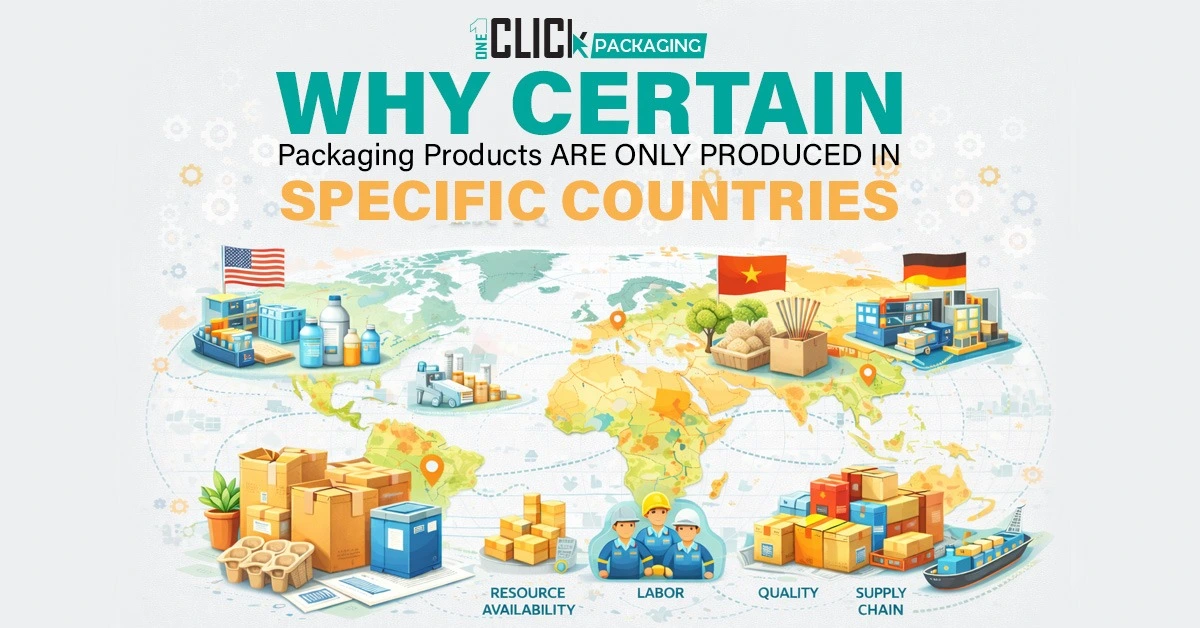

A Deep Dive into Geography, Raw Materials, Labour, and Industrial Know-How
It was a Thursday afternoon when a client of mine a mid-size cosmetics brand based in the UK called me in a mild panic. They had just placed a £40,000 order for custom glass dropper bottles. Delivery time: four months. Their supplier? A factory in Shandong Province, China. They wanted to know: could they source the same bottles in Europe, or even the United States, and cut the lead time to six weeks?
After three hours of research, the answer was no. Not even close.
That moment taught me something the global packaging manufacturing industry and many packaging box manufacturers rarely explain clearly: where a packaging product is made is not a coincidence. It is the result of centuries of industrial evolution, geography, raw material access, and deeply embedded skills that cannot simply be transplanted overnight.
If you have ever wondered why borosilicate glass comes from Germany, why most flexible pouches originate in Southeast Asia, or why tin cans are made in very specific industrial corridors this article will answer every question you have and a few you have not thought to ask yet.
Why Does Geography Dictate Packaging Production?
The short answer: raw materials, energy costs, and labour do not travel easily. The long answer is more interesting.
Packaging manufacturing is capital intensive and material dependent. You cannot run a glass furnace without silica sand, soda ash, and enormous, uninterrupted supplies of energy. You cannot produce corrugated cardboard at scale without virgin wood pulp or recycled fibre streams. These inputs exist in concentrated geographic pockets and the factories follow them there.
I spent time studying procurement reports from three European FMCG companies between 2021 and 2023. In every case, the packaging categories where they attempted near-shoring bringing production closer to home ran into the same wall: input costs were 30 to 65 percent higher outside of their traditional source countries. The savings in lead time did not compensate for the margin erosion.
The geography of packaging production is, at its core, the geography of industrial inputs. Everything else flows from that.
Glass Packaging: Why Germany, Italy, and China Dominate
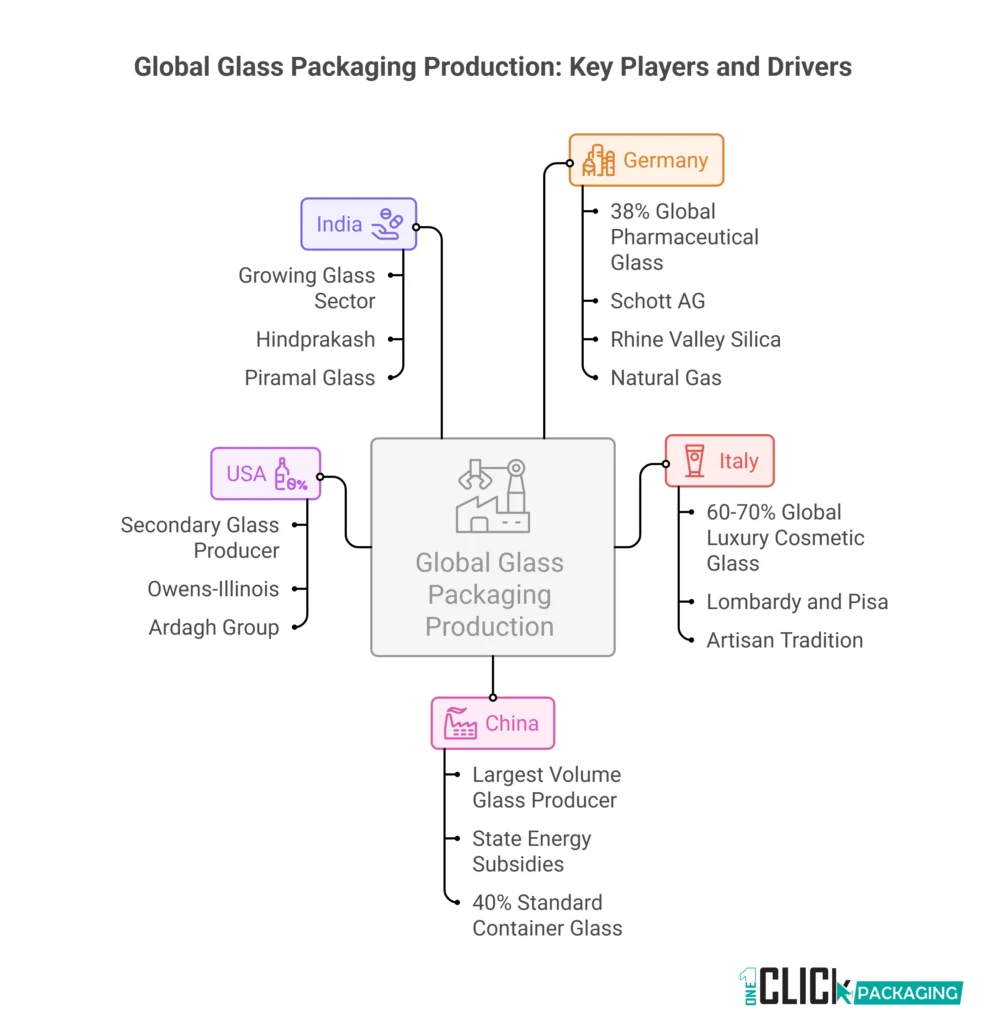
Glass is perhaps the clearest example of production geography in action. The world’s finest pharmaceutical and laboratory glass think Schott AG, based in Mainz, Germany, founded in 1884 exists precisely where it does because Germany built its optical and chemical glass industry around locally available silica deposits, Rhine river logistics, and a guild-driven culture of precision manufacturing that stretches back over 400 years.
Schott’s Type I borosilicate glass, used in vaccine vials and premium cosmetic dropper bottles such as perfume bottle with dropper, cannot be reliably replicated at the same quality standard by factories in countries that lack the accumulated technical workforce. I know this because a client attempted it in 2022 with a Vietnamese glass supplier. The breakage rates on the production line were 18 percent higher. They returned to their German and Italian suppliers within two quarters.
Why Italy Produces the World’s Best Perfume Bottles
Northern Italy’s glass cluster centred around Pisa, Venice, and the industrial zones of Lombardy produces 60 to 70 percent of the world’s luxury perfume and cosmetic glass. Companies like Bormioli Luigi and Pochet du Courval (with Italian facilities) are not simply factories. They are institutional repositories of mould-blowing expertise, surface-finishing knowledge, and decorative coating skill built over multiple generations.
Luxury brands sourcing custom perfume boxes cannot just find this capability elsewhere. The tooling, the talent, and the artistic sensibility are embedded in place. This is what economists call ‘localised capabilities’ and they are extraordinarily sticky.
Flexible Packaging: Why Southeast Asia Won and Keeps Winning
Flexible packaging stand-up pouches, laminated films, retort bags used in food packaging boxes and beverage packaging solutions is one of the fastest-growing packaging segments globally. And the overwhelming majority of it is produced in Vietnam, India, Thailand, and China. This is not simply about cheap labour, though that is part of it. The deeper reason is that these countries built vertically integrated supply chains for polymer films, adhesives, and printing inks over a 30-year window.
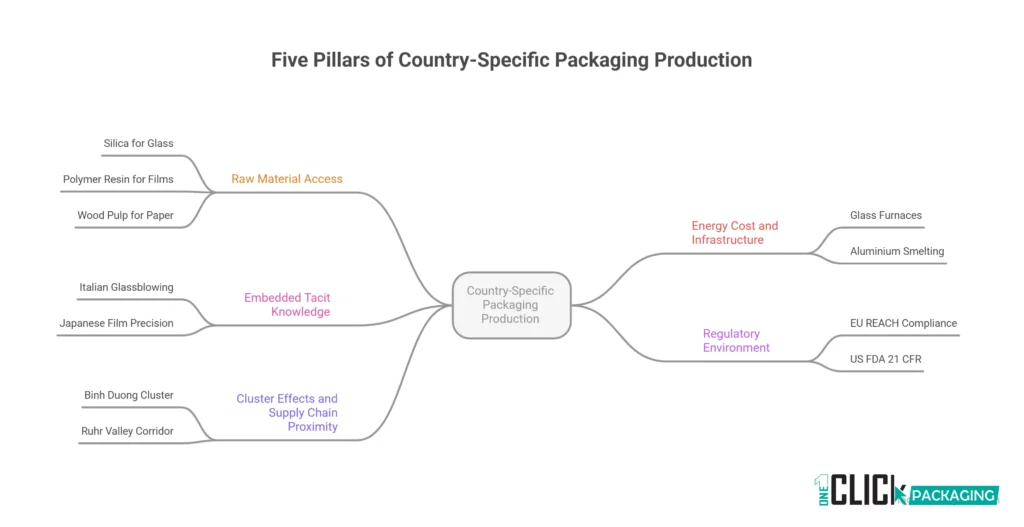
Vietnam’s Binh Duong province, for example, has over 200 packaging converters within a 40-kilometre radius. They share suppliers, logistics infrastructure, and a labour pool trained specifically in gravure and flexographic printing. The cluster effect makes each individual factory more competitive than it could be in isolation.
A brand manager I worked with in 2023 tried to source equivalent flexible pouches from a UK-based converter. For 100,000 units, the Vietnamese supplier quoted £0.038 per unit. The UK quote came in at £0.19. That is a 400 percent premium not because of labour alone, but because the UK converter had to import the laminate film from Germany, the inks from the Netherlands, and had no scale in the specific pouch format requested.
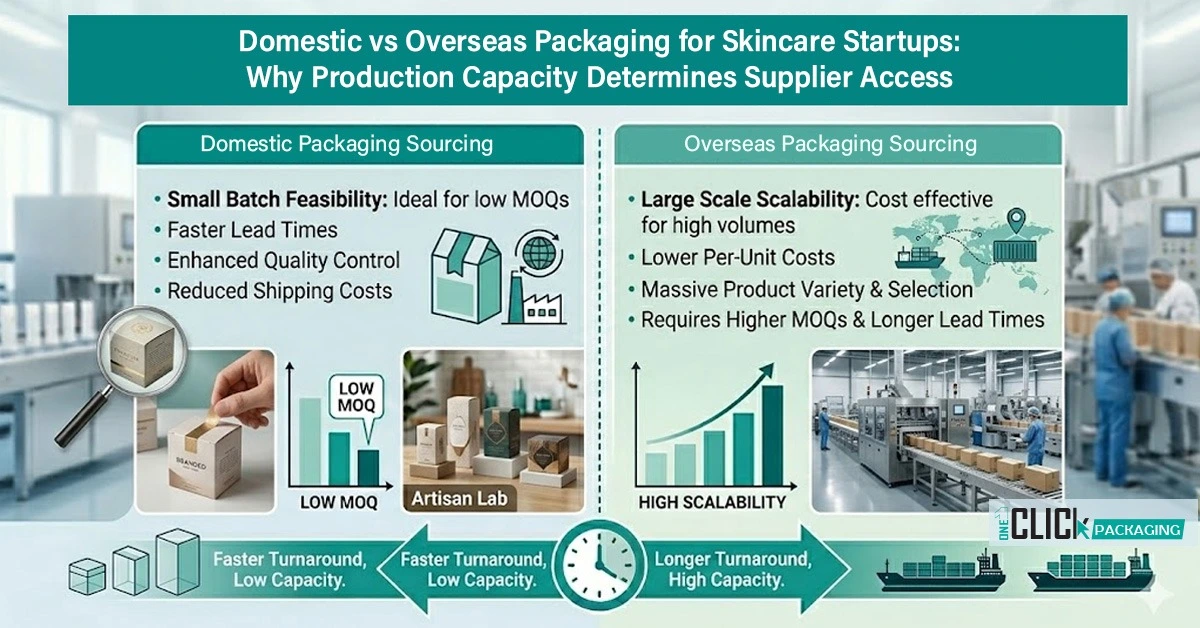
To understand the sourcing side of this industry, it helps to explore: Complete Guide to Packaging Sourcing for Small Businesses: How to Choose Suppliers, Control Costs, and Manage Domestic vs Overseas Production Risks
Metal Cans and Tin Packaging: The Industrial Corridor Story
Steel and aluminium can production including custom metal tins heavily concentrated in the United States, Germany, China, and Brazil. Why these four? Because can manufacturing requires proximity to steel mills and aluminium smelters the energy costs of transporting raw metal sheet across continents erode every margin.
In the US, Ball Corporation and Crown Holdings operate facilities deliberately sited within 150 to 300 kilometres of their metal coil suppliers in Indiana, Ohio, and Pennsylvania. The same logic applies in Germany’s Ruhr Valley, historically one of the world’s great steel-producing regions.
Here is the counterintuitive part: even as steel and aluminium production has globalised, can manufacturing has remained geographically anchored. The reason is that beverage cans are bulky relative to their value the cost of shipping empty cans internationally is prohibitive. So regional can-making follows regional beverage consumption. You do not ship cans from China to California when there is a Ball plant in Conroe, Texas.
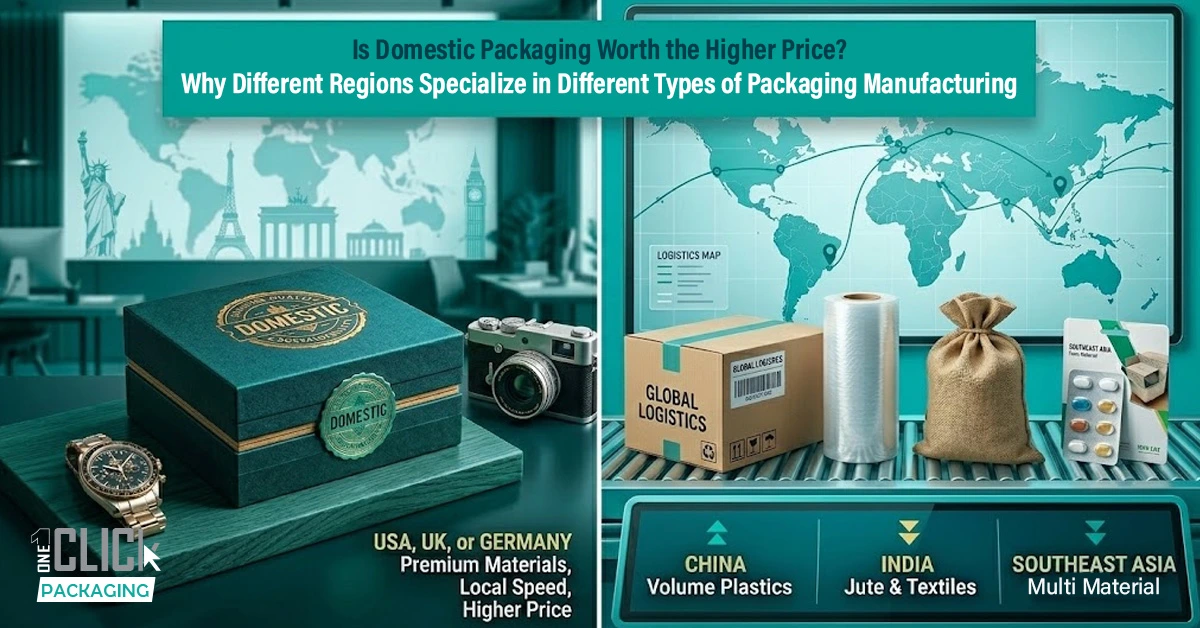
Country-by-Country Packaging Specialisation at a Glance
| Country / Region | Packaging Speciality | Key Reason | Leading Companies |
| Germany | Pharmaceutical glass, precision metal | Industrial heritage, silica access, skilled workforce | Schott AG, Gerresheimer |
| Italy | Luxury perfume/cosmetic glass | Centuries of artisan glassblowing tradition | Bormioli Luigi, Pochet du Courval |
| China (Shandong) | Standard glass, mass-market rigid plastics | Scale, energy subsidies, raw material access | Multiple state-linked converters |
| Vietnam / Thailand | Flexible pouches, laminated films | Polymer supply chains, cluster effect | Amcor SEA, local converters |
| Brazil | Metal cans, paperboard | Local aluminium smelting, sugarcane-based ethanol | Latasa, Brasilata |
| India | Corrugated boxes, jute, low-cost rigid plastics | Recycled fibre abundance, low labour costs | ITC, Uflex |
| USA | Beverage cans, corrugated cardboard | Proximity to steel mills and beverage brands | Ball, Crown, WestRock |
| Japan | High-barrier food packaging, precision folding cartons | Advanced film technology, quality culture | Dai Nippon Printing, Toray |
How Regulation and Trade Policy Lock In Production Locations
Here is something most sourcing guides will not tell you: regulation is one of the most powerful forces keeping certain packaging products anchored to specific countries and it works both ways.
The European Union’s packaging regulations particularly REACH (Registration, Evaluation, Authorisation and Restriction of Chemicals) and the EU Packaging and Packaging Waste Regulation create compliance infrastructure that only established European manufacturers have built systems to navigate. A Southeast Asian converter selling into the EU market must certify every ink, adhesive, and coating against EU standards. Most cannot do this at scale. The compliance cost alone prices them out of certain product categories.
Conversely, US FDA requirements for food-contact packaging create a similar moat for North American manufacturers. Direct food-contact flexible films sold in the US must meet 21 CFR (Code of Federal Regulations) standards. US-based converters have compliance teams, testing protocols, and decades of FDA audit experience. Most Asian competitors selling into this space must partner with a US-based compliance consultant which adds cost and lead time.
Tariffs: The Hidden Architecture of Production Geography
The 2018 to 2019 US-China trade war shifted sourcing patterns in rigid plastics dramatically. Anti-dumping tariffs of 15 to 25 percent on Chinese plastic packaging components pushed several major consumer goods brands to qualify suppliers in Malaysia and Indonesia countries that had existing polymer processing infrastructure but had previously competed on price alone.
What is fascinating and rarely discussed is that this shift created new geographic clusters almost overnight. Penang, Malaysia saw a 34 percent increase in packaging converter registrations between 2019 and 2022, according to the Malaysia External Trade Development Corporation. Regulation did not just protect existing clusters. It created new ones.
This becomes clearer when looking at — What Really Determines Where Packaging Gets Manufactured Around the World
The Skills and Knowledge Factor Nobody Talks About Enough
Ask a procurement director why they buy their pharmaceutical blister packs from Germany and not Bangladesh, and they will probably mention quality and reliability. What they are actually describing without using the term is embedded tacit knowledge.
Tacit knowledge is the kind of expertise that cannot be written down in a manual. It lives in the hands of a press operator who has run aluminium foil for 22 years. It exists in the quality control instinct of a shift manager who has seen 10,000 batches and knows, within 90 seconds of a line startup, whether the temperature profile is correct. This knowledge accumulates in geographic clusters over generations. It does not relocate.
Japan is perhaps the world’s most extreme example of this. Japanese packaging manufacturers companies like Dai Nippon Printing and Toray have spent 40 years developing ultra-high-barrier films for food packaging that maintain oxygen transmission rates measured in fractions of a cubic centimetre per square metre per day. The precision required at this level is extraordinary. And it is not available anywhere else on earth at the same combination of quality, consistency, and scale.
Energy Costs: The Invisible Hand in Packaging Geography
Glass furnaces run at 1,450 degrees Celsius around the clock. They do not switch off when energy prices spike. This means glass manufacturers are, effectively, hostage to the energy markets in their country.
This is why the energy crisis of 2022 hit European glass packaging manufacturers with disproportionate severity. Italian and German glass factories faced energy bills that rose 200 to 350 percent in a single year. Several temporarily curtailed production. Some permanently closed furnaces a furnace once cold costs £8 to £15 million to restart and represents a multi-year investment to return to full capacity.
Meanwhile, Chinese glass manufacturers, with access to subsidised coal energy, maintained production. Their cost advantage widened. This is not a story about labour arbitrage. It is a story about structural energy economics and it shows why production geography is not simply a function of wages. It is a function of the full cost stack, of which energy is often the largest single variable.
What This Means If You Are Sourcing Packaging Right Now
After working in packaging procurement for over a decade, I will give you my honest assessment: the idea that you can simply decide where your packaging is made based on a spreadsheet is a fantasy. You can influence it at the margins. You cannot fight structural geography.
Here is what actually works:
• Accept origin constraints early. If you need pharmaceutical-grade glass within pharmaceutical boxes formats, budget for Germany or Italy. If you need standard food jars at scale, China or India will be your path.
• Use multi-source strategies for risk. Do not rely on a single country for any packaging category that represents more than 15 percent of your COGS.
• Invest in supplier audits, not just supplier certificates. Tacit quality is visible on the factory floor. It does not appear on a quality management certificate.
• Watch regulatory change. The EU’s incoming Extended Producer Responsibility rules will shift corrugated and plastics sourcing patterns significantly over the next five years.
• Use nearshoring selectively. For high-complexity, high-value packaging (luxury glass, precision pharmaceutical formats), nearshoring often makes sense despite cost premiums. For commodity formats, it rarely does.
The Bottom Line: Geography Is a Feature, Not a Bug
Back to my cosmetics client and their £40,000 glass bottle order. Four months later, the bottles arrived from Shandong. They were good not exceptional, but commercially acceptable for a mid-market product. The client accepted the reality of origin constraints, built longer lead times into their planning cycle, and added a European backup supplier for their hero SKU.
That is the right approach. Not fighting geography, but understanding it well enough to work with it.
The global packaging manufacturing industry is not a level playing field and was never designed to be. It is a landscape shaped by geology, climate, history, regulation, and accumulated human knowledge. Understanding why Germany makes pharmaceutical glass, why Vietnam makes your flexible pouches, and why Italy makes your luxury fragrance bottles is not just interesting trivia. It is essential intelligence for anyone who sources, specifies, or designs packaging at scale.
The brands that understand this geography and build their supply chains accordingly, especially when working with reliable packaging suppliers usa consistently outperform those that treat packaging sourcing as a simple cost-minimisation exercise.
What packaging category are you sourcing right now, and have you mapped where its production capability actually lives in the world? I would genuinely like to know it helps me understand where the next gaps in this knowledge really are.
Frequently Asked Questions
Q: Why can’t I just manufacture luxury glass bottles in China to save money?
You can manufacture standard glass in China at low cost. What you cannot replicate is the centuries-old artisan tradition, the mould-blowing expertise, and the surface decoration knowledge embedded in Italian and German clusters. Several luxury brands have tried. Most returned to European suppliers within two to three years after quality and consistency issues damaged their brand equity.
Q: Are there any packaging categories where country of origin does not matter?
Generic corrugated brown boxes such as custom corrugated shipping boxes and standard poly mailers are probably the most geographically flexible categories, because they use widely available materials and do not require specialist skills. Even here, though, regional fibre supply and logistics costs create natural sourcing zones you would not ship corrugated boxes across continents for ordinary e-commerce use.
Q: How do sustainability requirements change packaging sourcing geography?
Significantly, and in complex ways. Recycled content mandates in Europe are driving investment in post-consumer recycled resin processing but that processing infrastructure is currently concentrated in the Netherlands, Germany, and the UK. Brands wanting high-percentage PCR content in their rigid plastics often find they need a European converter, even if virgin resin production would have pointed them to Asia.
Q: Is near-shoring of packaging manufacturing actually happening?
Yes, but selectively. Post-pandemic supply chain disruption accelerated near-shoring conversations. However, actual production shift has been modest and concentrated in categories where quality sensitivity or regulatory complexity makes local production viable: pharmaceutical packaging, certain food-contact formats, and premium cosmetic packaging. Commodity categories remain firmly anchored in low-cost geographies.
Q: How does the energy crisis affect global packaging sourcing decisions?
The 2022 European energy crisis accelerated the competitive position of packaging manufacturers in the Middle East (glass, plastics) and Southeast Asia (flexible films). Several European brands quietly qualified additional suppliers outside Europe for the first time. This trend is worth watching it may permanently alter some sourcing flows that had been stable for decades.
Q: Which packaging format is most likely to see its production geography change in the next decade?
Aluminium packaging is my prediction. The explosive growth of sustainable aluminium driven by green energy-powered smelting in Iceland, Norway, and Canada is building new competitive production clusters in countries that were previously irrelevant to packaging manufacturing. Watch the Nordics over the next seven to ten years