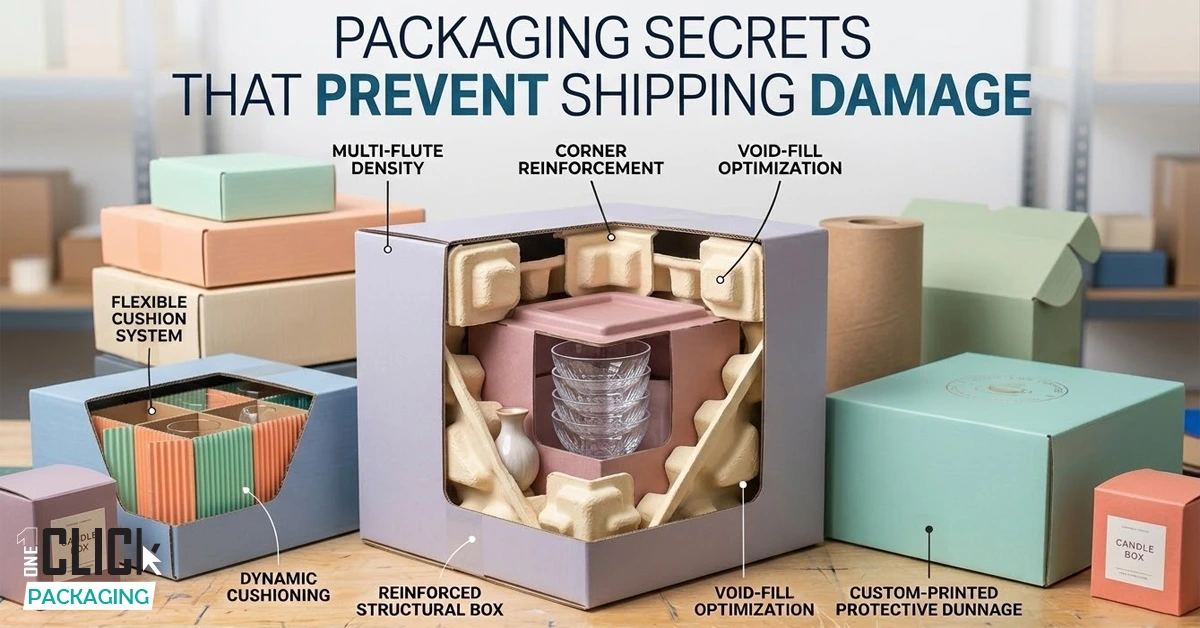

A 15% damage rate. That is what one kitchenware brand was quietly absorbing before we looked at their corrugated box spec. The box fit the product. The price was right. But the board grade was wrong for the route, and nobody had ever told them that one detail made all the difference.
Corrugated packaging, especially when comparing packaging box manufacturers, looks simple from the outside. It is not. The right box, chosen for the right reasons, can cut shipping damage claims by 80% or more. The wrong box, chosen on price alone, becomes a recurring cost that never shows up on a single invoice but quietly drains every month.
These are the corrugated packaging factors that actually matter when your product is in transit and you are not there to protect it.
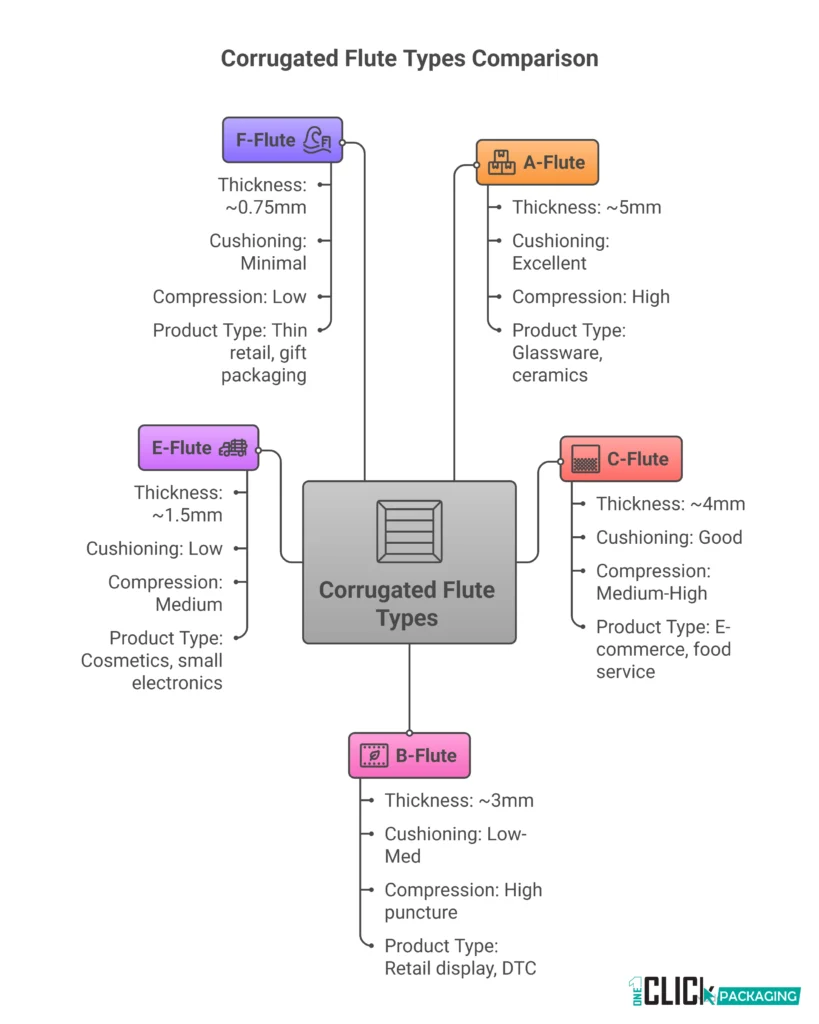
Choose the Right Flute for Your Product Weight and Fragility
The flute is the arched, wave-shaped layer inside corrugated board. Its size and shape determine how the box absorbs compression, impact, and stacking force. Most buyers never ask about flute type. That is a costly oversight.
| Flute | Thickness | Best For |
| A-Flute | ~5mm | Fragile goods, glassware, ceramics |
| C-Flute | ~4mm | General e-commerce, food service (most common) |
| B-Flute | ~3mm | Retail display, branded DTC, canned goods |
| E-Flute | ~1.5mm | Cosmetics, small electronics, premium unboxing |
C-flute is the default for most brands and works well for moderate-weight products. But it has a real weakness: concentrated point force punches through it easily in hat shipping boxes. If your product shifts inside the box, C-flute is not protecting it. For fragile or high-value items, A-flute or a double-wall construction is a far better choice.
The ECT Number on Your Box Bottom Actually Matters
Every corrugated box sold in the US carries a certification stamp. It shows either a Mullen Burst rating or an Edge Crush Test (ECT) rating. For shipping and stacking, the ECT number is the one that matters.
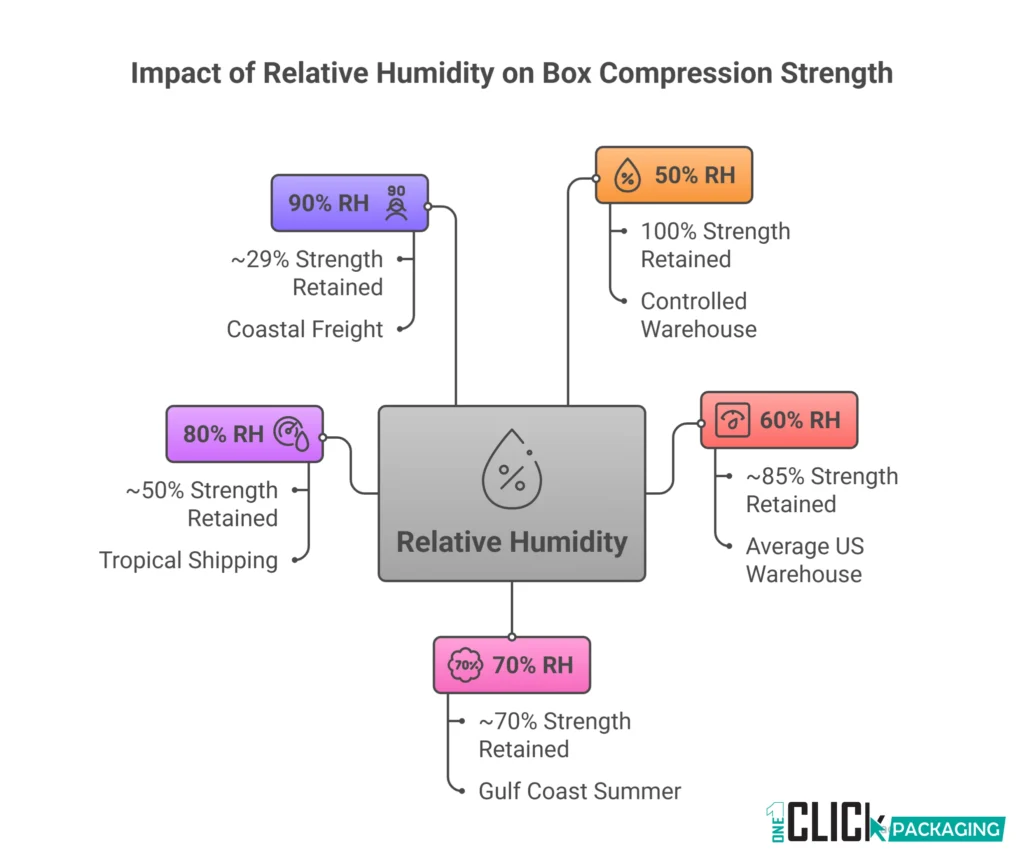
ECT measures how much vertical force the box edge can resist before buckling in vape cartridge packaging boxes. A 32 ECT box holds 32 lbs of force per linear inch of edge. That sounds solid. Under 80% humidity, it holds closer to 16 lbs. That is the gap most brands do not account for.
| Practical ECT GuideUnder 30 lbs product weight: 32 ECT single-wall minimum. Over 50 lbs or stacked on pallets: 44 ECT double-wall. High-humidity routes (Gulf Coast, tropics, monsoon regions): spec up one tier above your calculated minimum. |
Single-Wall Is Not Always Enough. Here Is When to Upgrade.
Single-wall C-flute handles most standard e-commerce shipments. But it has a stacking strength ceiling that drops fast in humid conditions. Double-wall BC-flute, which combines a B and C flute layer with three liner sheets, dramatically increases both compression resistance and puncture protection.
One client shipping cast iron cookware, common in auto parts packaging, switched from single-wall to double-wall boxes.Damage claims dropped from 8.3% to 1.1% in 90 days. The box cost increase was $0.42 per unit. The prior average damage cost was $28 per claim. The decision was obvious in hindsight. It always is.
Upgrade to double-wall when: your product weighs over 30 lbs, ships on pallets, travels through high-humidity regions, or gets stacked more than three boxes high in transit.
Moisture Destroys Box Strength Faster Than Any Drop Impact
This is the most underestimated threat in corrugated packaging. A TAPPI industry study found that corrugated board at 90% relative humidity loses up to 71% of its compression strength within 24 hours. Summer freight through the Gulf Coast, Southeast Asia, or any coastal route routinely hits those humidity levels.
Four practical ways to fight moisture damage:
• Upgrade to moisture-resistant liner: kraft-polyethylene laminate liners on high-humidity routes.
• Poly-bag products individually: creates a moisture barrier regardless of box condition.
• Stretch-wrap pallets: reduces ambient moisture exposure at freight docks and outdoor dwell.
• Limit corrugated storage time: do not store finished boxes more than 30 days in uncontrolled warehouse conditions.
| Kraft board dominates packaging for moisture resistance and tensile strength. Read: Why kraft packaging became the standard material for protective shipping → Why Kraft Packaging Became the Go To Material for Brands |
Seal the Box Right or Undo Everything Else You Did
A single strip of tape down the centre seam is the most common packing method in fulfilment. It is also one of the most common failure points in transit. Under drop impact, the unsealed ends of a single-strip seal fail first. The box opens. The product moves. The claim follows.
The H-tape method fixes this at zero additional cost beyond tape. Apply one strip down the centre seam, then one strip across each end perpendicular to the first. This creates an H shape on the top and bottom of every box. Seal strength increases roughly three times compared to a single strip.
For products over 40 lbs, replace standard polypropylene tape with filament reinforced tape rated at 100-lb tensile strength. Brands like 3M and Intertape Polymer Group make cold-temperature rated versions that maintain adhesion below 40 degrees Fahrenheit, which standard tape does not.
Three Changes That Reduce Shipping Damage Immediately
1. Add two inches of cushioning on all six interior faces, not just the sides. Products dropped vertically hit the top and bottom first. Most packers protect the sides and leave the top bare. Fill every face.
2. Switch to the H-tape method on every outbound box starting today. No new materials required. Just a different taping pattern. This single change eliminates the most common cause of boxes opening in transit.
3. Check your ECT rating against your actual shipping environment, not ideal lab conditions. If you ship to humid regions or stack more than three boxes high, your current box is almost certainly underspec. Moving up one ECT tier costs pennies per box and saves dollars per claim.
| Understanding how brands choose packaging materials across product types gives you a broader decision framework. Read: Packaging materials guide: what leading brands use to protect products → Packaging Materials Guide: What Brands Use to Protect Products |
The Box Is Part of the Product Experience
A damaged shipment is not just a cost. It is a broken brand promise, especially in premium jewelry packaging. The customer ordered something. What arrived was not what they expected. That moment is hard to recover from regardless of how good your returns process is.
The corrugated box variables covered here, flute type, ECT rating, board construction, moisture resistance, and seal method, are all knowable and fixable. None of them require expensive tooling or minimum order commitments to improve. They require knowing what to look for and making the change.
Start with one: pull the box you currently ship in, read the ECT number on the bottom, and compare it to the actual weight and humidity conditions your product travels through. That single check will tell you whether your packaging is protecting your product or just containing it.
What packaging change made the biggest difference in your shipping damage rate? Share it in the comments.
Frequently Asked Questions
What corrugated box is best for heavy products?
Double-wall BC-flute board with a 44 ECT rating is the standard starting point for products over 30 lbs. It combines two flute layers for stronger compression resistance. Pair it with full-overlap bottom flaps (FOSL style) to distribute load evenly across the base rather than concentrating it on the flap gap.
How do I know if my box ECT rating is strong enough?
Take your product weight and multiply it by 1.5 as a baseline compression requirement. Then reduce that number by 40% to account for humidity and stacking conditions. The result is the minimum ECT you need. A 20 lb product needs a box that holds at least 30 lbs, reduced to an effective 18 lbs in humid conditions, meaning a 32 ECT is just barely adequate. A 44 ECT gives you real safety margin.
Does bubble wrap inside a corrugated box actually help?
It helps for cushioning impact, but it does not prevent product movement. The real goal is immobilising the product so it cannot shift toward the box wall. Bubble wrap works when combined with adequate void fill on all six faces in cookie shipping boxes. A die-cut corrugated insert does the job better because it locks the product in position without relying on compression-sensitive fill materials.
Why does my tape keep failing in winter shipments?
Standard polypropylene tape loses adhesion below 40 degrees Fahrenheit. Most fulfilment operations use general-purpose tape year-round without realising it is rated for controlled temperatures only. Switch to cold-temperature acrylic tape, available from 3M and Intertape Polymer Group, for shipments travelling through cold regions between November and March.
Is it worth paying more for a premium corrugated box?
Run the numbers on your current damage rate. If you are absorbing 3% or more damage claims, upgrading your box almost always pays back immediately. A $0.50 increase per box that eliminates a $25 average damage claim at 3% frequency saves $0.75 per unit shipped. The math is rarely close. The better box wins every time once you calculate real damage cost per shipment.