Every skincare founder eventually runs into the same packaging problem.
You want a serum box that looks premium. You want custom colors, a perfectly fitted insert, perhaps foil stamping or soft-touch finishing. Then you request quotes and discover that the supplier offering the most attractive unit price wants a much larger order than your brand can realistically use.
Meanwhile, a domestic supplier may accept a smaller run, but the price per unit is higher.
This is where many founders ask the wrong question:
Is domestic or overseas packaging cheaper?
The better question is:
Which packaging supply chain can my current production volume actually support?
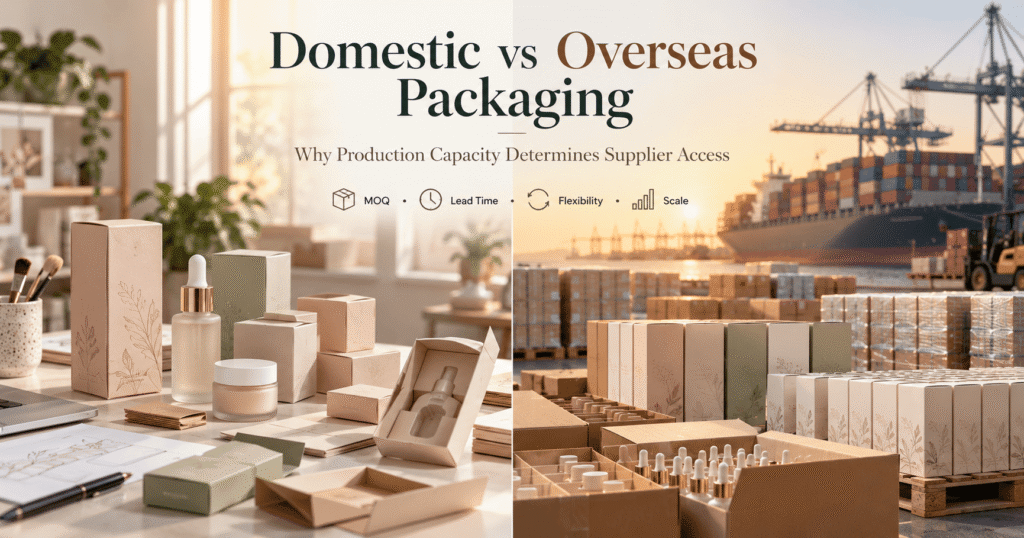
For an indie skincare startup, production capacity often determines which suppliers are accessible long before aesthetics or unit price enter the discussion.
Understanding that relationship can help you avoid tying up cash in excess inventory, delaying launches, or choosing packaging that does not match your stage of growth.
For a broader look at packaging sourcing models, see our guide to OEM vs fully custom packaging for small skincare brands.
Why Production Capacity Determines Packaging Supplier Access
Packaging manufacturers are businesses built around production efficiency.
Every custom packaging order can require setup, artwork preparation, printing plates or tooling, machine calibration, material allocation, finishing, quality checks, packing, and freight coordination.
Those costs exist whether a factory produces 500 units or 50,000 units.
That is why suppliers establish minimum order quantities, or MOQs.
From the manufacturer’s perspective, MOQ helps spread setup costs across enough units to make the production run commercially viable.
From the founder’s perspective, however, MOQ can become a major barrier.
Imagine that your skincare company currently sells 600 units of a moisturizer every month.
A supplier offering an attractive box price may require several thousand units of the same design. Suddenly, you are not simply buying packaging. You are committing months of cash to inventory before knowing whether your sales volume, branding, formula, or regulatory artwork will remain unchanged.
This is why supplier access tends to expand as production capacity grows.
A startup producing small batches usually needs flexibility.
A mature brand producing predictable volumes can prioritize scale.
Your sourcing strategy should reflect where the business is today, not where you hope it will be two years from now.
Overseas Packaging: Where Economies of Scale Become Powerful
Overseas manufacturing can be highly attractive once order volumes become large enough.
Factories operating at scale may have access to specialized machinery, broad material selections, extensive finishing capabilities, and manufacturing economics that lower the cost per unit as volume increases.
This is the basic advantage of economies of scale.
A skincare company ordering large quantities of the same folding carton may spread setup costs across far more units than a company ordering a short domestic run.
That can significantly change unit economics.
However, the lower unit price is only one part of the calculation.
Advantages of Overseas Packaging
Overseas suppliers can be attractive because they may offer:
- Lower unit costs at larger quantities
- Broad customization options
- Specialized manufacturing capabilities
- Custom structures and tooling
- Large-scale printing capacity
- Access to premium finishing techniques
- Better economics for stable, high-volume SKUs
For established skincare brands with predictable demand, those advantages can be meaningful.
If you know that you will sell tens of thousands of units of the same serum or moisturizer packaging, a high-volume manufacturing strategy may make financial sense.
Challenges of Overseas Packaging
The problems usually appear when a young brand tries to access those economics before its sales support them.
Common challenges include:
- Higher MOQs
- Larger upfront cash commitments
- Longer manufacturing and shipping cycles
- International freight costs
- Customs and import coordination
- Less flexibility when artwork changes
- More inventory to store
- Greater financial exposure if demand changes
Lead time becomes particularly important.
Packaging manufactured overseas does not only need production time. It also has to travel through an international supply chain.
Freight delays, customs clearance, port congestion, documentation issues, or production scheduling can affect the final in-hand date.
That does not make overseas manufacturing a bad option. It simply means founders should evaluate landed cost and replenishment risk, not just the factory’s quoted price per box.
Domestic Packaging: Paying More for Flexibility
Domestic packaging suppliers often compete on a different advantage: agility.
For an early-stage skincare company, flexibility can be more valuable than the absolute lowest unit price.
A domestic supplier may be easier to communicate with, may support smaller production runs, and may offer shorter replenishment cycles depending on the project.
This can reduce the amount of cash locked into packaging inventory.
Advantages of Domestic Packaging
For startups, domestic sourcing can offer benefits such as:
- Lower or more manageable MOQs
- Faster communication
- Easier sampling and revisions
- Shorter supply chains
- Faster replenishment potential
- Less exposure to international freight disruption
- Greater flexibility for packaging changes
This is particularly useful during the first stages of a brand.
Your formula may change.
Your branding may evolve.
Retailer requirements may change.
Your legal or regulatory information may need updating.
Even something as simple as changing the product volume from 30 ml to 50 ml can make existing packaging unusable.
Holding a smaller quantity of packaging gives you more room to adapt.
The Tradeoff: Higher Unit Cost
The tradeoff is usually price.
A smaller domestic production run may have a higher cost per box because manufacturing setup costs are being distributed across fewer units.
However, founders should be careful about treating a higher unit price as automatically more expensive.
Suppose one supplier offers a lower price but requires you to purchase far more packaging than you can use within a reasonable period.
The apparent savings may disappear once you consider:
- Storage
- Cash tied up in inventory
- Packaging redesigns
- Obsolete stock
- Freight
- Damaged inventory
- Forecasting errors
For startups, cash efficiency can matter more than unit-cost efficiency.
MOQ Should Be Viewed as a Cash Flow Decision
Founders often treat MOQ as nothing more than a supplier restriction.
It is better viewed as a financial commitment.
Before accepting a packaging MOQ, calculate how long it will realistically take your company to use that inventory.
For example, if you order six months of packaging, ask what could change during those six months.
Could you redesign the brand?
Could the product formula change?
Could a retailer require different information?
Could sales slow down?
Could you launch a new bottle?
Could you discontinue the SKU?
Packaging inventory becomes risky when it outlives the assumptions under which it was ordered.
This is especially important for printed skincare cartons because they may contain product-specific information that makes them difficult to repurpose.
Custom Packaging Becomes Easier as Production Volume Grows
As your volume increases, your options usually expand.
A startup may begin with an existing container and a custom label.
The next stage might introduce a professionally printed folding carton.
Later, the company may justify custom inserts, unique structures, premium finishes, or even proprietary packaging components.
That progression is normal.
Trying to jump immediately to the most customized manufacturing model can create unnecessary financial pressure.
If you are still deciding what level of customization makes sense, our guide to packaging box styles explains how folding cartons, rigid boxes, sleeves, mailers, and other structures fit different brand positions.
For skincare products such as serums, moisturizers, and cosmetics, tuck end boxes can be a practical starting structure because they combine printable surface area with relatively efficient construction.
Premium collections may eventually justify rigid packaging when the price point and customer experience support the additional packaging investment.
Domestic vs Overseas Packaging: A Practical Decision Framework
Instead of asking which sourcing method is universally better, evaluate your brand against five factors.
Your Monthly Production Volume
How many finished products are you actually producing and selling?
Use real sales data rather than optimistic forecasts.
If a supplier’s MOQ represents a very long period of inventory, the lower unit price may not justify the commitment.
Demand Predictability
A stable bestseller is easier to source in larger quantities than a newly launched SKU.
The more predictable demand becomes, the easier it is to take advantage of larger production runs.
Available Working Capital
Packaging should not consume money needed for formulation, inventory, fulfillment, advertising, or customer acquisition.
A lower unit price is not helpful if meeting the MOQ creates a cash-flow problem.
Packaging Stability
Ask how likely the artwork, bottle, formula, product size, or regulatory copy is to change.
If changes are likely, smaller runs reduce the risk of obsolete inventory.
Replenishment Lead Time
Calculate when you need to reorder.
Do not wait until the final few boxes remain.
International sourcing usually requires more planning because production, freight, customs, and delivery all need to fit into the replenishment timeline.
For material-specific decisions, review our Packaging Materials Guide before locking in a structure.
When Domestic Packaging Usually Makes More Sense
Domestic sourcing is often worth considering when a skincare brand is:
- Launching its first product
- Testing customer demand
- Frequently changing packaging
- Producing smaller batches
- Short on storage space
- Working with limited cash
- Preparing a temporary or seasonal SKU
- Testing a new retailer or market
At this stage, flexibility has real economic value.
Paying slightly more per unit can be worthwhile if it prevents you from purchasing thousands of boxes that may later become obsolete.
When Overseas Packaging Becomes More Attractive
Overseas manufacturing becomes more compelling as volume becomes predictable.
It may be worth evaluating when:
- Sales are stable
- Reorder quantities are consistently large
- Artwork is unlikely to change
- Cash flow can support larger purchases
- Storage capacity is available
- Forecasting is reliable
- Longer replenishment timelines are manageable
At that point, economies of scale can begin working in your favor rather than against you.
The goal is not to become an overseas buyer as quickly as possible.
The goal is to reach the point where larger manufacturing runs improve your economics without creating excessive inventory risk.
A Hybrid Strategy Often Works Best
Domestic and overseas sourcing do not have to be mutually exclusive.
Many growing brands benefit from using different approaches for different purposes.
For example, a company could use larger manufacturing runs for its stable hero products while using shorter-run packaging for new launches or seasonal SKUs.
This provides scale where demand is predictable and flexibility where it is not.
A hybrid sourcing strategy can also reduce dependence on a single supply chain.
The correct balance changes as the business grows.
Match Your Packaging Strategy to Your Growth Stage
There is no universal winner in the domestic vs overseas packaging debate.
For an early skincare startup, a higher-priced domestic package may be the financially smarter option if it preserves cash and allows smaller orders.
For a growing brand with reliable demand, larger overseas production runs may unlock much stronger unit economics.
The key is production capacity.
Your packaging supplier should match the volume your business can realistically produce, sell, store, and finance today.
Do not build your supply chain around the company you hope to become.
Build it around your current operation, then expand your supplier options as demand proves itself.
One Click Packaging helps brands develop custom packaging around their product dimensions, materials, printing requirements, and growth stage.
When you are ready to evaluate your next packaging run, request a custom packaging quote with your product dimensions, target quantity, artwork, material preferences, and finishing requirements.
Prefer to discuss your sourcing strategy first? Book a packaging consultation with One Click Packaging to talk through your production volume, packaging requirements, and next stage of growth.