
The Email That Changes Everything
You spent three weeks comparing Alibaba listings. You shortlisted four suppliers in Guangzhou and Yiwu. You even had a sample shipped from a supplier offering custom packaging boxes for new skincare brands. The packaging looked great. The price was a fraction of what a domestic supplier quoted. You were ready to pull the trigger.
Then the email came back: ‘Our minimum order quantity is 10,000 units per SKU. Can you confirm?’
If you’re a skincare founder in your first year of operation, that email is a wall. Not a hurdle. A wall.
Here’s the truth nobody puts in those ‘how to source packaging’ YouTube videos: overseas manufacturers are not refusing you because of your product. They are refusing you because of your production capacity. More specifically, because of theirs. And the two are deeply, structurally connected in ways that take most founders two or three expensive mistakes to fully understand.
This article is my attempt to save you those mistakes. We’ll go deep on why domestic and overseas packaging suppliers serve completely different production realities, why capacity is the invisible gatekeeper at every tier of the supply chain, and how you can actually use that knowledge to sequence your sourcing strategy correctly from day one.
What MOQ Actually Means (and Why It Has Nothing to Do With Your Budget)
Every founder I’ve talked to approaches MOQ as a negotiation problem. If I can just convince them, offer to pay upfront, maybe even send a Wechat message in Mandarin. It’s a reasonable instinct. But it misses the actual mechanics.
MOQ is not a preference. It’s an engineering constraint.
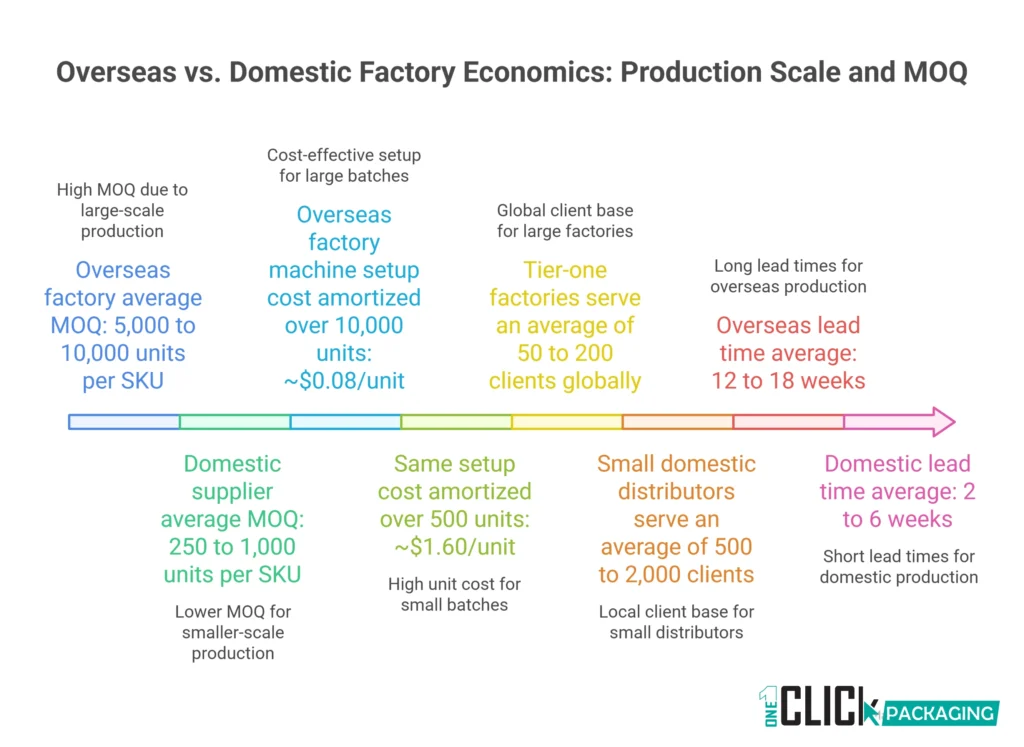
When a factory in Dongguan quotes you 5,000 units as their minimum for a custom glass serum bottle, that number reflects the economics of their production setup. The mold setup time, the machine changeover, the ink mixing for your specific color, the quality inspection batch size, the container shipping unit economics. Below a certain quantity, the factory physically cannot recover its fixed costs. They are not being difficult. Their machinery runs at scale or it doesn’t run profitably.
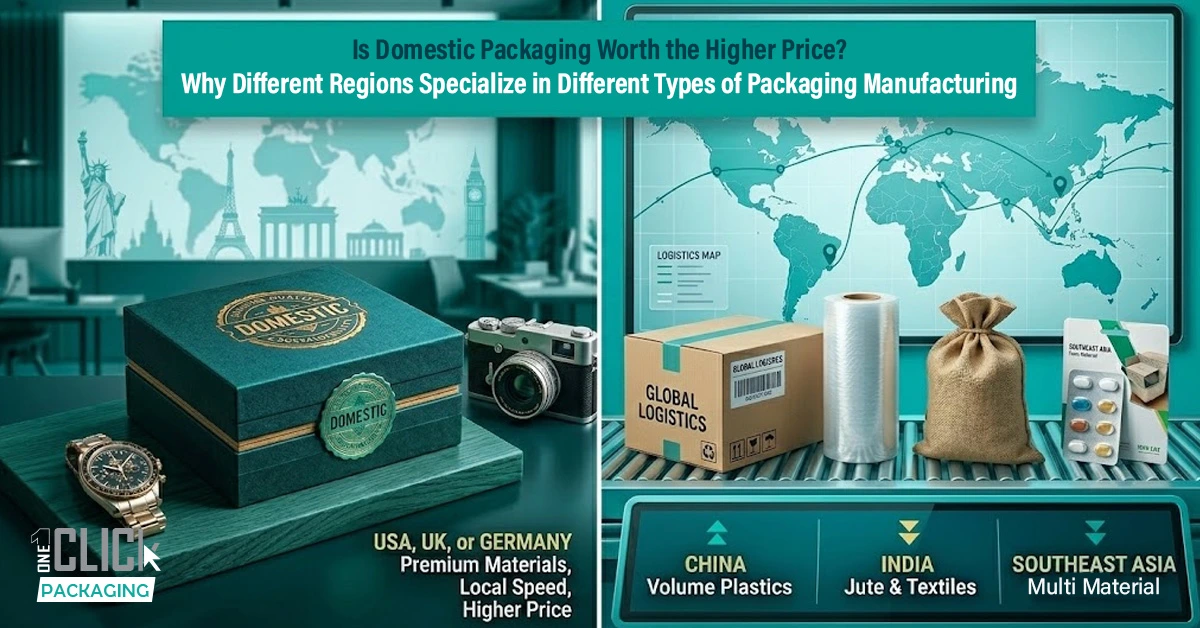
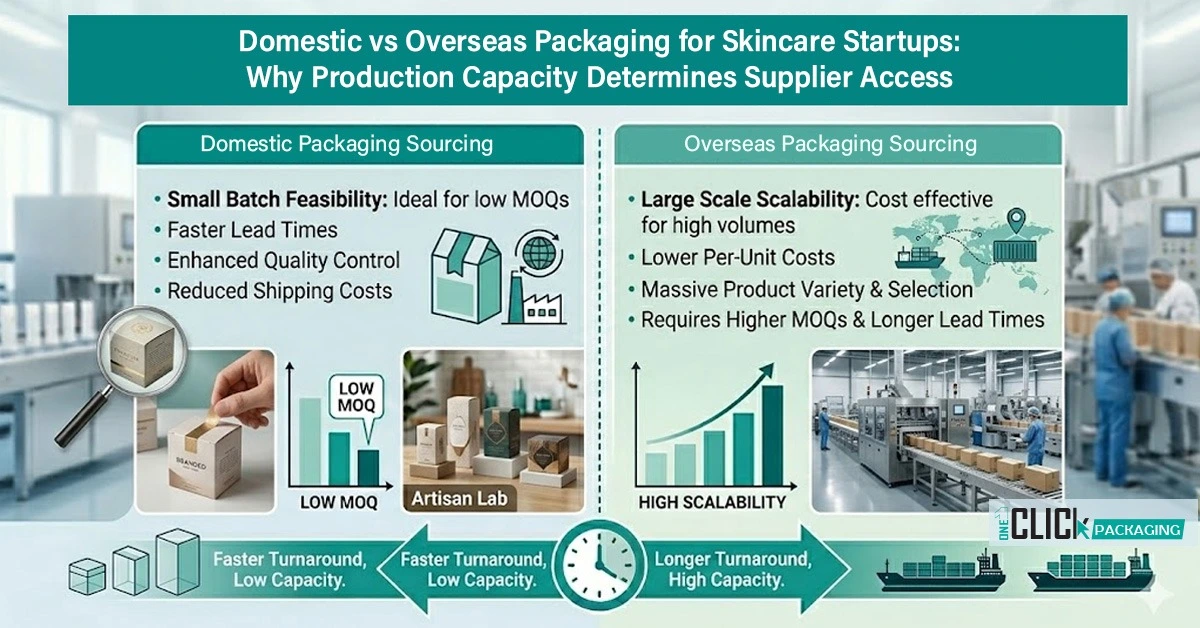
Domestic suppliers operate different equipment, different factory floor economics, and often different business models entirely when producing cosmetic packaging boxes for smaller beauty brands. A US-based packaging supplier running shorter production runs on flexible equipment can quote you 250 units and still make money. That’s not because they are more generous. It’s because their cost structure is designed for it.
If you’re trying to understand how MOQ fits into the bigger picture of working with suppliers, it helps to look at the broader process behind packaging sourcing decisions.
The mistake most founders make is treating MOQ as the only variable. It’s actually the output of a much larger equation involving factory capacity utilization, machine setup cost amortization, and minimum batch sizes for raw materials. Understanding that changes everything about how you approach a product packaging supplier conversation.
Why Overseas Factories Are Built for Volume and Nothing Else
China’s packaging manufacturing infrastructure was not built to serve indie beauty brands. It was built to serve L’Oreal, Estee Lauder, Unilever. Factories in Yiwu, Guangzhou, and Dongguan operate at scale because their entire cost model depends on it.
A factory running injection molding equipment at 70% capacity to serve major global brands has very little incentive to retool for 1,000-unit runs from a startup in Austin producing lotion packaging boxes for skincare lines. The margin per unit doesn’t justify the disruption to their production scheduling.
This is not cynicism. This is factory economics.
When you understand that most Chinese packaging suppliers are optimizing for production efficiency, not customer diversity, the MOQ issue becomes a lot less personal. It’s systemic. The factories that will work with you at low volumes are not the ones producing for Sephora. They’re smaller operations, often with older equipment, less quality certification, and more willingness to take on experimental clients. That’s a real trade-off.
I’ve spoken with three founders who tried to ‘sweet-talk’ tier-one Chinese suppliers into lower MOQs by offering to pay 100% upfront, sometimes $15,000 to $25,000. In two of those cases, the factory accepted the money, produced a partial run, and cited ‘supply chain issues’ for the rest. The founders got half their order and a lesson in supplier psychology.
Volume is the language of overseas factories, especially when producing custom makeup packaging for global cosmetic brands. Until you speak it fluently, you will be working with factories that serve your tier, not the tier you aspire to.
The Domestic Supplier Advantage Nobody Talks About
Here is the thing about domestic US packaging suppliers that gets overlooked in every cost comparison article: their real advantage is not price. It is access.
When you’re at 250 to 2,000 units per SKU, domestic suppliers will talk to you. They will send samples. They will take your calls. They will allow you to iterate on components without reprinting tooling fees. That access has an economic value that never shows up in cost-per-unit spreadsheets.
Brands like Versed, Youth to the People, and Glow Recipe all started with relatively modest packaging runs. Many of their early-stage founders have mentioned in interviews the value of being able to rapidly prototype with suppliers who were willing to work at their actual current scale.
The domestic supplier relationship also gives you something else: data. When you’re iterating on your formula, your packaging needs to evolve with it, especially when testing formats like cream packaging boxes for skincare formulations. A domestic partner who can turn around revised samples in two weeks versus 10 weeks is not just faster. That founder compresses her learning cycle by months. That has compounding value on your product development roadmap.
Supply chain disruptions can also affect packaging costs and timelines. Learn more about global manufacturing capacity shortages.
Domestic suppliers do cost more per unit. Sometimes significantly more. A glass dropper bottle that costs $0.18 from a Guangzhou supplier might run $0.55 from a US distributor. At 500 units, that’s a $185 difference. At 50,000 units, it’s a $18,500 difference. The math changes completely with scale, which is the whole point.
What Production Capacity Really Means for Supplier Access
Let me be very direct about something: your ability to access a given tier of supplier is directly determined by your demonstrated production capacity, not your projected capacity. Factories do not finance your growth aspirations when you’re sourcing items like custom mascara packaging at very small production volumes. They service your current volume.
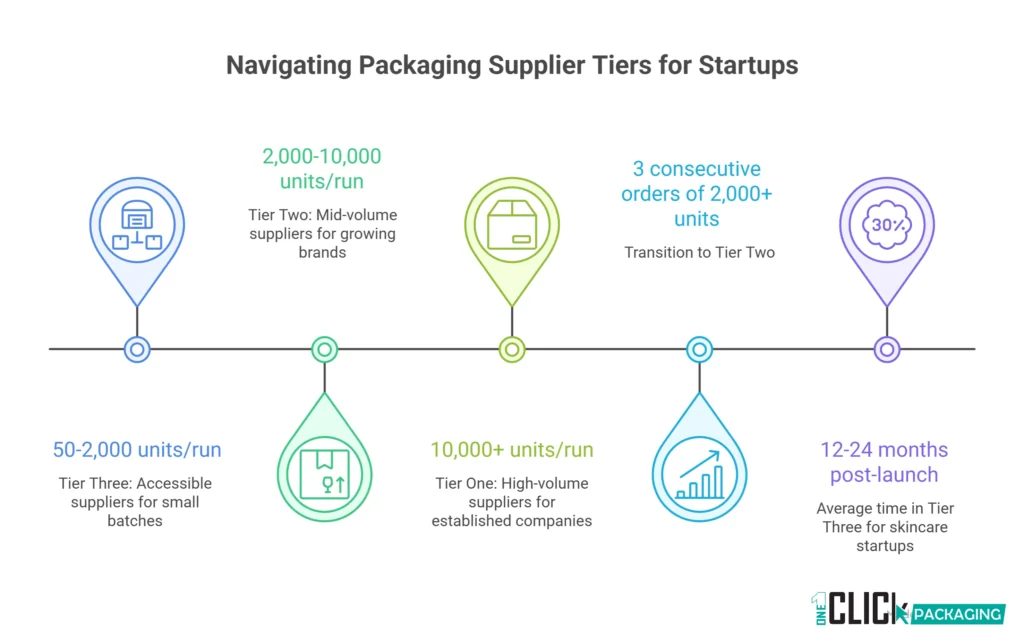
There are roughly three supplier tiers for skincare packaging, and most founders learn about them the hard way.
Tier One: Global-Scale Manufacturers
These are factories producing for the top 50 beauty conglomerates. Think ABA Packaging, Albea, RPC Group. Their MOQs typically start at 10,000 units and go up. Communication goes through account managers who manage $1M+ client accounts. They will not return emails from a brand doing under $500K in annual revenue. Not because they’re rude. Because it’s not their business model.
Tier Two: Mid-Scale Manufacturers and Distributors
This is where a brand moving 2,000 to 10,000 units per SKU per run starts to gain real access. Companies like Berlin Packaging, SKS Bottle, TricorBraun operate in this range. They work with growing brands, offer some customization, and have account managers who will engage meaningfully. This is the tier most successfully funded indie brands operate in between Series A and their first big retail deal.
Tier Three: Small-Run Specialists and Domestic Distributors
This is where most startups begin, and where they should begin. US-based companies like Fillmore Container, Alibaba’s domestic distributors, and indie packaging houses serve the sub-2,000-unit world. Their per-unit costs are higher, their customization is more limited, but they will talk to you. They will ship in two weeks. They are built for your scale.
Domestic vs Overseas Packaging: A Direct Comparison
| Factor | Domestic Suppliers | Overseas Suppliers |
| MOQ | 50–500 units typical | 1,000–10,000 units typical |
| Lead Time | 2–6 weeks | 8–20 weeks |
| Unit Cost | Higher per unit | Lower per unit (at volume) |
| Production Capacity | Limited; good for small runs | Massive; scales rapidly |
| Communication | Easy; same time zone | Challenging; language/time gaps |
| Quality Control | Easier to visit and audit | Requires third-party audit |
| Customization | Flexible, faster iteration | Slower; tooling costs apply |
| Minimum Relationship Threshold | Low; accessible at startup scale | High; requires volume proof |
Note: Lead times reflect averages as of early 2025 and may vary based on factory location, shipping method, and current global supply conditions.
Why Overseas Factories Say No (Even When You’re Willing to Pay)
This catches a lot of founders off guard. You’ve found a factory. You’ve got $20,000 to spend. You’re ready to commit. And they still won’t work with you. Why?
Because your order doesn’t fit their production schedule. An overseas factory running at 80% capacity for established clients has to disrupt their workflow to take on a small new account. The machine changeover, the new material procurement, the quality documentation for a new client. All of that has a cost that your order doesn’t cover.
There is also a risk calculus happening that most founders don’t see. New clients, especially from overseas, are high-risk from the factory’s perspective. Do they pay on time? Are their specs clear? Will there be endless revisions? Will they leave after one order?
Established clients who order 50,000 units quarterly are predictable, especially when producing items like lip gloss packaging boxes.They are worth protecting. A new startup ordering 2,000 units once is unpredictable. That uncertainty has a price.
Global disruptions can also shift packaging production and supplier availability. Learn how global events disrupt packaging manufacturing and supply networks.
I’ve heard founders say ‘but I have the money right now.’ That’s not the point. Factories optimize for reliable, recurring demand. A one-time payment from an unknown brand doesn’t change their capacity math.
The Hidden Cost of Going Overseas Too Early
Let me walk you through a real pattern I’ve seen repeated across multiple skincare startups.
A founder sources overseas because the per-unit cost is dramatically lower. She commits to 5,000 units of a packaging component. Lead time is 14 weeks. While waiting, she discovers her formula needs adjustment and the cap doesn’t seal properly with the revised fill. She now has 5,000 units of packaging she can’t use and a 14-week wait to restart.
Total cost: the packaging order itself (roughly $4,000 to $8,000), plus 14 weeks of lost time at a critical stage of brand development. If she’d used a domestic supplier at 500 units and paid 40% more per unit, she would have caught the issue in week three and pivoted without catastrophic loss.
The lesson isn’t that overseas sourcing is bad. It’s that it’s bad for iteration. Once your formula is locked, your packaging specs are tested and proven, and your volume justifies the MOQ, overseas sourcing is often the right move. But that inflection point comes later than most founders expect.
The founder who sequences this correctly builds a domestic-to-overseas transition plan tied to volume milestones, not budget availability. That’s a meaningful strategic difference.
How to Build a Sourcing Strategy That Matches Your Actual Scale
Here is the framework I’d recommend to any skincare founder thinking about packaging sourcing from the beginning.
Stage One: Proof of Concept (Under 1,000 Units Per Run)
Work domestically. Use small-run specialists. Accept the higher per-unit cost as R&D expense, not COGS. Your goal at this stage is learning, not margin. Test your packaging with real customers. Identify any failures in real-world conditions. Nail your specs. At this stage, the speed of iteration is worth more than the savings on unit cost.
Stage Two: Early Commercial Scale (1,000 to 5,000 Units Per Run)
This is where a hybrid approach often makes sense. Domestic for your hero SKUs that need ongoing formula refinement, and potentially a carefully vetted overseas partner for your core packaging components that are fully locked. Begin building overseas supplier relationships now, even if you’re not ordering yet. The relationship lead time is as real as the production lead time.
Stage Three: Scaling for Retail (5,000 Units and Up)
Now overseas makes strategic sense. You have proven demand. Your specs are locked. Your volume justifies the MOQ. At this point, overseas cost savings translate directly into margin improvement that funds your marketing and retail expansion. This is when the math that looked attractive in year one actually works.
Your sourcing strategy also needs to account for global supply disruptions. Learn how global events disrupt packaging manufacturing and supply networks.
The Real Vetting Process for Overseas Suppliers at Scale
When your volume does justify an overseas move, vetting is not optional, particularly when producing custom eyeliner boxes for retail distribution. The internet is full of horror stories from founders who found a supplier on Alibaba, placed a $15,000 order, and received packaging that was off-color, off-spec, and delivered six weeks late.
Here’s a minimum viable vetting process that actually works.
• Request a factory audit report, or hire a third-party auditor (QIMA and Bureau Veritas both offer this service, typically $300 to $600 per audit).
• Ask for the supplier’s top three existing clients and their order volume range. Tier-two and tier-three suppliers will tell you. Tier-one factories won’t need to.
• Order a paid sample run at 50 to 100 units before committing to any MOQ. If they refuse a paid sample, walk away.
• Negotiate payment terms: 30% deposit, 70% on delivery. Any supplier insisting on 100% upfront on your first order is a red flag.
• Ask specifically about their current production lead time and queue. Supply chain events can extend lead times by 40% to 60% without warning.
The best overseas partnerships I’ve seen from skincare brands started with a sourcing agent who had an existing relationship with the factory. Companies like Gembah or Sourcify serve this function for early-stage brands. The agent cost, typically 5% to 10% of the order value, is usually worth it when you’re making your first major overseas commitment.
Force Majeure Is Not a Strategy: Why Supply Chain Resilience Requires Domestic Backup
This is the part most sourcing articles don’t cover, because it requires admitting something uncomfortable: your overseas supplier is always one global event away from being temporarily inaccessible.
COVID-19 demonstrated this at scale. Port congestion added 6 to 10 weeks to trans-Pacific shipping times in 2021 and 2022. Factory shutdowns in Yiwu and Guangzhou during lockdowns created supply gaps that lasted months. Brands with no domestic backup supplier had to pause launches. Brands with domestic relationships, even at higher per-unit cost, kept their supply chains moving.
The 2021 Suez Canal blockage was six days long. It disrupted global shipping schedules for weeks. The 2023 Red Sea shipping rerouting added 12 to 14 days and 15% to 20% cost increases to most Asia-to-Europe-to-US shipping lanes. These are not black swans. They are recurring structural risks.
A sourcing strategy that assumes smooth overseas supply chain operation is not a strategy. It’s a hope. Build a domestic backup relationship for your top two or three SKUs, especially if you rely on formats like eyeshadow packaging boxes in your beauty product range. Yes, it costs more per unit. Yes, it takes management bandwidth. The alternative is explaining to your retail buyer why you can’t fill their purchase order.
The Real Question Is Not Where. It’s When.
The domestic versus overseas debate in skincare packaging and custom packaging solutions is not actually a debate about quality or cost. It’s a debate about timing. Both sourcing options are valid. Both serve real needs. The problem is that founders consistently try to access the option that matches their budget aspirations instead of the one that matches their current production reality.
Overseas factories are not gatekeeping. They are just optimized for a scale that most early-stage brands haven’t reached yet. Domestic suppliers are not inferior. They are purpose-built for the scale you’re actually at when you’re building proof of concept.
The founders who get this right treat domestic sourcing as a foundation, not a consolation prize. They extract every bit of learning they can at small domestic runs. They get their specs locked. They build their volume. Then, when they walk into an overseas conversation with 5,000-unit run history and clear specs, they’re no longer a startup asking for favors. They’re a real customer.
That transition, from ‘please take a chance on us’ to ‘here’s our spec sheet and our order forecast,’ is the whole game. And production capacity, yours and your supplier’s, is what drives every move on that board.
What stage is your brand at right now? And is your sourcing strategy actually built for that stage, or the stage you’re hoping to get to?
Frequently Asked Questions
Can I negotiate MOQ with an overseas supplier?
Sometimes, but not often, and usually not on your first order. MOQ negotiation is more realistic once you’ve placed two or three orders and established payment reliability. Some suppliers will lower MOQ if you accept standard (non-custom) packaging options. If negotiating, offer to pay 100% upfront on a first order and propose a specific growth trajectory.
What is the realistic minimum investment to start sourcing overseas?
For a serious first overseas order with legitimate vetting, budget $8,000 to $20,000 depending on your SKU count and component types. Below that, the per-unit economics rarely justify the added complexity, lead time, and risk versus a domestic supplier.
Do domestic packaging suppliers in the US allow full custom branding at low MOQs?
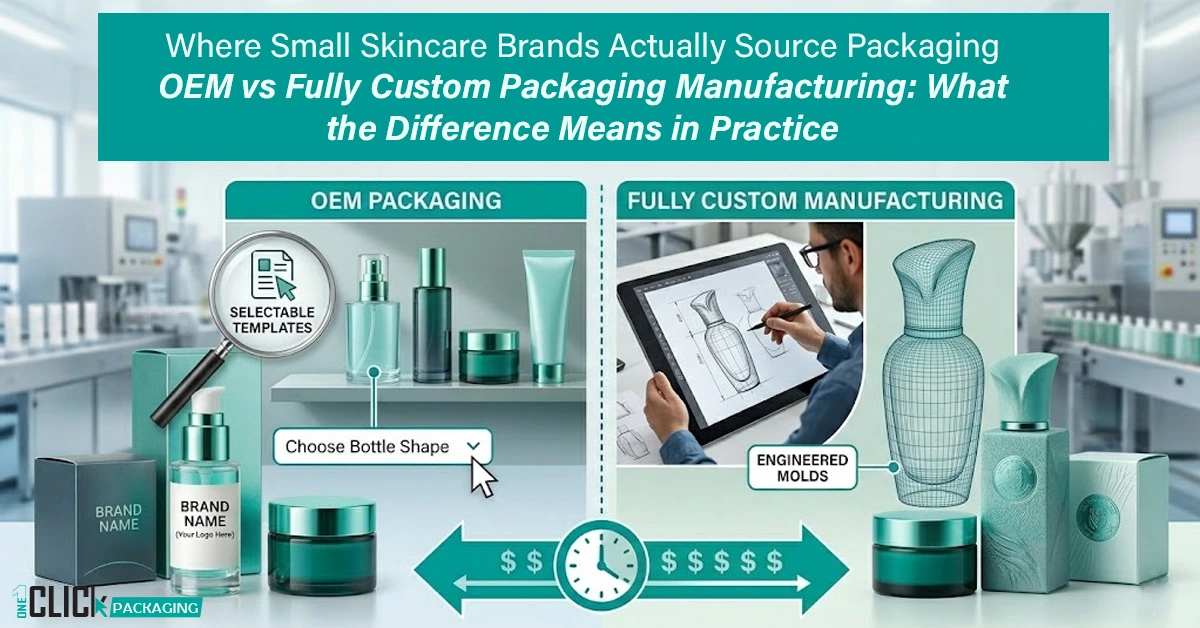
Most domestic suppliers offer stock shapes with custom labeling at low MOQs (250 to 500 units). True custom tooling for unique mold shapes typically requires 2,000 units minimum even domestically, and tooling fees of $1,500 to $5,000. The fastest path to a distinctive look at low MOQ is custom decoration on stock shapes, not custom molds.
How do I find small-run domestic packaging suppliers?
SKS Bottle, Fillmore Container, Alibaba US distributors, and regional packaging shows like HBA Global Expo are solid starting points. Indie Beauty Expo vendor floors are also excellent for discovering specialty packaging suppliers who work with emerging brands specifically.
What triggers the shift from domestic to overseas sourcing?
Typically, a combination of three factors: your formula is fully locked and tested, your volume per SKU per run consistently exceeds 3,000 to 5,000 units, and your cash flow can absorb a 14 to 20-week capital commitment without disrupting operations. All three need to be true simultaneously before the overseas math actually works in your favor.
Is it possible to use overseas suppliers from the beginning if my launch quantity is high?
If you’re launching with 10,000 units or more, overseas sourcing may work from day one, but only if your specs are fully developed and tested beforehand. Many founders in this position have worked with a domestic supplier for sampling and prototyping, then transitioned the full production run overseas. Skipping the domestic sampling stage is where costly mistakes happen.