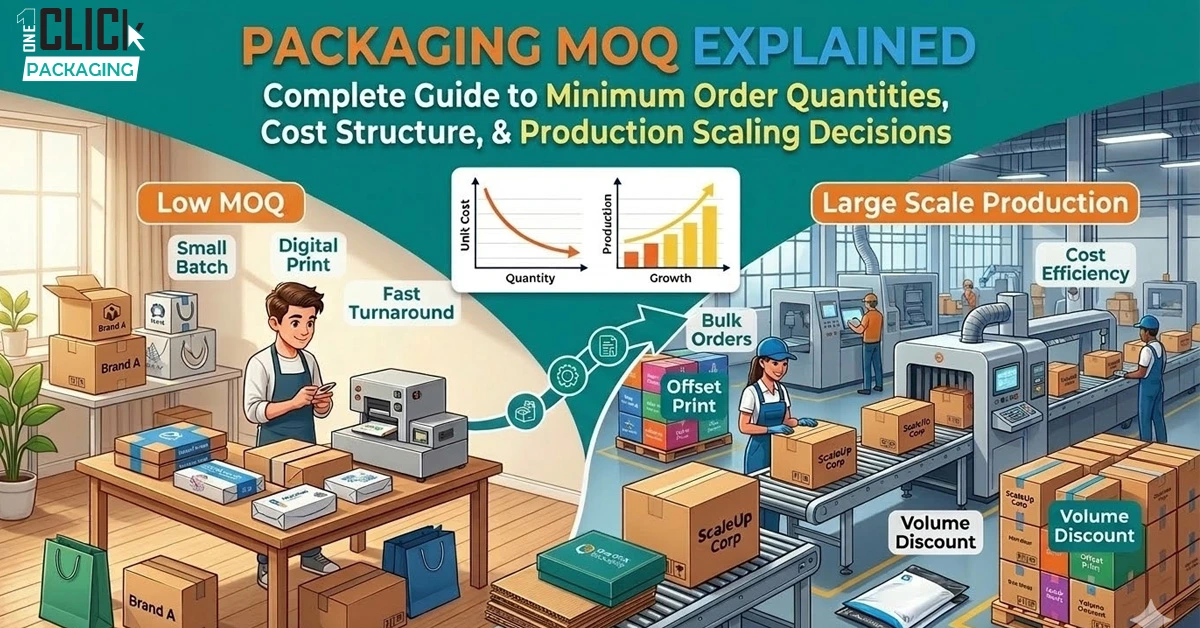

The $47,000 Lesson Nobody Warned Me About
A brand founder I worked with in 2022 I’ll call her Priya ordered 50,000 custom kraft boxes for a product she had not yet proven. The supplier’s MOQ looked reasonable on paper. The unit price was excellent. The total landed cost? Just under $47,000.
Six months later, 38,000 of those boxes sat in a climate-controlled warehouse in New Jersey, slowly warping. The product had changed. The size was wrong. The brand had pivoted. That warehouse bill ran $1,200 per month until she finally discounted the boxes to a liquidator for pennies.
Priya did not make a bad decision. She made an underinformed one. Nobody had explained what packaging MOQ actually means across the full financial picture: not just unit price, but tooling amortization, carrying cost, cash flow impact, and the hidden risk of ordering at scale before your product is stable when sourcing custom packaging boxes for a new product launch.
This guide fixes that. Whether you are a startup founder pricing your first SKU, an operations director renegotiating supplier contracts, or a brand manager deciding between domestic and overseas production, you will leave here with a complete, honest picture of how minimum order quantities work and how to use them to your advantage.
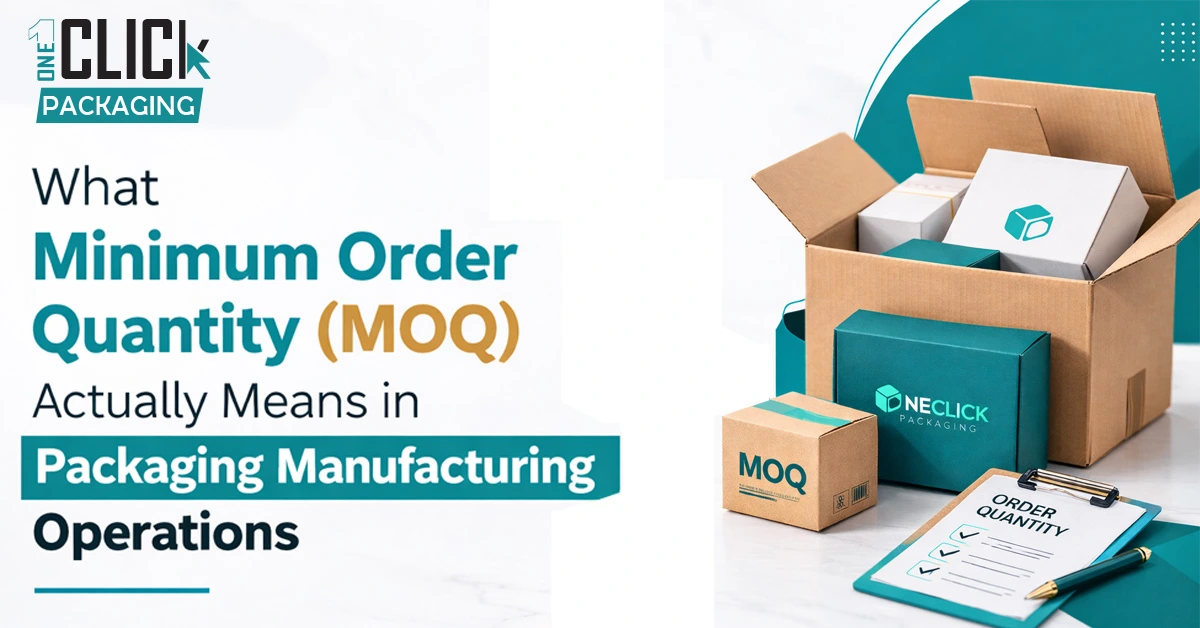
What Minimum Order Quantity (MOQ) Actually Means in Packaging Manufacturing
MOQ stands for minimum order quantity. In packaging manufacturing, it refers to the smallest number of units a supplier will produce in a single production run. Ask for fewer, and they will either refuse the order entirely or charge a premium that makes the economics unworkable.
Here is what most articles miss: MOQ is not arbitrary. It is not a negotiating tactic. It is a direct reflection of the cost structure inside a manufacturing facility. Understanding why MOQs exist is the first step toward negotiating them, working around them, or accepting them with full clarity.
The most important thing I tell every founder I consult with: MOQ is not the same as the right order quantity. It is the floor. What you decide to order above that floor determines your real financial outcome.
Related Articles on this topic go deeper into the full definition and manufacturer psychology:
[SEE → What Minimum Order Quantity (MOQ) Actually Means in Packaging Manufacturing Operations]
[SEE → Why Packaging Manufacturers Require Minimum Order Quantities]
Why Packaging MOQs Exist: The Real Cost Drivers Behind the Number
Every packaging MOQ traces back to three core cost categories: setup costs, tooling investment, and raw material procurement. Strip away the jargon and it comes down to one simple truth: factories have fixed costs that must be recovered regardless of how many units you order.
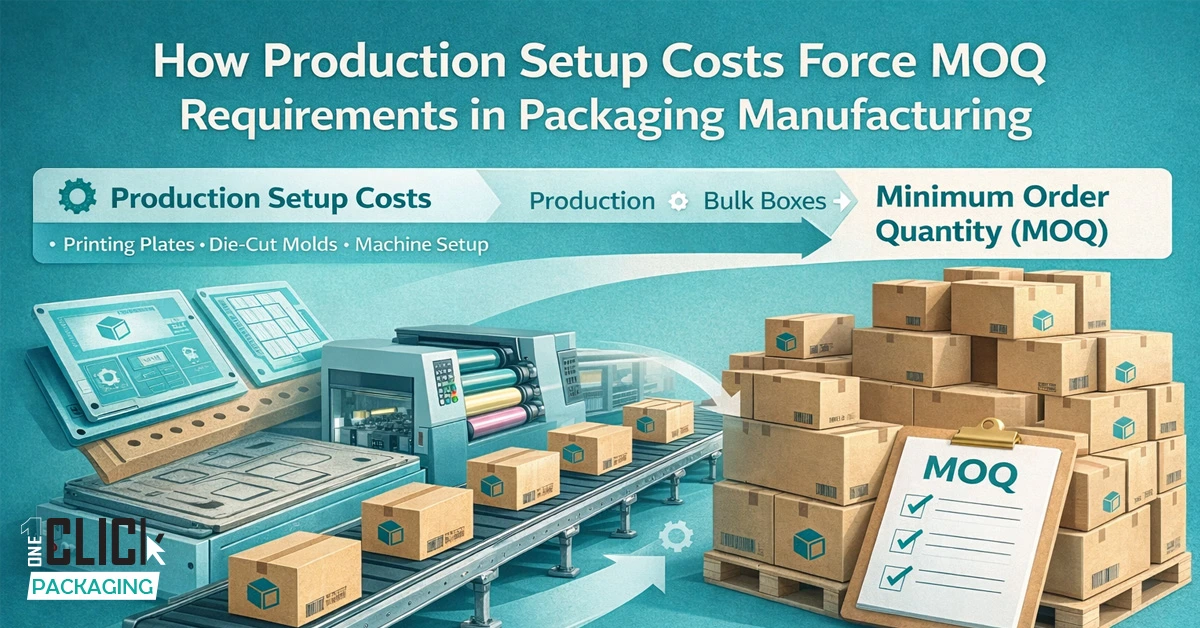
Setup and Production Run Costs
Before a single box is printed, cut, or formed, a production facility spends hours configuring its equipment. Press setup on a litho-laminate run might take four to six hours. A digital press is faster, but even that requires color calibration, substrate loading, and test prints. That labor, machine time, and wasted material during setup has a real dollar cost.
If you order 500 units, that setup cost gets divided by 500. If you order 10,000 units, the same cost is divided by 10,000. The per-unit math changes dramatically. Suppliers set MOQs at the point where their setup costs are absorbed to a level that allows them to price competitively and still maintain margin.
[SEE — Setup Cost Logic → How Production Setup Costs Force MOQ Requirements ]
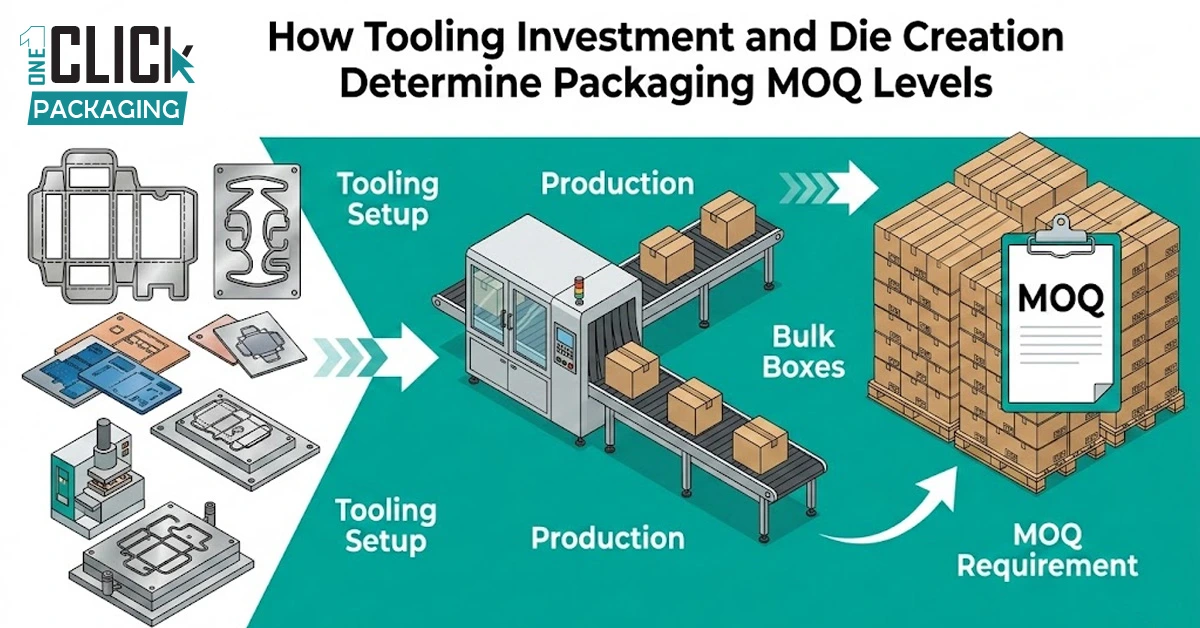
Tooling and Die Creation
Custom structural packaging requires custom dies, particularly when producing complex custom rigid boxes for premium product packaging. A bespoke die-cut corrugated box might cost $400 to $1,200 to create. A rigid box mold for a premium cosmetics launch can run $3,000 to $8,000 or more. These are one-time costs, but they must be recovered somewhere in the unit price.
Suppliers build tooling amortization into their pricing model. At low volumes, the per-unit tooling cost is prohibitive. At higher volumes, it becomes negligible. This is a primary reason MOQs for custom structural formats are significantly higher than for simple printed items using standard die lines.
[Related → How Tooling Investment and Die Creation Determine Packaging MOQ Levels]
Raw Material Procurement
Paper mills, board suppliers, and film manufacturers sell in minimum quantities. A corrugated supplier buying fluting and liner from a mill must meet minimum roll quantities. A folding carton printer orders board by the pallet or truckload, which is why retail apparel brands ordering formats like custom pantyhose boxes often encounter minimum order quantities. When you order 300 cartons, you may still be triggering the purchase of a full pallet of board that the printer cannot sell elsewhere.
This raw material minimum cascades directly into the MOQ the printer offers you. It is not greed. It is supply chain math.
How MOQ Varies by Packaging Type, Material, and Structural Design
Not all packaging MOQs are equal, especially when comparing simple cartons with retail packaging formats like custom tie boxes used for apparel accessories. A digital short-run folding carton has a completely different MOQ profile than a vacuum-formed tray, a glass bottle, or a custom rigid setup box. Knowing where your packaging format sits on the MOQ spectrum is essential before you start requesting quotes.
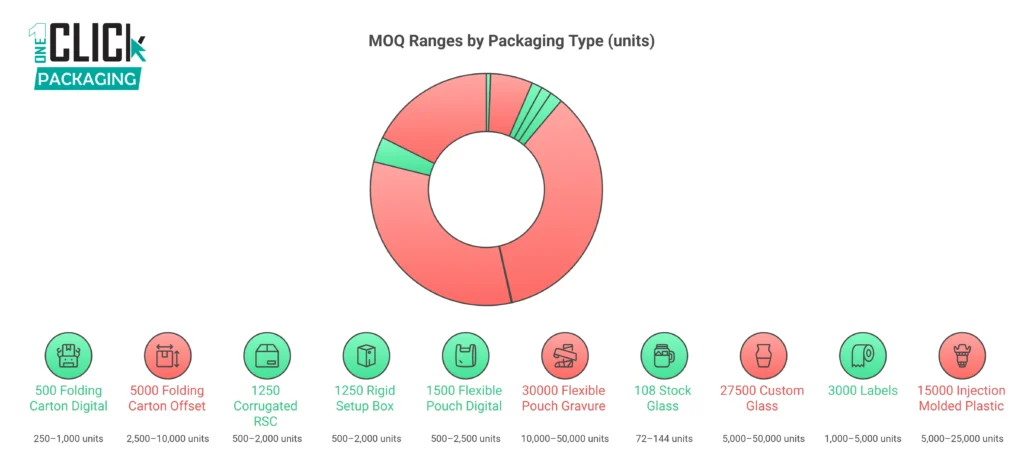
Here is a realistic overview of MOQ ranges by packaging type as of mid-2024, drawn from conversations with suppliers in the US, China, and Southeast Asia:
| Packaging Type | Typical MOQ (Units) | Key MOQ Driver | Short-Run Option? |
| Folding cartons (offset print) | 2,500 – 10,000 | Press setup, plate costs | Yes – digital at 250+ |
| Folding cartons (digital print) | 250 – 1,000 | Substrate cost, labor | Yes – primary option |
| Corrugated RSC boxes | 500 – 2,000 | Setup + flute minimum | Yes at 100+ with surcharge |
| Custom rigid setup boxes | 500 – 2,000 | Die/mold tooling | Rarely |
| Flexible pouches (rotogravure) | 10,000 – 50,000 | Cylinder engraving cost | No |
| Flexible pouches (digital) | 500 – 2,500 | Substrate waste, sealing | Yes |
| Glass bottles (custom mold) | 5,000 – 50,000 | Mold creation cost | No |
| Stock glass bottles | 72 – 144 (cases) | Warehouse minimums | Yes |
| Plastic (injection molded) | 5,000 – 25,000 | Mold tooling ($5k-$50k) | No |
| Labels (pressure sensitive) | 1,000 – 5,000 | Plate and press setup | Yes at 100+ rolls |
The wide variance in these numbers explains why packaging strategy is not one-size-fits-all. A startup in health and beauty has very different options than a startup in beverages. Your packaging format choice is also, implicitly, a MOQ decision.
MOQ vs Unit Price: How Order Volume Changes Your Real Cost Per Unit
This is where most founders make their first significant financial mistake when ordering custom retail boxes at scale without forecasting demand. They focus on the unit price without modeling the total cost of ownership across the full order.
Let me show you a real scenario. A supplement brand I worked with in 2023 was choosing between two folding carton quotes for their 60-count bottle box:
| Order Qty | Unit Price | Tooling/Setup Fee | Total Cost | Effective Cost/Unit |
| 500 (digital) | $1.85 | $0 | $925 | $1.85 |
| 1,000 (digital) | $1.42 | $0 | $1,420 | $1.42 |
| 2,500 (offset) | $0.68 | $600 | $2,300 | $0.92 |
| 5,000 (offset) | $0.52 | $600 | $3,200 | $0.64 |
| 10,000 (offset) | $0.38 | $600 | $4,400 | $0.44 |
The 10,000-unit run looks outstanding at $0.44 per unit. But if you are selling 500 units per month, that order represents a 20-month inventory supply. Add warehousing at $0.08 per unit per month, and your effective cost climbs back to $2.04 per unit when you account for the full carrying cost. The cheap order is not cheap anymore.
This does not mean high-volume orders are wrong. It means the decision requires a full model, not just a unit price comparison.
The Hidden Cost Nobody Puts in the Spreadsheet: Inventory Carrying Costs
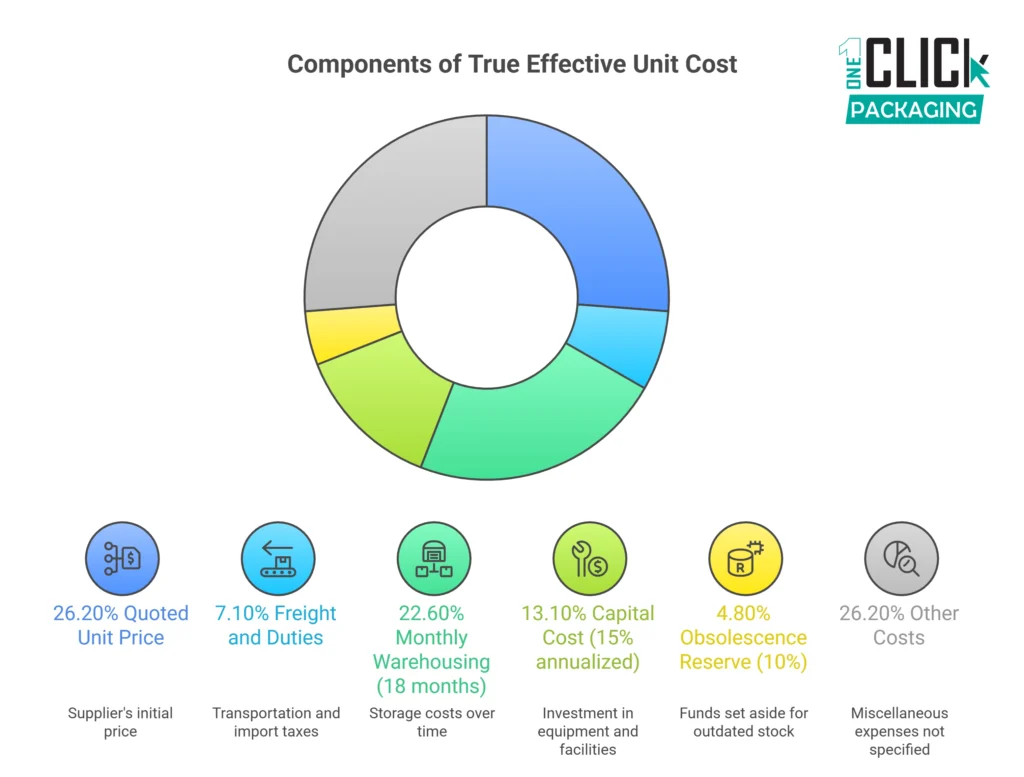
Carrying cost is the total annual expense of holding inventory, which becomes significant for brands storing large volumes of cardboard boxes. Industry benchmarks put it at 20 to 35 percent of inventory value per year. That covers warehousing, insurance, capital cost (the money you could have deployed elsewhere), handling, and obsolescence risk.
For packaging specifically, obsolescence risk is severe. Brands change. Products get reformulated. Regulations require new label copy. A design refresh happens faster than you expect. That 18-month supply of beautifully printed boxes, whether for apparel or bakery products packed in pie boxes, can become a liability overnight.
The formula is straightforward:
Annual Carrying Cost = (Order Value) x (Carrying Cost Rate)
On a $15,000 packaging order with a 25% carrying rate, you are spending $3,750 per year just to hold the inventory. Divided over 18 months, that adds $0.25 per unit to a 15,000-unit order — a number that never appears on the supplier’s quote.
Domestic vs Overseas Packaging MOQ: What the Comparison Actually Looks Like
This is a conversation I have with clients constantly, and the answer is almost never what they expect. Overseas suppliers, particularly in China and Vietnam, often have higher MOQs for custom work but dramatically lower unit prices. Domestic US suppliers sometimes offer lower packaging MOQ but at 2x to 4x the per-unit cost.
The decision framework I use considers five factors: volume, lead time, flexibility need, cash flow position, and product stability.
• Volume under 2,500 units: Domestic digital printing almost always wins on total cost.
• Volume 2,500 to 10,000 units: Hybrid strategies work well — stock domestic for testing, overseas for scale.
• Volume above 10,000 units: Overseas production typically delivers compelling economics if lead time is manageable.
• Product in active iteration: Never go high-MOQ overseas on an unstable spec. You will own obsolete inventory.
• Cash flow constrained: Higher unit price on a domestic short run often preserves cash better than a large overseas commitment.
One nuance that surprises people: some Chinese suppliers, particularly in the Dongguan and Shenzhen packaging corridors, have introduced digital short-run capabilities with MOQs as low as 300 to 500 units. Lead times are longer than domestic, but the unit economics can still beat domestic offset at moderate volumes.
How to Successfully Negotiate Lower Packaging MOQ With Manufacturers
Negotiating packaging MOQ is possible. I have helped brands reduce their minimum requirements by 40 to 60 percent using specific techniques that address the supplier’s actual cost concerns rather than simply asking for less.
The fundamental principle: suppliers set MOQs to protect margin. Your job is to offer them margin protection through a different mechanism.
Volume Commitment Strategies
A blanket purchase order is one of the most effective tools available. Instead of asking for a lower MOQ on a single order, you commit to purchasing a set volume over 6 or 12 months. The supplier gets revenue certainty. You get lower MOQs on each individual release. I have seen this drop MOQs from 5,000 units to 1,500 units with zero change in unit pricing.
Standardized Component Strategies
Custom structural work drives high MOQs because of tooling. Switching to a supplier’s standard die line eliminates that cost entirely. I worked with a wellness brand in 2023 that reduced their carton MOQ from 5,000 to 1,000 simply by accepting a standard tuck-end box format rather than a custom auto-lock bottom. The visual difference to the end consumer was negligible. The financial impact was significant.
Tooling Ownership
If you pay for your die outright, you own it. That removes the tooling amortization burden from the supplier’s pricing model and sometimes allows them to lower the MOQ because their setup cost exposure is reduced. On an $800 die that you own, you are now free to move that die to a different supplier if better pricing emerges later. This is a particularly powerful strategy for brands committing to a format long term.
Packaging MOQ Strategy for Startup Product Launches
Startups face a uniquely difficult version of the packaging MOQ challenge when launching products that require custom product packaging from the beginning. You need packaging to sell product. You cannot sell enough product to justify the MOQs that make packaging affordable. And you cannot raise the money to fund the packaging until you have proven sales. It is a genuinely difficult loop.
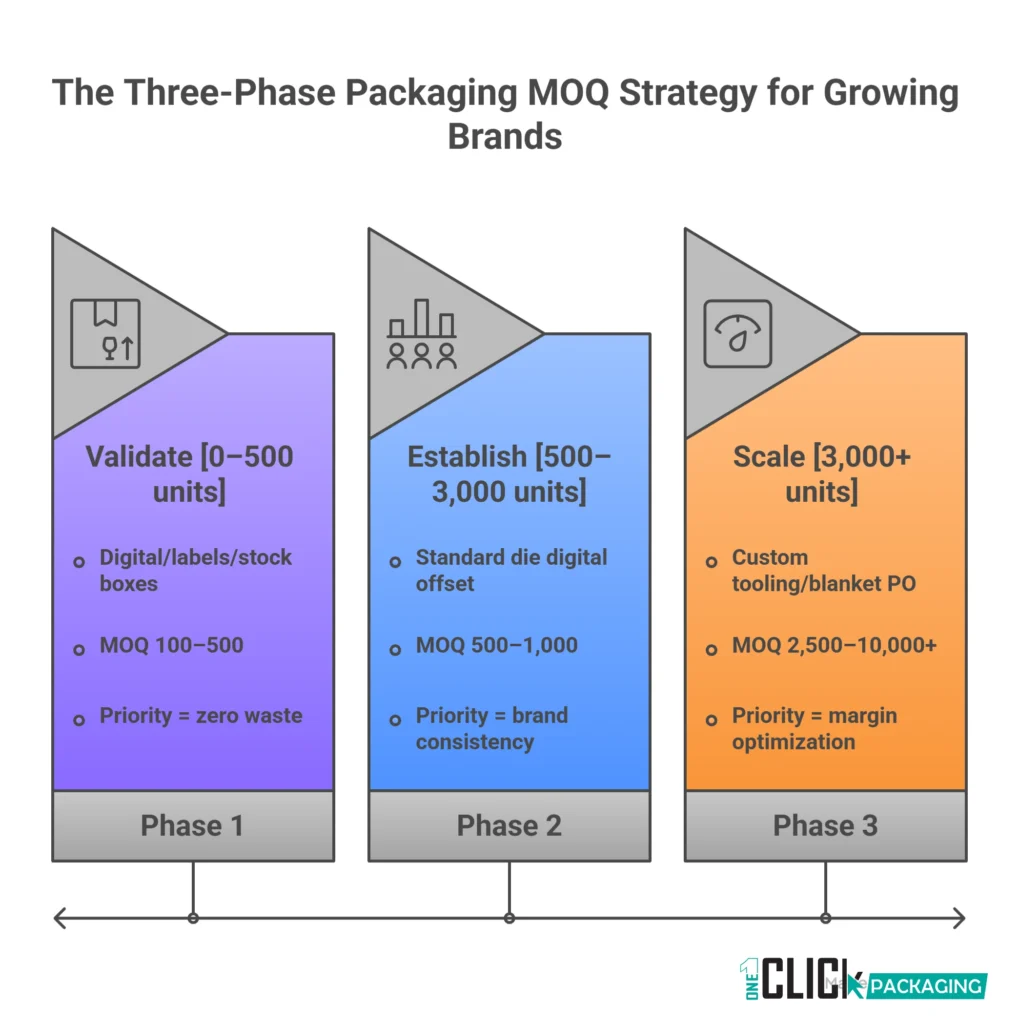
The strategy I have seen work most consistently across the brands I have consulted with follows a three-phase structure:
• Phase 1: Phase 1 (0 to 500 units): Use digital short-run printing, stock boxes with custom labels, or bakery packaging formats such as cupcake boxes while validating early demand, or even unboxed direct-to-consumer fulfillment. Preserve cash. Prove the product.
• Phase 2: Phase 2 (500 to 3,000 units): Move to a standard die line with digital offset printing. Establish your visual identity. Test messaging on packaging through A/B split runs.
• Phase 3: Phase 3 (3,000+ units): Invest in custom tooling, commit to an MOQ that earns you the unit economics you need at scale, and build a blanket PO relationship with one primary supplier.
The brands that get into trouble skip Phase 1 and 2 entirely. They go straight to a 10,000-unit overseas order because the unit price is attractive. Then they pivot. Or their product changes. Or sales are slower than forecast. And that gorgeous, expensive inventory sits.
How MOQ Directly Impacts Your Packaging Profit Margins
Every dollar spent on packaging, whether for retail goods or confectionery products packed in custom printed candy boxes, comes directly out of contribution margin. And the relationship between MOQ decisions and margin is more direct than most finance teams model.
Consider a product with a $25 retail price and a $10 COGS target. If packaging currently runs $1.80 per unit and the brand can reduce that to $1.20 per unit by committing to higher MOQ, that is $0.60 more in contribution margin — a 3.5 percentage point margin improvement on a 25-dollar product. At 50,000 units per year, that is $30,000 in additional gross profit.
But the inverse is equally true. If you over-order to hit a lower unit price and end up writing off 20% of inventory to obsolescence, that write-off eliminates years of packaging savings. The math has to be done both ways
MOQ Risk Assessment: A Framework for Small and Growing Businesses
Before committing to any packaging order above your comfortable carrying threshold, run this five-question framework. I use a version of this with every client before they sign a PO.
• What is your realistic sell-through rate per month for this SKU, based on actual (not projected) data?
• What is your maximum comfortable inventory horizon for this packaging format? (Most growth brands should target 3 to 6 months.)
• How stable is the product specification? Is there any likelihood of a reformulation, size change, or regulatory update in the next 12 months?
• What is the full landed cost including freight, duties, and warehousing for the proposed order volume?
• If 30% of this inventory becomes obsolete, can the business absorb that write-off without a cash crisis?
If you cannot answer question one with real data, the answer to question five is almost always no. Start smaller. Move faster.
The Complete Strategic Framework for Packaging MOQ Decision Making
Putting it all together, here is the decision framework that incorporates every variable covered in this guide. Use it every time you face a significant packaging procurement decision.
• Map your packaging format to its MOQ tier using the type/material breakdown above, especially for food brands using packaging like cake boxes.
• Model total cost of ownership: unit price + tooling amortization + freight + carrying cost.
• Determine your optimal inventory horizon based on sell-through rate and product stability.
• Evaluate negotiation levers: blanket PO, standard components, tooling ownership, domestic vs overseas split.
• Run the obsolescence scenario: what is the financial impact if 20 to 30% of this order cannot be used?
• Make the decision from a total cost and risk position, not a unit price position.
This framework will not always lead you to the lowest unit price. It will lead you to the best financial decision, which is a meaningfully different thing.
Final Thoughts: MOQ Is a Strategy Decision, Not a Supplier Constraint
The brands that win at packaging are not the ones that found the lowest MOQ or the cheapest unit price. They are the ones that understood the full cost structure, matched their order strategy to their business stage, and used every lever available to optimize across the complete financial picture when sourcing custom printed boxes for their products.
Priya, the founder from the opening of this article, eventually rebuilt her packaging strategy around quarterly blanket POs with a domestic digital printer. Her unit costs are higher than they could be at overseas scale. But her inventory never exceeds 90 days, her cash flow is predictable, and she has zero obsolescence write-offs in the two years since the pivot. She calls it the best operational decision she ever made.
The information is in front of you now. Use the framework. Model the full costs. Negotiate with knowledge. And never let a unit price make a decision that requires a full business case.
What is your current packaging MOQ situation? Are you over-ordered, under-committed, or right-sized? The answer might be worth $30,000 to your margins this year.
Frequently Asked Questions About Packaging MOQ
What is a typical MOQ for custom packaging?
There is no single typical MOQ. It varies significantly by format and print process. Digital short-run folding cartons used for products packaged in soap boxes can start at around 250 units. Custom rigid boxes typically start at 500 to 1,000. Flexible packaging with gravure printing often starts at 10,000 to 50,000 units. The key variable is print technology and structural tooling complexity.
Can you negotiate MOQ with a packaging supplier?
Yes, and it is more productive than most buyers realize. The most effective approaches include committing to a blanket purchase order across multiple releases, accepting standard die lines instead of custom tooling, and paying for tooling upfront so the supplier’s amortization risk is removed. Expect 30 to 50 percent MOQ reductions through well-structured negotiation.
Why is my overseas MOQ higher than my domestic quote?
Overseas suppliers, particularly for custom structural formats, tend to set higher MOQs because their cost structure is optimized for longer production runs. However, this is changing. Digital short-run capabilities are expanding in China and Vietnam. If your domestic digital printer quotes 500 units but the overseas supplier quotes 3,000, the question is whether the per-unit saving at 3,000 units justifies the added inventory risk and lead time.
How does MOQ affect my product launch strategy?
MOQ is one of the most important variables in launch planning. High-MOQ commitments before proving product-market fit create inventory risk that can be fatal to an early-stage brand. The standard guidance is to accept higher per-unit costs during the validation phase to preserve cash and flexibility, then move to scale-order economics once sales velocity is confirmed.
What is the difference between MOQ and economic order quantity (EOQ)?
MOQ is the supplier’s minimum. EOQ is a formula-driven calculation of the order quantity that minimizes your total inventory costs, balancing ordering cost against holding cost. In an ideal scenario, your EOQ and your supplier’s MOQ align closely. When they do not, you must choose between paying higher per-unit costs to stay at EOQ or carrying more inventory than optimal to reach MOQ.
Does paying for tooling upfront lower MOQ?
Often yes. Tooling ownership removes the amortization risk that drives part of the MOQ requirement. Suppliers set higher minimums partly to ensure they recover their die or mold investment over the run. If you absorb that cost directly, some suppliers will lower the minimum significantly. Always ask explicitly when getting quotes for custom structural formats.
What happens if I order below a supplier’s MOQ?
Most suppliers will either decline the order or apply a short-run surcharge of 15 to 40 percent above the standard unit price. Some will fulfill at a modified price but require you to pay for a full plate or die setup regardless. In digital printing, below-MOQ orders are more accommodated, though per-unit costs will be higher.
How do I calculate the true cost of a high-MOQ order?
Add unit price multiplied by quantity, plus tooling fees, plus freight and duties, plus warehousing at approximately $0.06 to $0.12 per unit per month, plus a capital cost for the cash tied up (your cost of capital as a percentage of the inventory value). Divide the total by units to get your all-in effective cost per unit. This number is always higher than the supplier quote.
Is a lower MOQ always better for my business?
Not necessarily. Low-MOQ orders carry higher unit costs. If your volume is predictable and your product is stable, committing to higher MOQs can deliver meaningful margin improvement. The right answer depends on your sell-through velocity, product stability, cash position, and risk tolerance. A growing brand with three SKUs and six months of sales data should be asking whether they are underordering just as much as they should be asking whether they are overordering.
When should I switch from short-run to high-volume packaging orders?
Make the transition when three conditions are met: you have at least three to four months of consistent, predictable sales data; your product specification and branding are stable with no expected changes in the next 12 months; and you have the cash or credit facility to fund the inventory without creating operational stress. Moving too early is the most common mistake. Moving too late costs margin you have already earned.