
Here is a story almost every small brand owner knows. You find a packaging supplier, love their samples, and finally ask for a quote. The reply comes back: minimum order 5,000 units. You only need 500. Suddenly the whole deal falls apart, and nobody fully explained why.
That experience is not a supplier being difficult. It is the reality of how packaging manufacturing actually works. MOQ, or minimum order quantity, is not an arbitrary hurdle in operations run by packaging box. It is a direct reflection of production economics, material costs, and the way industrial machinery runs.
This article will walk you through what minimum order quantity genuinely means inside a packaging plant, why the numbers are what they are, and how understanding that logic puts you in a far stronger position when negotiating with suppliers.
What Is Minimum Order Quantity (MOQ) in Packaging Manufacturing?
Minimum order quantity is the smallest number of units a manufacturer will produce in a single production run. In packaging, this number is determined almost entirely by cost structure, not by how much the manufacturer likes or dislikes your business.
When a factory sets an MOQ, they are telling you the minimum volume at which their fixed setup costs, material waste, and labor overhead break into a price that still allows them to operate profitably. Below that volume, they either lose money or have to charge you a price that makes the deal unworkable on your side anyway.
MOQ is not a sales tactic. It is a financial floor built by real production costs that exist whether or not your order covers them.
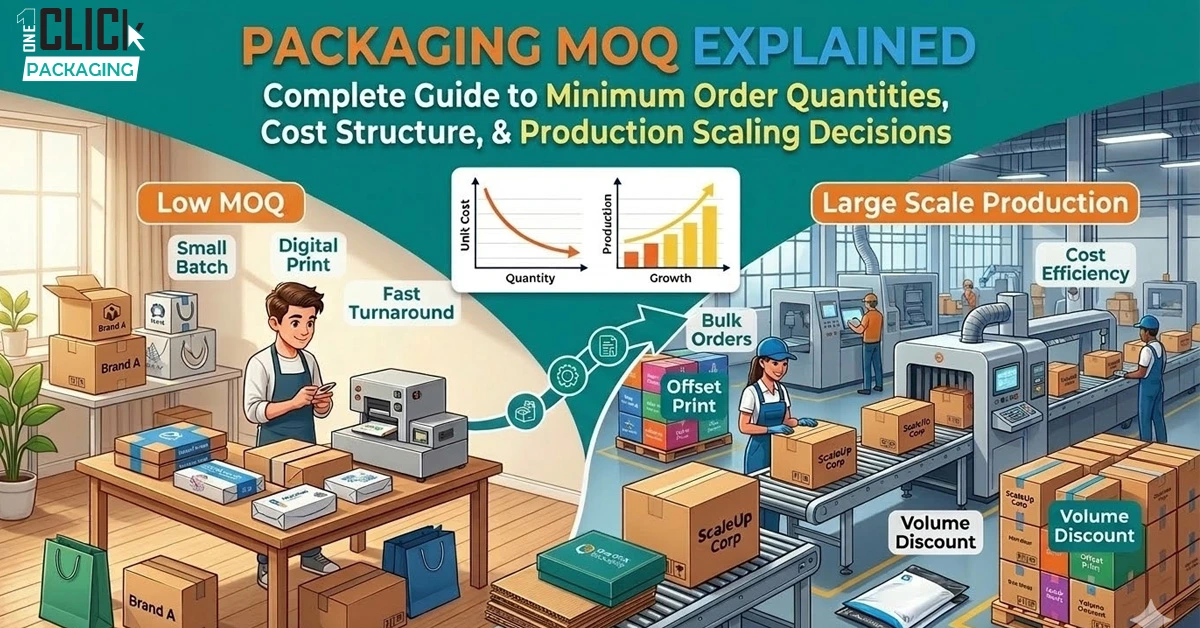
If you want to understand the full economics behind these production limits, the detailed breakdown below explains how MOQ structures actually work in real manufacturing environments.
Why Setup Costs Are the Real Engine Behind Every MOQ
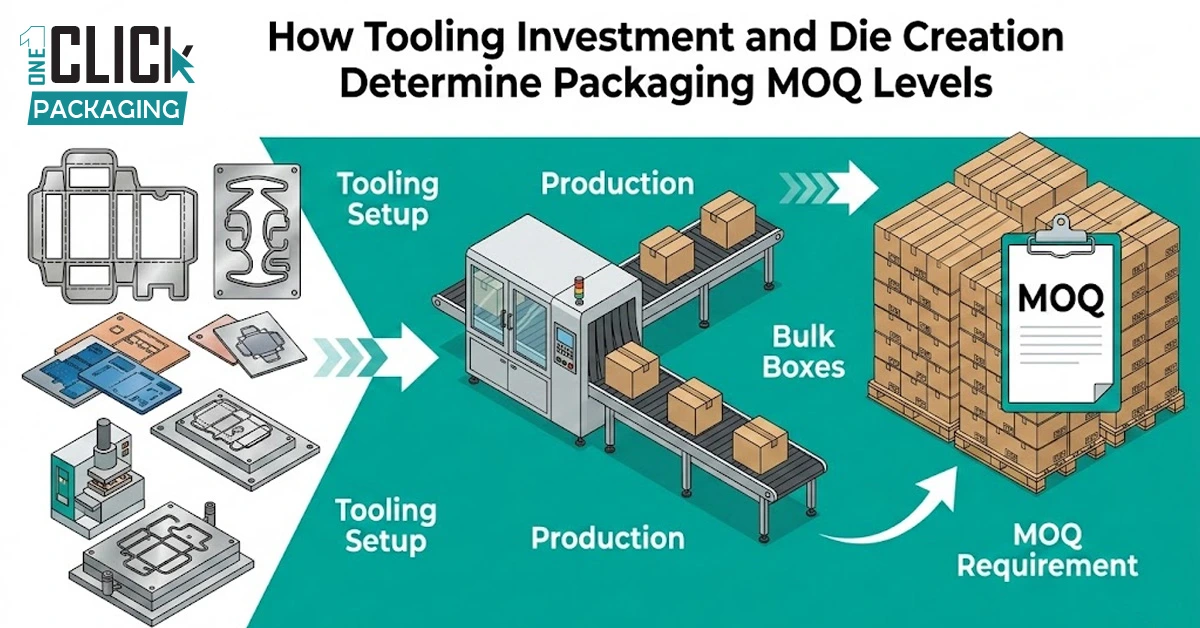
Before a single box, bag, or label comes off a production line, the factory has already spent significant money preparing for your job, particularly when manufacturing cosmetic display boxes. This preparation phase is called setup, and it is where most MOQ requirements are born.
Consider a corrugated box run. The die that cuts and scores your box to the exact dimensions you need costs anywhere from 800 to 2,500 dollars to fabricate. That cost is fixed. Whether you order 200 boxes or 20,000 boxes, the die cost is the same. The only variable is how many units absorb that cost.
At 200 units, your die cost alone adds more than 10 dollars per box before a single piece of cardboard is cut. At 5,000 units, that same die cost drops below 50 cents per unit. The math forces a volume floor, and that floor is your MOQ.
The Setup Cost Categories Manufacturers Are Absorbing
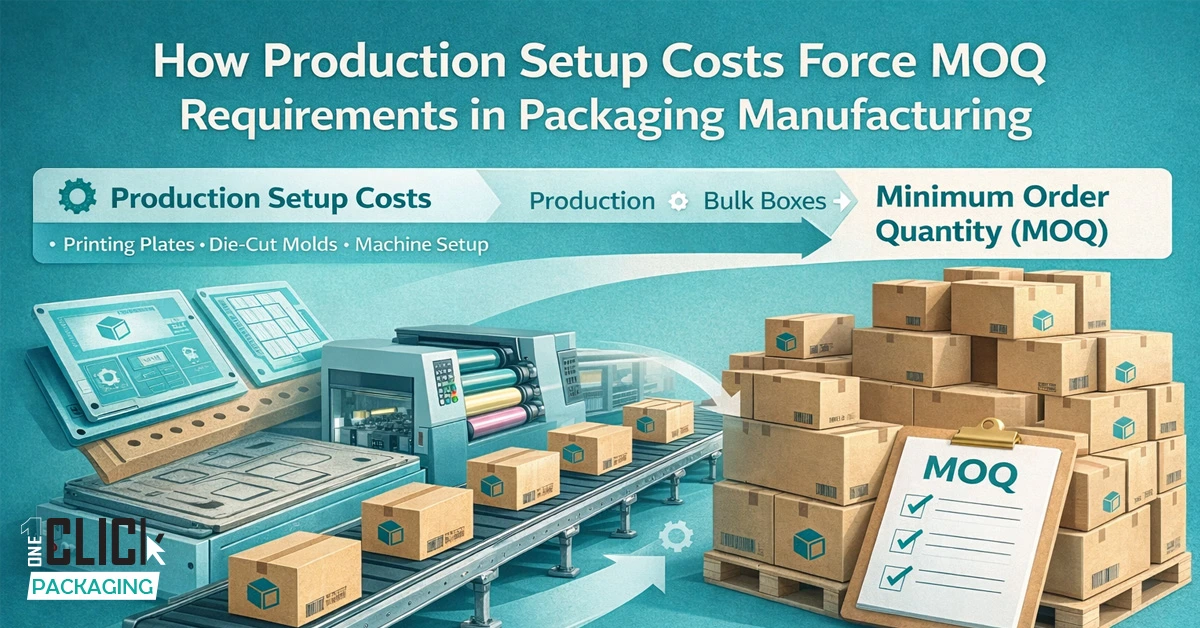
Setup costs in packaging manufacturing fall into four main buckets that drive MOQ requirements across nearly every substrate and format.
• Tooling and die fabrication: custom cutting dies, emboss plates, and foil stamp dies
• Plate making for printing: flexographic plates, offset plates, and screen printing frames
• Machine time for changeover: hours of press or line time consumed switching from the previous job
• Material waste during calibration: the first portion of every run is adjustment waste before consistent quality is achieved
To see how these setup costs translate into real minimum order requirements on factory floors, the following breakdown explains the production economics in more detail.
[See: How Production Setup Costs Force MOQ Requirements in Packaging Manufacturing]
How Packaging Material Type Changes MOQ Thresholds
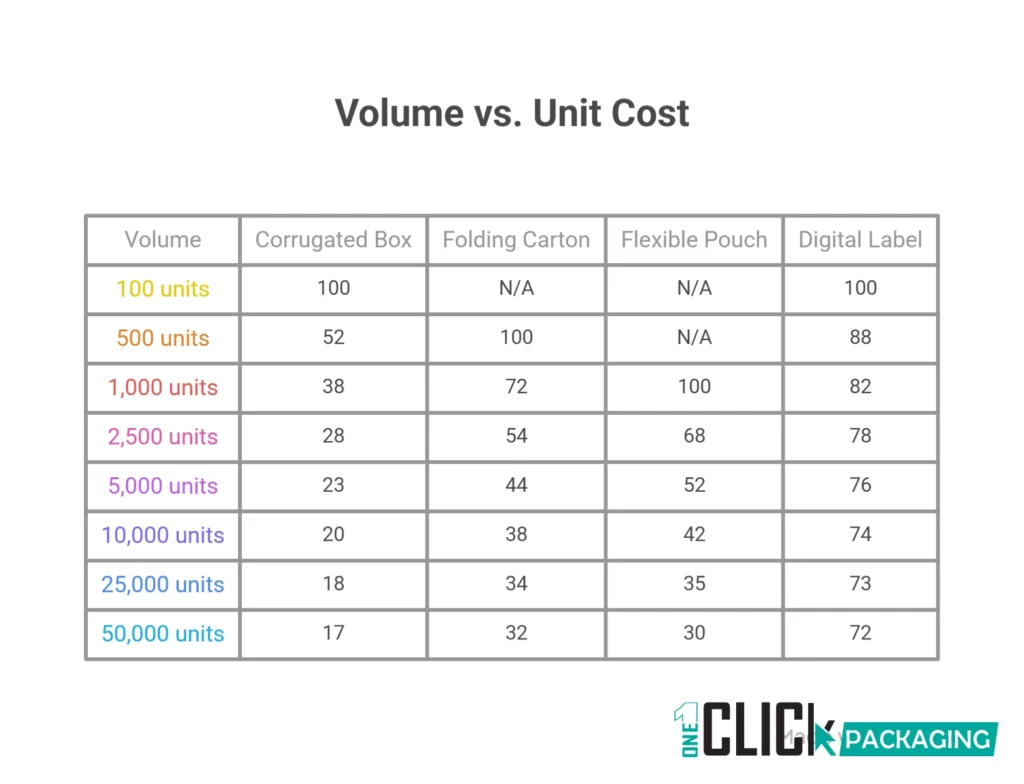
Not every packaging format has the same MOQ, whether producing cartons or pizza slice boxes for food service packaging. The minimums shift dramatically depending on the material, the printing process, and the complexity of the structure. Understanding this lets you pick your format strategically.
| Packaging Type | Typical MOQ Range | Primary Cost Driver | Negotiation Flexibility |
| Corrugated shipping boxes | 500 – 2,000 units | Die fabrication + setup | Moderate |
| Folding cartons (offset printed) | 2,000 – 10,000 units | Plate making + press setup | Low |
| Flexible pouches (gravure printed) | 5,000 – 50,000 units | Gravure cylinder engraving | Very low |
| Labels (digital printing) | 50 – 500 units | Minimal setup | High |
| Rigid boxes (set-up boxes) | 500 – 2,000 units | Assembly labor + tooling | Moderate |
| Poly mailers (custom print) | 1,000 – 5,000 units | Plate fees + minimum run | Moderate |
Digital printing has fundamentally disrupted MOQ norms for labels and some folding carton formats, including short runs of bakery packaging boxes. Because there are no plates and minimal setup, digital presses can run 50 or 100 units profitably. That is why craft brands and startups increasingly use digital printing for their initial market entry, then transition to offset or flexo once volumes justify the plate investment.
The Role of Printing Process in Setting MOQ
The printing method your packaging requires is one of the single biggest determinants of your MOQ, especially when producing products like custom printed coffee boxes. Each process has a different cost structure, and that structure sets the volume floor in a different place.
Flexographic Printing
Flexo is the workhorse of packaging printing for bags, pouches, corrugated, and labels. Plates cost between 300 and 1,200 dollars per color, and a typical four-color package requires four sets. The combined plate cost plus press setup time creates MOQs in the 1,000 to 5,000 unit range for most flexo applications.
Offset Lithography
Offset printing produces exceptional color fidelity and is widely used for folding cartons and high-end retail packaging such as custom perfume boxes. Plate costs are lower per color than flexo, but the setup time is longer and material waste during calibration is higher. MOQs typically land between 2,000 and 10,000 units for offset packaging runs.
Gravure Printing
Gravure is the premium process for flexible packaging and requires engraved cylinders that can cost 1,500 to 4,000 dollars per color. A full-color gravure package can carry 10,000 to 20,000 dollars in cylinder costs alone. This is why gravure MOQs frequently start at 20,000 units and can reach 100,000 units for some film applications. Gravure is the format where MOQ conversations get serious fastest.
Digital Printing
No plates, minimal setup, near-zero changeover waste. Digital printing has eliminated the traditional MOQ barrier for labels and short-run folding cartons. The trade-off is cost per unit: digital is more expensive per piece than plate-based processes at higher volumes. This creates a crossover point, typically somewhere between 1,000 and 3,000 units, where plate-based printing becomes cheaper per unit despite its higher setup cost.
All of these printing methods ultimately lead back to the same economic reality that drives minimum order quantities in packaging manufacturing.
[See — Why Packaging Manufacturers Require Minimum Order Quantities in Real Production Environments]
Material Minimums: When MOQ Is a Raw Material Problem
Setup costs are not the only MOQ driver. Some minimums come from the material supply chain, not the production floor, especially in flexible packaging like CBD oil packaging.
Film for flexible packaging is purchased in master rolls. A single master roll of a specialty film, like a metallized barrier film or a compostable PLA-based structure, often represents 50 to 100 kilograms of material. Your order has to use enough film to justify that roll purchase, or you are buying material you will never use.
Specialty inks and coatings have similar dynamics. A Pantone spot color requires a minimum ink batch, often 2 to 5 kilograms, regardless of how little of it your run actually consumes. The remaining ink may sit in inventory with limited shelf life, which means the supplier either wastes it or passes the cost along through higher pricing and higher MOQs.
Substrate-specific examples where material minimums drive MOQ include cold foil applications, specialty barrier coatings for food contact packaging, metallic substrates, and biodegradable films that have limited supplier availability and wide minimum purchase requirements.
How MOQ Affects Your Unit Cost: The Math You Need to Know
The relationship between order volume and unit cost is not linear. It drops steeply from small volumes and then flattens. Understanding where your specific packaging format hits that flat zone tells you at what volume you are paying a premium and at what volume you are paying market rate.
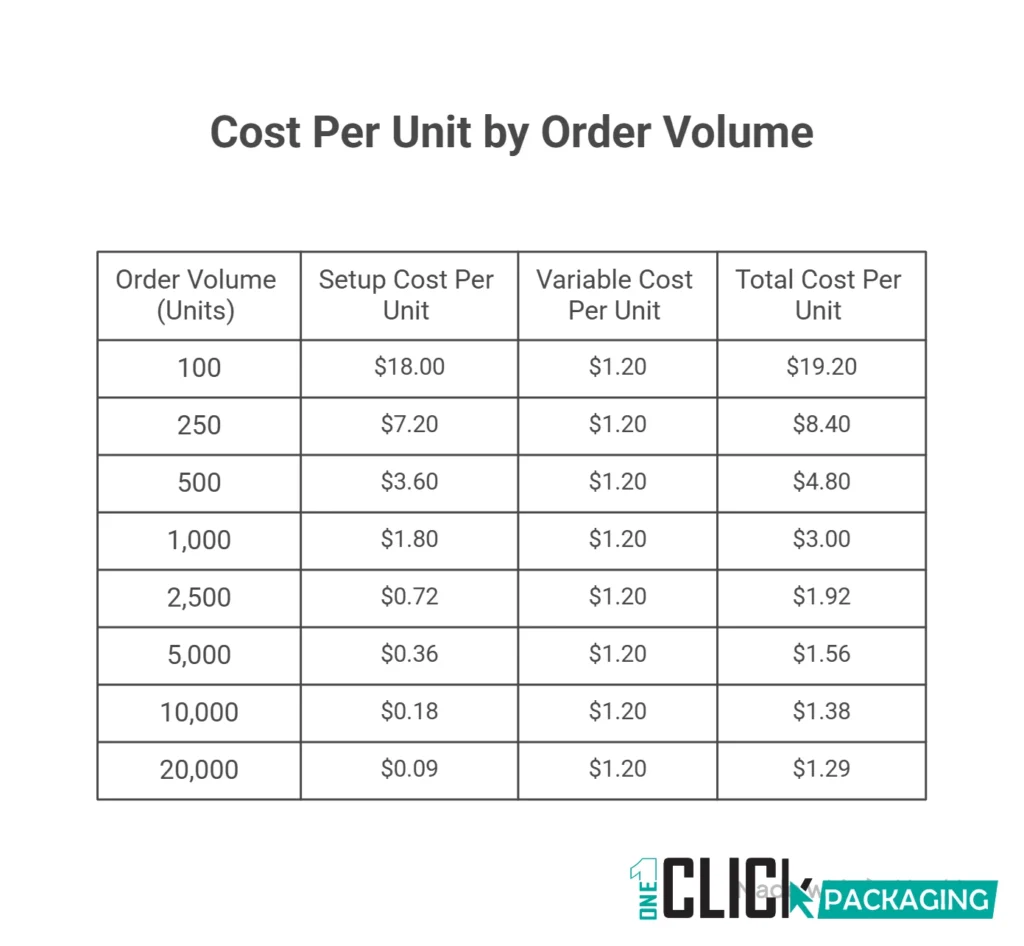
A useful way to think about this is to separate costs into fixed and variable components. Fixed costs include tooling, plates, setup time, and ink batches. Variable costs include substrate material, inks used, and direct labor per unit. When you calculate unit cost at different volumes, you are essentially dividing your fixed costs over more and more units while your variable cost per unit stays roughly constant.
This means a doubling of order quantity from your MOQ floor might reduce your unit cost by 30 to 40 percent. A further doubling might only reduce it by another 10 to 15 percent. The steepest gains always come in that first multiple of the MOQ, which is why suppliers often have strong pricing incentives for orders at two or three times the stated minimum.
Negotiating MOQ: What Actually Gives Suppliers Room to Move
MOQ is negotiable more often than buyers realize, but only when the request is grounded in understanding the supplier’s cost structure rather than just pushing back on the number.
Here are the approaches that actually create room in an MOQ conversation.
Offer a Higher Unit Price
If you genuinely need a lower quantity, offer to pay a setup premium rather than asking the supplier to absorb the cost. Quantifying the setup fee and paying it separately allows the supplier to hit their cost recovery target at a lower volume. Many suppliers will agree to this, especially if you represent repeat business potential.
Commit to Future Volume
A written purchase commitment for a follow-on order at full volume can sometimes unlock a smaller initial run. The supplier recovers their setup cost across the committed volume rather than just the first run. This only works if your commitment is credible and you are willing to put it in writing.
Use Their Standard Tooling
Custom dies, plates, and tooling are a significant part of why your MOQ is what it is. If your design can use a standard die size from the supplier’s existing library, you eliminate that tooling cost entirely. For corrugated boxes and folding cartons, this is often more possible than brands assume. Your structural design may need minor adjustments, but the MOQ reduction can be substantial.
Consolidate SKUs
If you have multiple packaging variants, running them on the same press setup with a single plate change between versions can spread fixed costs across a larger combined volume. This often makes it possible to get each individual SKU at lower quantities while the combined run still meets the supplier’s economics.
MOQ Versus Minimum Order Value: Two Different Concepts
Some manufacturers do not express their minimums in units. They express them in dollar value. Minimum order value and MOQ are related but different constraints, and confusing the two leads to negotiation mistakes.
A minimum order value means the supplier requires a minimum purchase amount per order, regardless of unit count. This typically reflects the supplier’s administrative cost of processing an order. A small order that takes the same invoicing, scheduling, and logistics effort as a large one is unprofitable below a certain revenue threshold even if the units are physically small and cheap to make.
In practice, a 1,500 dollar minimum order value at a unit cost of 30 cents means your effective MOQ is 5,000 units. But at a unit cost of 1.50 dollars, your effective MOQ drops to 1,000 units. Understanding which constraint you are actually hitting changes your strategy for meeting it.
When MOQ Creates Inventory Risk: The Hidden Cost
Meeting an MOQ to get the packaging you need creates a secondary problem that many brands underestimate: you may now own more packaging inventory than you can use before it becomes obsolete.
Packaging has a shelf life that is rarely talked about. Corrugated boxes weaken over time if stored improperly. Printed colors can fade or shift under fluorescent lighting. Food contact materials have compliance requirements tied to production dates. And your product design, regulatory requirements, or branding may change before you work through a large inventory position.
The real cost of an MOQ is not just the upfront cash outlay. It is the carrying cost of inventory, the warehouse space consumed, and the potential write-off if that packaging cannot be used. A brand that buys 10,000 units to meet an MOQ but only needs 2,000 per year is tying up capital and warehouse space for five years of inventory.
This is worth factoring into your supplier evaluation. A supplier with a higher unit price but a lower MOQ may have a lower total cost of ownership than a cheaper per-unit price tied to a volume you cannot realistically absorb.
How Contract Packaging and Co-Manufacturing Change the MOQ Equation
One route that many growing brands miss is using a contract packager or co-manufacturer to aggregate volume. Rather than going directly to a packaging manufacturer as a buyer of raw packaging components, you supply your product to a co-packer who already runs large volumes of packaging from that same supplier.
The co-packer absorbs the MOQ because they are buying at much higher volumes across multiple customers, including mylar bags and similar flexible formats. You effectively access lower unit pricing and higher-quality printing without meeting the manufacturer’s direct MOQ. The trade-off is that you give up some control over the procurement relationship and typically pay a margin to the co-packer.
For brands under 50,000 units per year, this model often produces better economics than direct packaging procurement. The calculation changes once you reach volumes where your own buying power starts to approach supplier MOQs naturally.
Industry-Specific MOQ Patterns Worth Knowing
MOQ norms vary meaningfully across end markets, and knowing what is normal in your category helps you calibrate whether a supplier quote is standard or unusually high.
• Food and beverage: flexo-printed pouches and bags typically start at 5,000 to 25,000 units; labels can be much lower with digital printing
• Beauty and personal care: folding cartons often start at 2,000 to 5,000 units; luxury rigid gift boxes can be as low as 300 to 500 units for premium positioning
• E-commerce and shipping: custom corrugated boxes often have MOQs of 500 to 1,000 units if using standard die sizes
• Pharmaceutical: regulatory requirements around batch records and documentation often push practical minimums higher than pure production economics would suggest, especially in medicine packaging.
• Retail softgoods: poly bags and garment bags on flexo equipment typically start at 5,000 units
The Bottom Line on MOQ in Packaging Manufacturing
Minimum order quantity is the packaging industry translating its cost structure into buyer-facing requirements. Every number you see on a quote sheet has a reason behind it. Die costs, plate fees, press setup time, material minimums, and ink batch requirements all combine to create a volume floor below which the supplier cannot make the economics work.
Once you understand that logic, MOQ stops being an obstacle and starts being a negotiation conversation. You can offer setup fees, commit to volume, use standard tooling, or find co-packing arrangements that give you custom packaging solutions at a volume you can actually absorb.
The brands that manage packaging costs most effectively are the ones that understand their supplier’s economics as well as their own. Start there, and the MOQ conversation changes completely.
What packaging format are you sourcing, and where are you running into MOQ friction? The specifics matter more than the general principle here, and the right approach varies considerably by substrate and printing process.
Frequently Asked Questions About MOQ in Packaging Manufacturing
Can I split an MOQ across multiple SKUs with the same artwork?
Sometimes, but it depends on how much the SKUs differ. If you have two product sizes that use the same graphic file but different structural dimensions, you may need separate tooling for each, which means separate MOQs. If the only difference is a variable text element like a flavor name, some suppliers can accommodate version printing within a single run at one MOQ. Ask specifically about gang printing or versioning options.
Is MOQ the same as minimum run quantity?
Not always. MOQ typically refers to the minimum per order, while minimum run quantity can refer to the minimum per production run. Some suppliers will allow you to order above the MOQ but split delivery across multiple shipments, which pulls from a larger single run. This is sometimes called a blanket order and can be a useful tool for managing inventory while still meeting production minimums.
Why do overseas manufacturers have lower MOQs than domestic ones?
Often they do not on a comparable basis. What appears to be a lower MOQ from an overseas supplier may reflect lower labor costs that shift the breakeven economics, but the underlying fixed costs of tooling and setup are frequently similar. The real difference is that overseas factories often carry a wider inventory of standard components, so certain items are not custom-made but pulled from existing stock. Always compare equivalent custom versus stock items between domestic and overseas quotes.
What happens if I order below the stated MOQ?
Most suppliers will decline the order or quote a price with a short-run surcharge that brings the economics back to where they need to be. This surcharge can range from 15 to 50 percent above the standard price and reflects the setup cost spread over fewer units. In some cases the surcharge makes the order viable at a lower quantity; in others the economics never work regardless of willingness to pay.
How often should I renegotiate MOQ with an existing supplier?
Every time your volume trajectory changes materially. If your annual consumption has grown by 50 percent since you last negotiated terms, you likely have leverage for better pricing and potentially adjusted minimums. Most buyers let pricing drift without revisiting it. Suppliers rarely volunteer to lower MOQs or improve pricing without a conversation.