
Understanding why minimum order quantities exist and why fighting them costs more than accepting them
Here is a scenario I watch play out constantly. A brand founder calls a packaging manufacturer and asks for 500 custom-printed boxes. The supplier quotes a price that seems outrageous sometimes three or four times what the founder expected per unit. The founder assumes the manufacturer is gouging them. They walk away frustrated. They find a cheaper printer who agrees to the low quantity. The boxes arrive with inconsistent colors, wavy seams, and ink that rubs off on the product.
Six weeks and two production runs later, the founder ends up paying more than the original quote would have cost — and they still have a quality problem.
I have seen this exact sequence happen with brands across cosmetics, food, electronics, and apparel. The underlying misunderstanding is always the same: people assume that minimum order quantities exist because manufacturers want more revenue. That is not even close to the real reason.
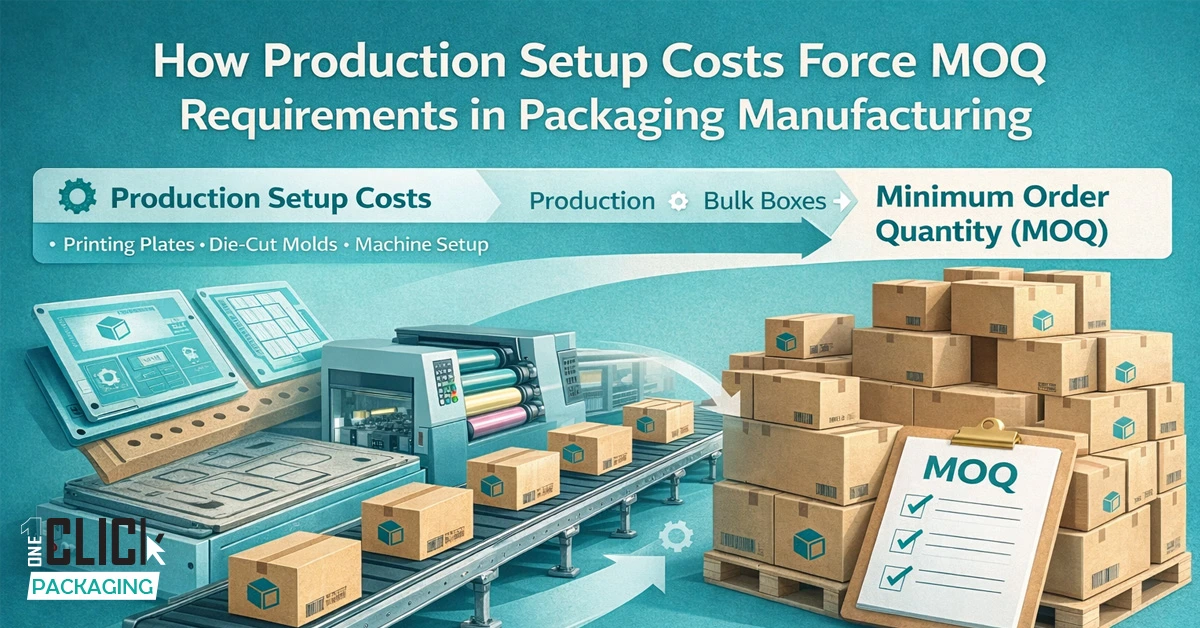
MOQ requirements in packaging manufacturing across the custom packaging industry exist because of something called production setup costs and once you understand how those costs work mechanically, the logic of every MOQ conversation changes completely.
What Are Production Setup Costs and Why Do They Matter?
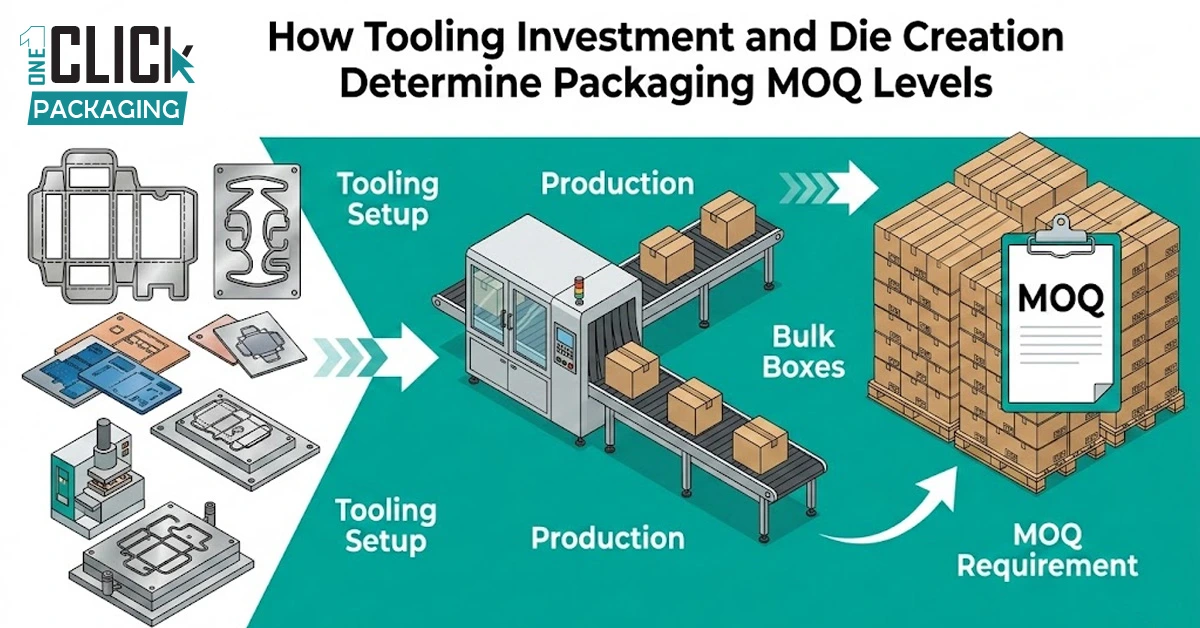
Production setup costs are all the expenses a manufacturer absorbs before a single finished unit rolls off the line. They happen every time a new job starts. They have nothing to do with how many units you order.
Think of it this way. A flexographic press used for corrugated box printing might take a full eight-hour shift to set up for a new job. The press operator is running color calibration, adjusting plate registration, running test substrates, checking ink viscosity, and pulling dozens of samples to verify that the output matches the approved proof. That labor, that materials waste, and that machine downtime all cost money — real, fixed, unavoidable money.
The critical insight: setup costs are the same whether you order 500 units or 50,000 units. The manufacturer must recover that cost somewhere. The only place to recover it is across the units you purchase.
This is where the math of MOQ becomes undeniable.
The Math Behind Minimum Orders: A Real Numbers Breakdown
Let me walk through a real-world example using numbers I regularly see in mid-tier folding carton manufacturing for products like Custom Printed Candle Boxes.
Assume a job has the following setup costs:
• Plate creation and mounting: $800
• Press setup labor (8 hours at $65/hour): $520
• Makeready waste (paper and ink): $340
• Quality checks and proofing: $180
• Total fixed setup cost: $1,840
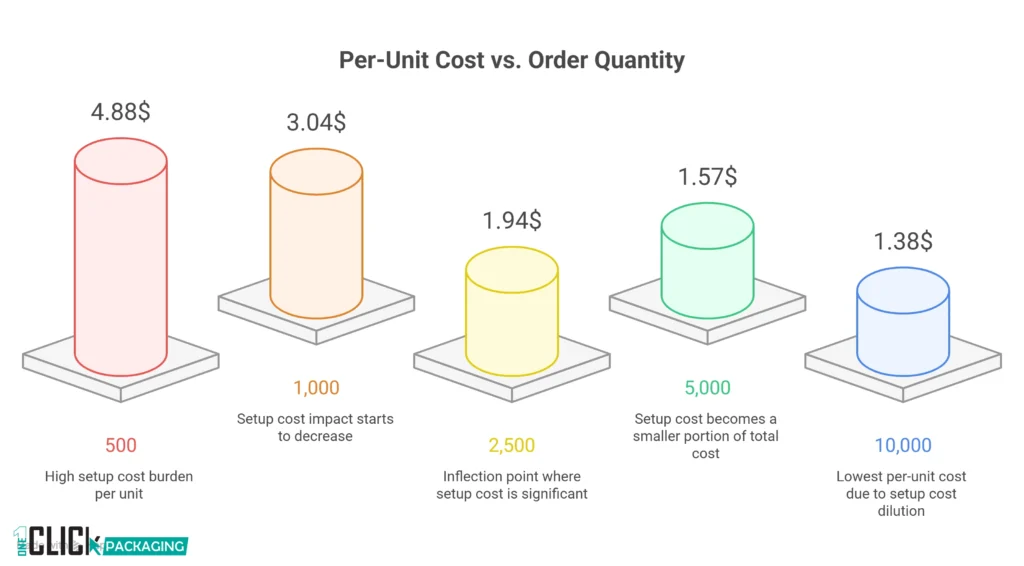
Now watch what happens to the per-unit cost as order volume changes:
| Order Quantity | Setup Cost Per Unit | Variable Cost Per Unit | Total Cost Per Unit |
| 500 units | $3.68 | $1.20 | $4.88 |
| 1,000 units | $1.84 | $1.20 | $3.04 |
| 2,500 units | $0.74 | $1.20 | $1.94 |
| 5,000 units | $0.37 | $1.20 | $1.57 |
| 10,000 units | $0.18 | $1.20 | $1.38 |
At 500 units, more than 75% of the per-unit cost is setup. At 10,000 units, setup is barely 13% of the unit cost. The manufacturer is not marking up your product arbitrarily. They are simply reflecting the economics of how packaging production actually works.
Why Packaging Manufacturers Set Hard Minimums Instead of Just Charging More
A reasonable question surfaces at this point: why not just charge the customer for the true per-unit cost at low volumes? Why set a hard minimum order at all?
The answer is twofold, and both parts are worth understanding.
Reason 1: The Machine Time Problem
Packaging manufacturing equipment flexo presses, digital cutting systems, laminating lines, foil stamping machines runs on scheduled machine time. Every job occupies a slot. A 500-unit job takes almost exactly the same machine time allocation as a 2,000-unit job once you account for setup. Scheduling a 500-unit job that generates $244 in setup revenue when a 5,000-unit job generating $2,440 in setup revenue could occupy the same slot creates an obvious business problem.
Manufacturers are not being stubborn. They are managing throughput economics that are largely invisible to buyers.
Reason 2: The Waste Ratio Problem
Here is something that surprises most first-time packaging buyers: a 500-unit job might generate 80 to 150 units of waste during setup and quality verification. That is a 16% to 30% waste rate before a single sellable unit comes off the line. At 5,000 units, the same absolute waste amount represents a 2% to 3% waste rate. The economics only work at scale for categories like custom product packaging.
I spent time on the production floor of a mid-size flexible packaging plant in Chicago in early 2023. The plant manager showed me their actual waste logs. For short-run jobs under 1,000 units, their average makeready waste ratio was 22%. For runs over 5,000 units, it dropped to 4%. The quality was also noticeably more consistent on longer runs for products like Soap Boxes because operators had time to fine-tune settings mid-job.
If you are still getting familiar with how MOQ works at a fundamental level, this foundation is worth building before diving deeper into production economics.
How Setup Costs Differ Across Packaging Production Methods
Not all packaging manufacturing carries the same setup cost structure. Understanding the differences helps you negotiate more intelligently and choose the right supplier for your volume.
Offset Lithography
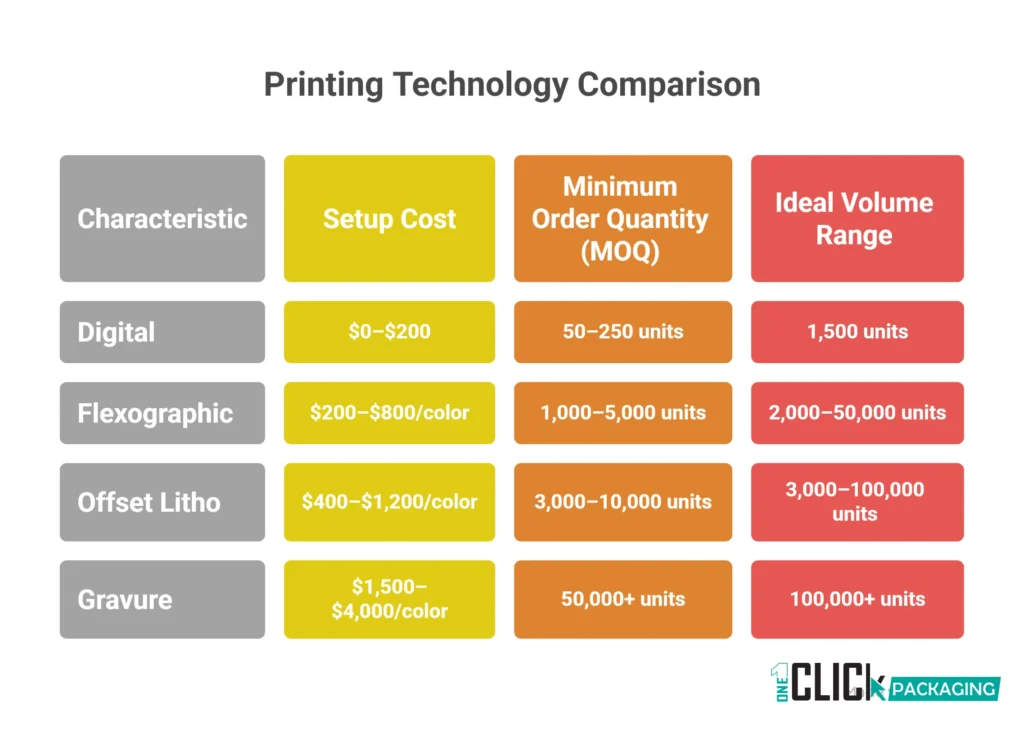
Offset lithographic printing, common in high-end folding carton and label production, has some of the highest setup costs in the industry. Plate creation alone can run $400 to $1,200 depending on the number of colors. Press setup requires extremely precise color calibration. MOQs for offset work typically start at 3,000 to 5,000 units for simple designs and push toward 10,000 for complex multi-color work.
Flexographic Printing
Flexo is the dominant technology for flexible packaging used in custom food packaging, corrugated boxes, and many label applications. Setup costs are meaningful but generally lower than offset. Plate costs range from $200 to $800 per color. MOQs typically fall in the 1,000 to 5,000 unit range. The technology also handles longer runs extremely well, which is why flexible packaging for consumer goods almost always moves through flexo.
Digital Printing
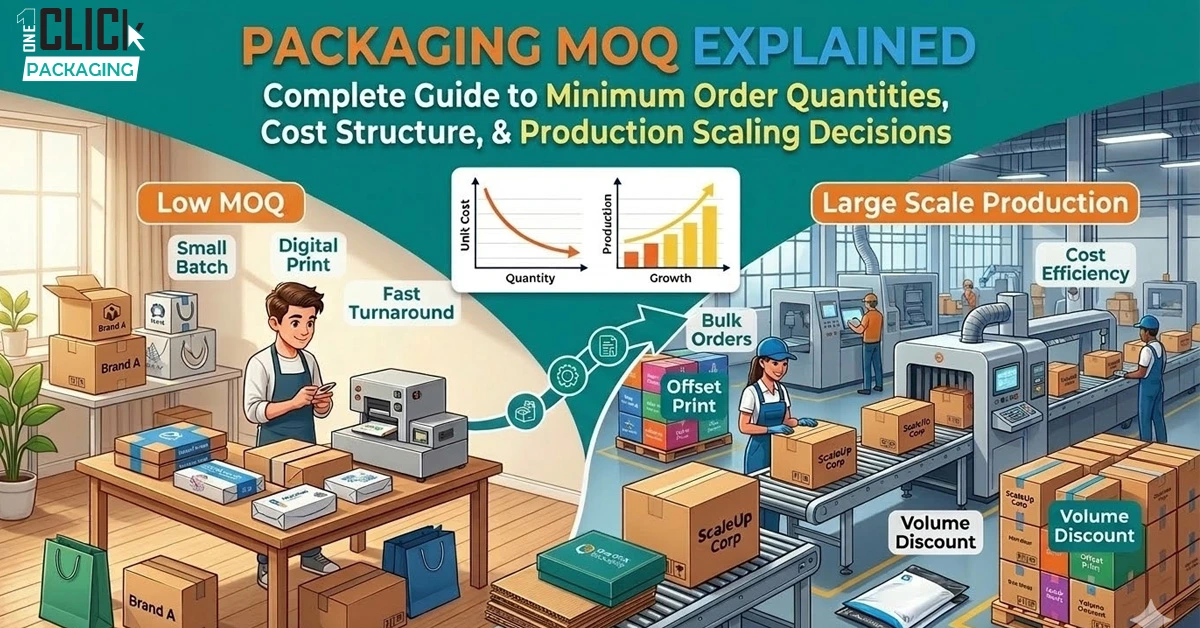
Digital printing has genuinely changed the low-volume packaging conversation. Setup costs are dramatically lower because there are no physical plates. Many digital packaging printers can accept orders as low as 50 to 250 units with reasonable per-unit economics.
But here is the nuance most people miss: digital printing has higher variable costs per unit. At low volumes, digital wins. At mid-to-high volumes, traditional methods win. The crossover point for most folding carton applications, including products like Perfume Boxes, is somewhere around 1,500 to 2,000 units. Above that threshold, a traditional offset or flexo run almost always beats digital on per-unit cost.
Gravure Printing
Gravure has the highest setup costs in packaging production. Cylinder engraving can cost $1,500 to $4,000 per color. This is why gravure is almost exclusively used for very long runs typically 100,000 units and above where the per-unit economics become compelling and the quality consistency is unmatched. If your supplier mentions gravure and your order is under 50,000 units, ask questions.
How Batch Production Amplifies Setup Cost Logic
Setup costs do not operate in isolation. They interact directly with how packaging facilities schedule and run batch production and understanding that interaction reveals additional MOQ dynamics most buyers never learn.
Packaging facilities rarely run a single job at a time for products like Supplement Packaging. They batch similar jobs together on the same press run to share setup costs across multiple customers. This is called gang printing or gang running, and it is extremely common in the label and folding carton industries.
When your job is batched with others, the supplier can share some of the fixed setup costs across multiple customers. This is one reason some suppliers can offer lower MOQs than their setup costs would otherwise suggest they are partially recovering setup costs from other orders running simultaneously.
The flip side is that batching introduces its own constraints. Your job runs when the batch runs, not when you need it. Lead times on gang runs are typically longer and less flexible than dedicated runs.
For a deeper look at how batch scheduling works inside a packaging facility and what it means for your lead times and quality consistency, this resource covers the mechanics in detail.
Full Setup Cost Breakdown by Packaging Category
Here is a reference breakdown of typical setup cost ranges by packaging type, based on supplier quotes collected through 2023 and early 2024. These are industry-level ranges, not guarantees.
| Packaging Type | Setup Cost Range | Typical MOQ | Primary Tech | Digital Alt? |
| Folding Cartons | $1,200 – $3,500 | 3,000 – 5,000 | Offset Litho | Yes (<1,500) |
| Flexible Pouches | $800 – $2,200 | 2,000 – 5,000 | Flexo | Limited |
| Corrugated Boxes | $600 – $1,800 | 500 – 2,000 | Flexo / Digital | Yes (<500) |
| Pressure Labels | $300 – $900 | 1,000 – 3,000 | Flexo / Digital | Yes |
| Rigid Boxes | $2,000 – $6,000 | 500 – 2,000 | Manual / Semi-auto | No |
What You Should Take Away From This
Minimum order quantities in packaging manufacturing across the custom packaging boxes market are not arbitrary. They are not invented to maximize supplier revenue. They are a direct mathematical consequence of how production setup costs must be recovered across a finite number of units.
The founder in my opening story eventually understood this. She moved her cosmetic line’s secondary packaging to a digital printer for her first two runs, kept volumes below 1,000 units, and used that period to validate which SKUs were actually worth scaling. When she hit 800 units per month on her hero product, she moved back to offset with a 3,000-unit MOQ and her per-unit cost dropped by $1.40. She used the savings to fund better substrate quality.
That is the right way to think about MOQ. It is not a wall. It is a pricing signal about where the economics of production shift in your favor.
The brands that understand setup costs use them as a strategic tool. The brands that fight them blindly keep paying for the same setup, over and over again, without realizing it.
What is your current packaging MOQ situation? Are you fighting minimums you have not fully mapped against your own cost of capital and storage? Drop the numbers in the comments — the conversation is worth having.
Frequently Asked Questions About Setup Costs and MOQ in Packaging
| Why do packaging MOQs vary so much between suppliers? MOQ differences between suppliers usually come down to three factors: the printing technology they use, how aggressively they batch jobs with other customers, and how they structure their overhead recovery. A supplier using digital presses can accept 100 units because setup costs are near zero. A supplier running offset for a premium carton brand needs 5,000 units minimum to recover $2,800 in plate and setup costs. Neither supplier is wrong — they are reflecting fundamentally different production economics. |
| Why is the MOQ for rigid boxes so much lower than for folding cartons? Rigid boxes are largely assembled by hand or with semi-automated equipment. The setup time is shorter and less dependent on high-speed press calibration. The tradeoff is that rigid boxes have a higher variable cost per unit. The economics are different, not better or worse. At volume, folding cartons almost always beat rigid boxes on cost. At low volume, rigid boxes can be surprisingly competitive. |
| What happens to my setup fees if I reorder the same design? This depends entirely on your supplier’s plate policy. Some suppliers store your plates and dies for six to twelve months at no charge, meaning a reorder requires only press setup labor not new plate creation. Others charge for storage. Always ask about plate storage policy before signing your first order. Knowing your plates are stored can reduce reorder setup costs by 40 to 60 percent. |