
The order confirmation email arrived at 11:47 PM. A startup founder had finally found a contract packaging manufacturer willing to take on their project. Then came the reply: a minimum order quantity of 50,000 units.
That number was not random. It was not a negotiating tactic. It was the direct financial consequence of a custom die that needed to be built before a single box could be cut, scored, and folded. The manufacturer needed enough units to recover that tooling cost and still turn a margin. Until you understand that logic from the inside, MOQs feel like arbitrary gatekeeping in many branded packaging projects.
Once you do understand it, the whole pricing structure of custom packaging makes complete sense.
This article explains exactly how tooling investment and die creation set the floor on packaging order quantities, why that floor moves depending on project variables, and what you can do to negotiate or work around it when your volumes are still growing.
What Is a Packaging Die and Why Does It Exist?
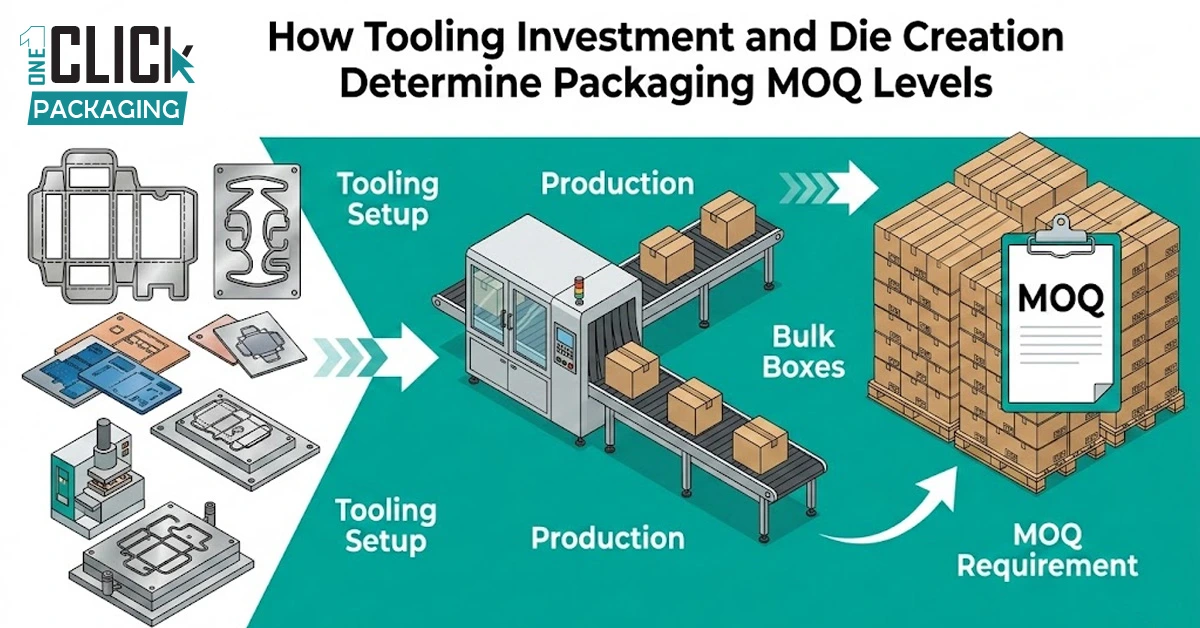
A die is a precision-cut steel tool mounted on a wooden or metal board, used to stamp, cut, and score flat packaging material into the exact shape required for your box, carton, including custom folding cartons, pouch, or insert. Think of it as a custom cookie cutter built specifically for your packaging geometry.
Every unique packaging structure needs its own die when producing auto parts packaging box designs. A 200ml candle box with a tuck-end closure and a window cutout requires a die that matches those exact dimensions and features. A slightly larger version of the same box, even just 10mm taller, requires a completely different die. There is no sharing, no borrowing, and no improvising.
Die creation happens before the first piece of your packaging is ever produced. The tool must be designed, cut, tested, adjusted, and approved before the production run begins. That process costs money regardless of how many units you eventually order.
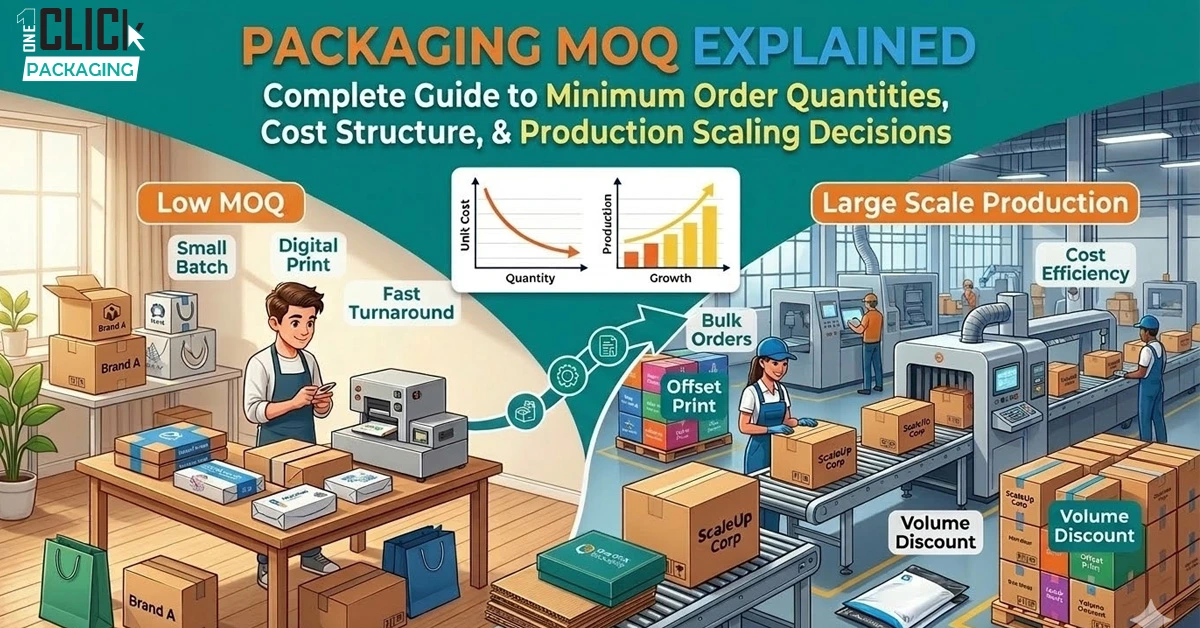
To understand the full economics behind order minimums, [See →Packaging MOQ Explained: Complete Guide to Minimum Order Quantities, Cost Structure, and Production Scaling Decisions]
The Two Main Categories of Packaging Dies
Steel rule dies are the industry standard for corrugated boxes, corrugated mailer boxes, folding cartons, and most paper-based packaging. A steel rule die uses sharp steel blades pressed into a precision-cut wooden or composite board. The blades cut through the material while scoring rules create fold lines. These dies are durable, relatively affordable to produce, and can handle runs in the tens of thousands before showing wear.
Rotary dies are used in high-speed continuous production environments, particularly for flexible packaging and label manufacturing. They are significantly more expensive to produce than flatbed steel rule dies but operate at much faster cycle speeds. A rotary die for a flexible pouch might cost three to five times more than a comparable flatbed die, which directly inflates the MOQ required to justify it.
How Tooling Cost Becomes a Minimum Order Quantity
Here is the core mechanic that almost nobody explains clearly. A manufacturer builds your custom die for a fixed cost. That cost does not change whether they run 500 units or 500,000 units on it. What changes is how that fixed cost is spread across the production run.
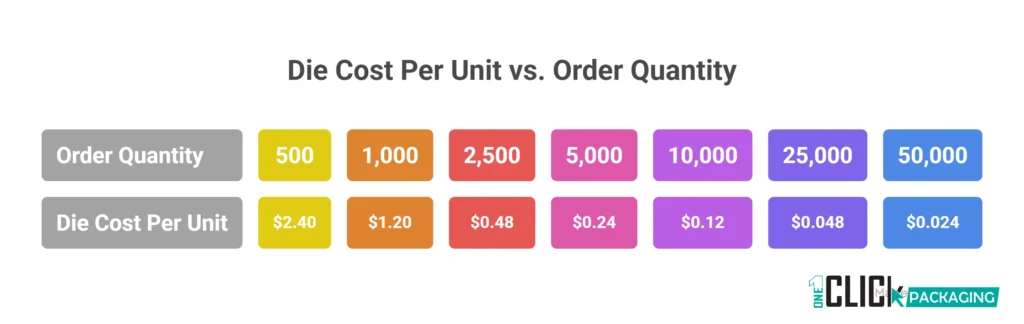
If a die costs $1,200 to produce and the manufacturer wants to recover that investment within a single order, they need enough units so that the per-unit die amortization stays below a commercially viable threshold. At 1,000 units, the die alone adds $1.20 per box. At 10,000 units, it adds $0.12. At 50,000 units, it drops to $0.024.
The manufacturer is not trying to charge you $1.20 per box for a die cost. They are setting a minimum order level where the die recovery cost becomes a small enough fraction of the unit cost to make the whole project financially sensible for both sides.
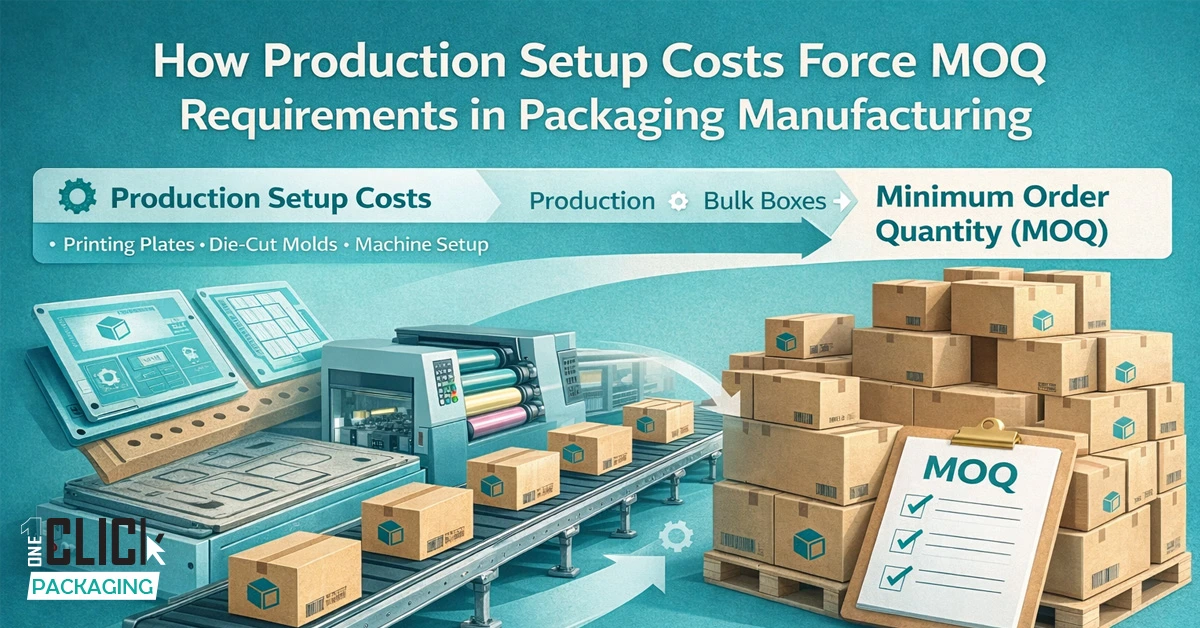
For a deeper look at how setup costs ripple through all aspects of packaging pricing, [SEE → How Production Setup Costs Force MOQ Requirements in Packaging Manufacturing]
The MOQ Calculation Manufacturers Actually Use
Most packaging manufacturers use a simple internal formula when quoting custom work. They start with total fixed costs for the job, which includes die creation, plate making for printing, setup time, and material waste on makeready. They then add their target margin and work backward to find the minimum run length where the per-unit price is still competitive with similar stock packaging.
That last part matters more than most buyers realize. If your custom box ends up costing $2.80 per unit at 2,000 units but a comparable stock box costs $0.60 per unit, the manufacturer knows the project only makes commercial sense at a volume where custom and stock prices begin to converge. That convergence point often becomes the practical MOQ floor.
When Multiple Tooling Costs Stack Up
A printed packaging project does not just need a cutting die. It also needs printing plates, one per color in most offset and flexographic processes. A four-color design needs four plates. Each plate carries its own creation cost, its own amortization logic, and its own contribution to the MOQ floor.
A folding carton with a custom structural shape plus four-color printing might carry a total tooling investment of $2,800 to $5,500 across die and plates. That stacked cost pushes the breakeven run length considerably higher than a simple one-color unprinted box would require.
What Variables Push Tooling Costs Higher or Lower?
Not all tooling investments are equal. Several factors determine where your specific project lands on the cost spectrum.
Packaging Material Type
Corrugated cardboard is the most tooling-friendly material. Steel rule dies for corrugated work are well within the $800 to $1,800 range for standard structures. Rigid boxes, especially set up boxes, by contrast, often require multiple tooling components for wrapping, gluing, and assembly fixtures. Rigid set-up box tooling can reach $3,000 to $7,000 on a single project, which is one reason premium rigid box MOQs tend to start at 500 to 1,000 units even when volumes feel low.
Flexible packaging using laminated film structures requires rotary dies or laser cutting setups. A custom stand-up pouch with a zip-lock feature and a shaped top might carry $4,000 to $9,000 in tooling depending on the film combination and the seal geometry. That tooling investment creates a much steeper MOQ curve than a simple folding carton.
Structural Complexity and Die Cut Features
Every additional design feature adds precision demands to the die. A straight rectangular box with a simple tuck end is about as tooling-friendly as packaging gets. Add a window die cut, an auto-bottom, a hanger tab, a curved edge, or a nested insert slot used for custom packaging inserts, and die complexity increases substantially.
Manufacturers price die complexity in tiers. A simple structure might be a standard quote. A moderately complex structure with two or three special features adds 30 to 50 percent to the die cost. A highly custom structural design with tight tolerance requirements can double or triple standard die pricing.
Tolerance Requirements and Material Thickness
Thicker materials require more robust dies with heavier steel rules. High-tolerance applications, such as packaging for electronics or medical devices where dimensional precision is critical in clamshell box applications, require dies built to tighter specifications with more frequent testing cycles. Both factors drive up tooling cost and, in turn, raise the production volume needed to amortize the investment.
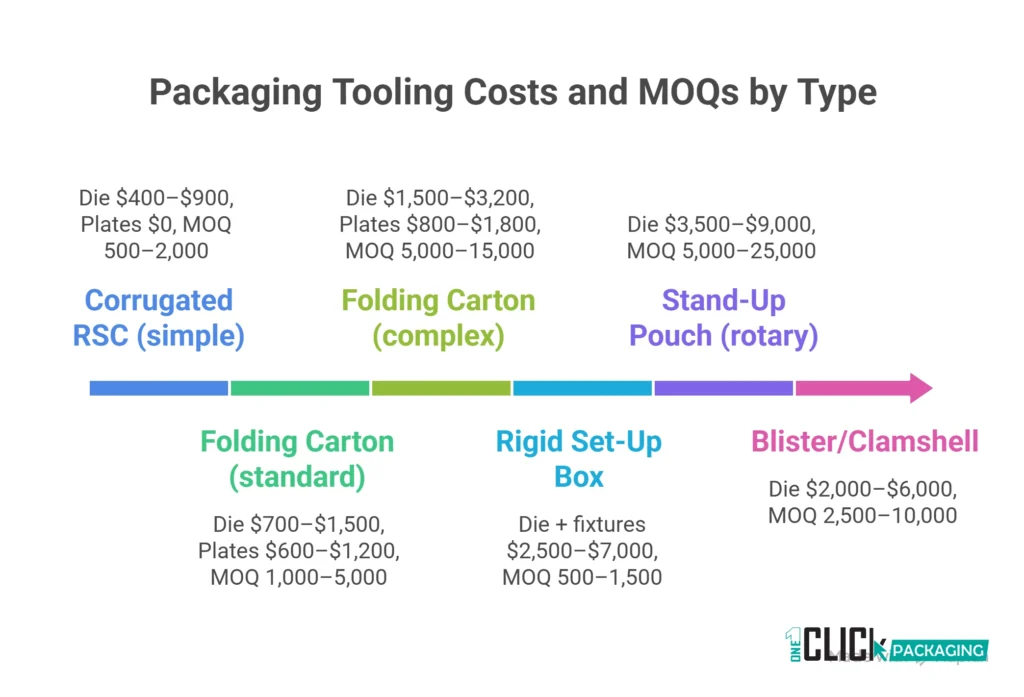
Tooling Cost Ranges by Packaging Type
The table below reflects current market ranges as of mid-2025. Actual quotes will vary by manufacturer, region, and project-specific requirements.
| Packaging Type | Die Cost Range | Typical MOQ Floor | Tooling Payoff Volume |
| Corrugated RSC Box (simple) | $400 – $900 | 500 – 2,000 units | 3,000 – 5,000 units |
| Folding Carton (standard structure) | $700 – $1,500 | 1,000 – 5,000 units | 8,000 – 15,000 units |
| Folding Carton (complex, multi-feature) | $1,500 – $3,200 | 5,000 – 15,000 units | 20,000 – 35,000 units |
| Rigid Set-Up Box | $2,500 – $7,000 | 500 – 1,500 units | 2,000 – 5,000 units |
| Stand-Up Pouch (rotary die) | $3,500 – $9,000 | 5,000 – 25,000 units | 30,000 – 75,000 units |
| Blister / Clamshell (thermoform) | $2,000 – $6,000 | 2,500 – 10,000 units | 15,000 – 30,000 units |
Die Ownership: Who Holds the Tool After Production?
This is a question that shockingly few buyers ask at the quoting stage, and it has real consequences. In most cases, the die is built by the manufacturer and owned by the manufacturer, even though the buyer funds it. You paid for it in your setup fee, but the tool lives at their facility and is considered their property.
The practical implication: if you want to move your production to a different supplier, you will likely need to pay for a new die at the new facility. Your existing die either stays with the old supplier or gets scrapped. This creates a switching cost that many brands do not account for during early supplier negotiations.
Some manufacturers, particularly in Europe and parts of East Asia, will transfer die ownership to the buyer after a defined number of production runs or after the die cost has been fully amortized through orders. This is worth negotiating upfront, especially on projects where you expect to scale significantly or potentially multi-source production.
Die Amortization Schedules and Reuse
A well-maintained steel rule die can survive 50,000 to 150,000 impressions before requiring replacement or refurbishment. If your MOQ is 5,000 units and your annual volume reaches 30,000 units, the same die serves you for multiple years. At that point, the original tooling investment has been fully absorbed and your per-unit cost drops accordingly.
Manufacturers track die life and will typically advise when a tool needs to be refurbished or replaced for long production runs of custom bakery packaging. The cost of die refurbishment, which involves replacing worn steel rules and adjusting the board, is substantially lower than original die creation, typically 25 to 40 percent of original cost. This ongoing tooling maintenance is another variable that affects long-run unit economics.
How to Reduce Your Effective MOQ Through Smart Tooling Decisions
Once you understand why MOQs exist, you can start engineering around them rather than just accepting the number a manufacturer gives you.
Use Gang Runs to Share Die Costs
Gang printing and cutting means combining multiple packaging SKUs onto a single production run that shares setup and die costs. If you have three product variants that use the same structural design but different printed artwork, you can often run them together using one die and multiple print plates. The die cost gets amortized across the combined volume of all three SKUs, which allows each individual variant to reach commercial viability at a lower unit volume.
Several packaging manufacturers specialize in gang run production models, particularly for small and medium brands. Companies like Packola, Printed Box, and similar digital-offset hybrid manufacturers have built their business around shared setup economics that allow MOQs as low as 50 to 100 units, though at a higher per-unit cost than dedicated long runs.
Start with Near-Line Stock Structures
Near-line stock refers to packaging structures that are close to standard but have been slightly customized, typically through print customization on a pre-existing die. The manufacturer already owns the die. Your per-unit cost includes no die amortization charge. MOQs for near-line stock packaging often run 50 to 70 percent lower than equivalent fully custom structures.
The trade-off is design flexibility. You work within the structural constraints of an existing tool, which limits window shapes, closure styles, and dimensional options. For many early-stage products, that trade-off is entirely acceptable.
Negotiate Tooling Amortization Across Multiple Orders
Some manufacturers will agree to spread the tooling recovery cost across your first two or three orders rather than requiring full recovery on the initial run. This effectively lowers the MOQ for the first order by acknowledging that the die investment will be paid back over time through your ongoing business.
To get this deal, you typically need to sign a supply agreement that commits you to a minimum annual volume or a defined number of follow-on orders. The manufacturer is extending credit on the tooling cost in exchange for volume certainty.
Digital Packaging and the Tooling-Free Revolution
Digital printing technology has genuinely changed the entry economics of custom packaging over the past decade. Digital cutting systems using laser or digital plotter cutting eliminate the need for a physical die entirely on short run projects.
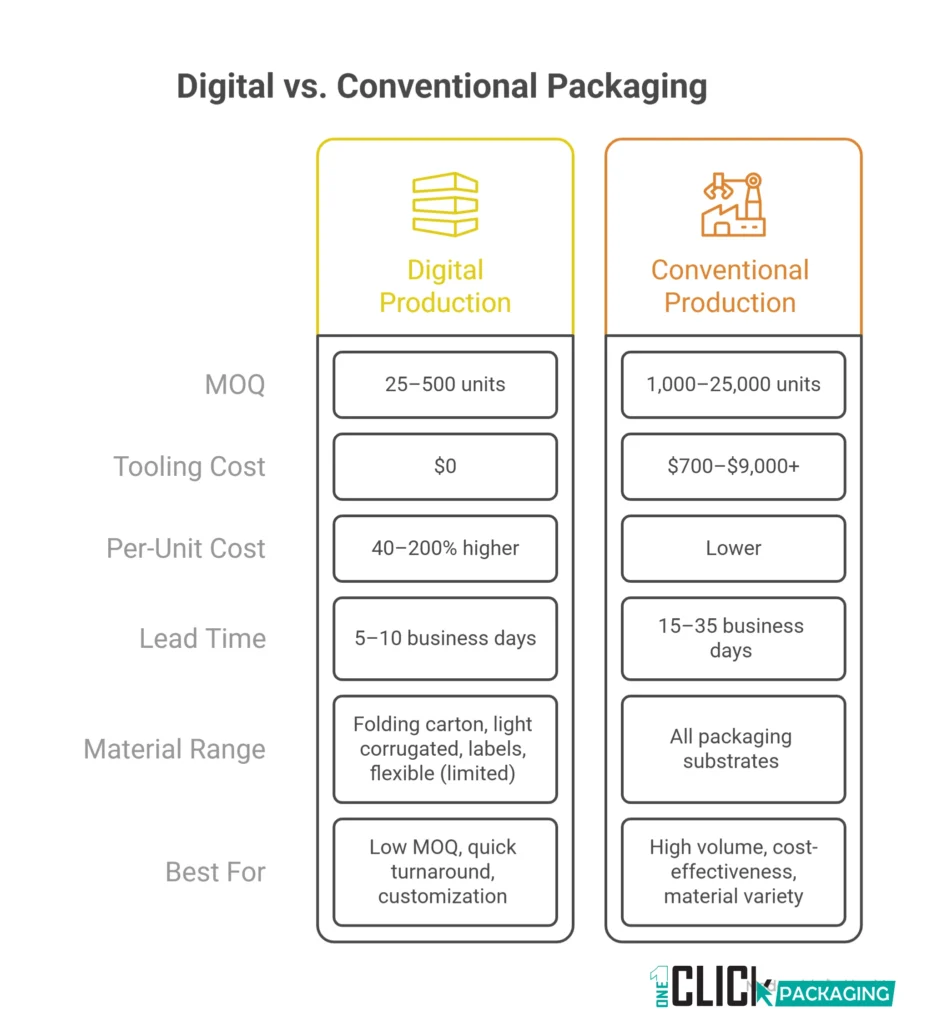
HP Indigo, Xeikon, and comparable digital press technologies combined with Kongsberg or Zund digital cutting tables allow manufacturers to produce fully custom printed and cut packaging without a single steel rule die in the process, including custom printed boxes. MOQs on digital lines can be as low as 25 to 100 units, and the per-unit cost, while higher than conventional at scale, is commercially viable for product launches, retail tests, and seasonal limited editions.
The honest limitation of digital-only production is material range and speed. Digital packaging lines work well for folding cartons, light corrugated, and labels. They struggle with heavy corrugated, rigid box construction, and most flexible packaging substrates. For anything in those categories, conventional tooling still dominates and the MOQ dynamics described throughout this article fully apply.
Case Study: How a Food Brand Reduced Its MOQ by 60 Percent
A specialty condiment brand approached a folding carton manufacturer with a brief for a four-color custom tuck-end box in three sizes for custom food packaging. The initial quote came back with MOQs of 10,000 units per size, totaling 30,000 units before they could even test whether the packaging would resonate with retail buyers.
After reviewing the tooling structure, the brand’s packaging consultant identified that all three sizes could use a single die family, meaning the structural geometry was consistent enough that minor tooling adjustments could serve all three dimensions. The manufacturer agreed to build one master die with two supplementary rule adjustments rather than three fully independent dies.
Combined tooling cost dropped from an estimated $4,200 across three separate dies to $1,900 for the shared-family approach. The manufacturer revised the MOQ downward to 4,000 units per size on the basis that the total job volume of 12,000 units adequately covered the reduced tooling investment. The brand launched, tested, and reformulated their packaging direction before committing to a 50,000-unit follow-on run six months later.
The lesson here is worth repeating: tooling decisions are not just a cost line on a quote. They are structural constraints that directly define your commercial flexibility.
Asking the Right Questions Before You Commit to a Tooling Investment
Before you sign off on a custom packaging quote that includes die creation costs, these are the questions worth asking every time.
1. Who owns the die after production? Can ownership transfer to us after a defined run?
2. What is the expected die lifespan in impressions, and what does refurbishment cost?
3. Can the die be modified if we need dimensional changes to the packaging in the future?
4. Is there an existing near-line stock structure close enough to our requirements that we could avoid die creation for a first market test?
5. Can you amortize the tooling cost across our first three orders rather than recovering it entirely on the initial run?
6. What happens to our tooling if we increase volume beyond current projections? Does the per-unit amortization charge reduce?
The answers to these questions tell you far more about your total cost of packaging ownership than the unit price alone. Manufacturers who give evasive or inconsistent answers to tooling ownership and amortization questions are generally not the right long-term partners for a growing brand.
The Bottom Line on Tooling, Dies, and MOQ
Tooling investment is not a hidden fee or a manufacturer preference. It is the structural foundation of every custom packaging project. The die exists before the first unit is made. Its cost is fixed and must be recovered. The number of units required to recover it at a competitive price point is your MOQ.
Understanding this relationship gives you three practical advantages. First, you can evaluate quotes with better context, knowing whether a manufacturer’s MOQ reflects genuine tooling economics or simply a preference for larger orders. Second, you can engineer your project to minimize tooling complexity and therefore lower your MOQ floor before you even go to market. Third, you can negotiate tooling terms, ownership, amortization schedules, and die-sharing arrangements, that your competitors likely never think to discuss.
The brands that scale fastest in custom packaging solutions are not the ones with the biggest budgets. They are the ones who understand the tooling economics well enough to make smart structural decisions early, when the leverage is still available.
What is the most challenging tooling or MOQ situation your packaging project has run into? The specifics are almost always more solvable than they appear from the outside.
Frequently Asked Questions
What is the average cost to create a custom packaging die?
For folding cartons and light corrugated packaging using standard steel rule dies, expect to pay between $700 and $2,500 depending on structural complexity. Flexible packaging and rotary die applications run significantly higher, often $3,500 to $9,000 or more. These figures are consistent with mid-2025 market rates across North American and European manufacturers.
Why do manufacturers set MOQs instead of just charging more per unit for small runs?
Manufacturers do charge more per unit for small runs, but per-unit pricing alone cannot make a project viable when fixed setup costs represent a large fraction of total job cost. Below a certain volume, the math simply does not work at any price a buyer would accept. MOQs are the structural floor below which the job is unprofitable regardless of unit pricing.
Can I own my packaging die so I can use multiple manufacturers?
Yes, but you need to negotiate this upfront. Die ownership transfer is not standard in most manufacturer contracts, but it is a commercially reasonable request, particularly on higher-value tooling. Some manufacturers will agree to transfer ownership after full amortization. Others will charge a buyout fee. Securing die ownership gives you meaningful leverage when it comes time to multi-source or switch suppliers.
How does digital printing change MOQ requirements for packaging?
Digital production eliminates die creation costs entirely for supported substrates, which drops the MOQ floor dramatically. Orders of 50 to 500 units are commercially viable on digital lines. The per-unit cost is higher than conventional long-run production, but for product launches and market testing, digital packaging is often the right economic choice before committing to conventional tooling investment.
What happens to my MOQ if I need to change the packaging dimensions after ordering the die?
Any meaningful dimensional change requires a new die. Minor adjustments within the tolerance of the existing tool may be achievable at low cost. But a change to the overall footprint, height, or structural feature set almost always requires a new die creation, which resets the tooling amortization logic and effectively creates a new MOQ floor for the revised design.
Is rigid box tooling more or less expensive than folding carton tooling?
Rigid box tooling is typically more expensive per project because it involves multiple components including wrapping fixtures, gluing jigs, and assembly guides in addition to cutting tools. However, the lower production speed of rigid box manufacturing means the tooling cost per impression is comparable or even lower than folding cartons. Rigid box MOQs tend to be lower in unit terms precisely because the production process is slower and the per-unit margin is higher.