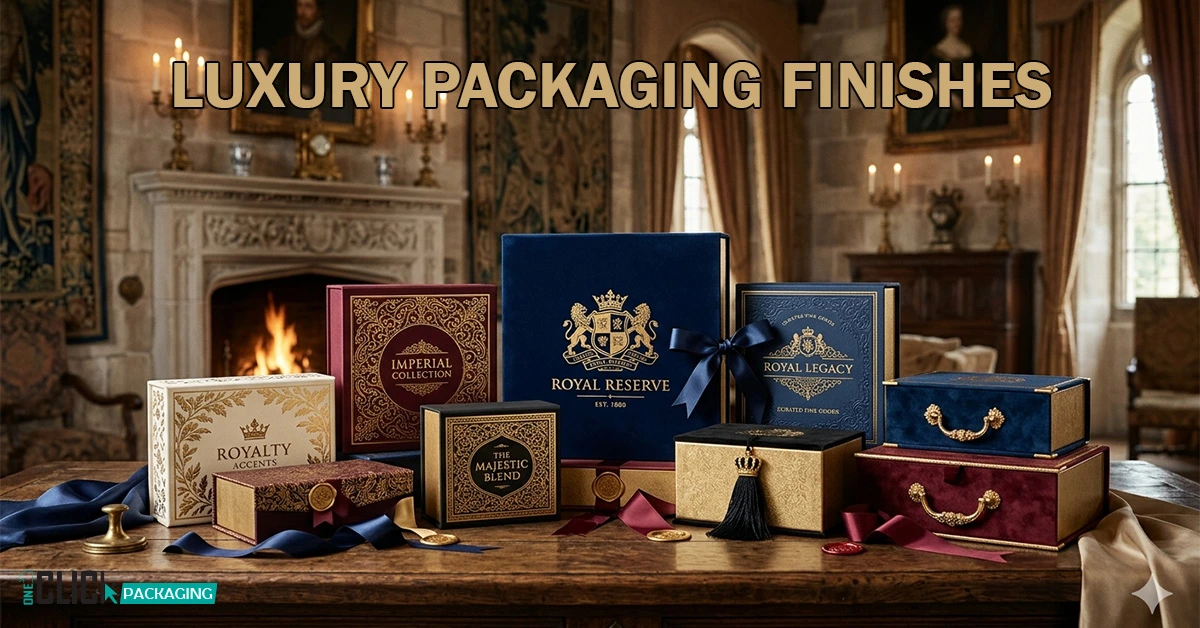

| Quick Answer Luxury packaging finishes are surface treatments applied to boxes, bags, and containers to enhance their visual and tactile appeal as part of a customized packaging solution. The most common types include UV coating (high gloss or soft-touch matte), foil stamping (gold, silver, holographic), embossing and debossing (raised or recessed patterns), spot UV (selective gloss contrast), and textured laminates (linen, leather, soft-touch). These finishes signal premium quality, increase perceived product value, and directly influence a buyer’s first impression at the point of sale or unboxing. |
A few years ago, I picked up a candle at a boutique in Lahore. I had no idea what the scent was. I had no idea what the brand was. But I put it in my basket immediately — because the box felt like nothing I had ever touched. Soft, almost suede-like, with a single line of gold lettering pressed into the surface. The lid sat with a quiet, satisfying resistance, similar to rigid gift packaging. I spent $60 on a candle I had never smelled based entirely on how the packaging felt in my hands.
That is the power of luxury packaging finishes. And it is not an accident. It is engineering.
This supporting guide breaks down every major coating, texture, and surface effect used in premium packaging today — what each finish does, what it costs, which brands use it, and how you layer them to create packaging that buyers cannot ignore.
What Makes a Packaging Finish Feel Luxurious?
The answer is not simply ‘shininess.’ In fact, matte finishes dominate the premium tier right now. What makes a finish feel luxurious comes down to four factors: tactile contrast, visual depth, material consistency, and deliberate restraint.
Tactile contrast is the most underestimated. When a customer runs their fingers across a box and feels an unexpected shift — from soft matte to gloss logo, or from flat surface to raised emboss — their brain registers surprise and then delight. That moment of discovery is the physical equivalent of a gasp. It communicates that someone thought carefully about every millimetre of this product.
Visual depth refers to how three-dimensional the packaging looks. A flat, single-colour box printed on uncoated paper looks cheap even if the design is excellent. A box with a matte base, debossed pattern, and gold foil badge has visual layers that make the eye travel across the surface. It rewards attention.
To understand how these finishes sit within the broader material ecosystem, it helps to first explore the substrate itself. [SEE→ Packaging Materials Guide: What Brands Use to Protect Products]
UV Coating: The Gloss-to-Matte Spectrum Explained
UV (ultraviolet) coating is the most widely used surface treatment in commercial packaging. A liquid coating is applied to the printed substrate and cured instantly under UV light. The result is a protective layer that can range from mirror-like gloss to a perfectly dead matte finish depending on the formulation.
Full Gloss UV
Full gloss UV was the standard premium finish through the early 2010s. It delivers a wet, high-reflectivity surface that makes printed colours look saturated and vivid. It is still widely used in food and electronics packaging where visibility and shelf pop matter most. The challenge: it now reads as slightly dated in the ultra-premium tier because every mid-range brand uses it.
Soft-Touch Matte (Velvet) Coating
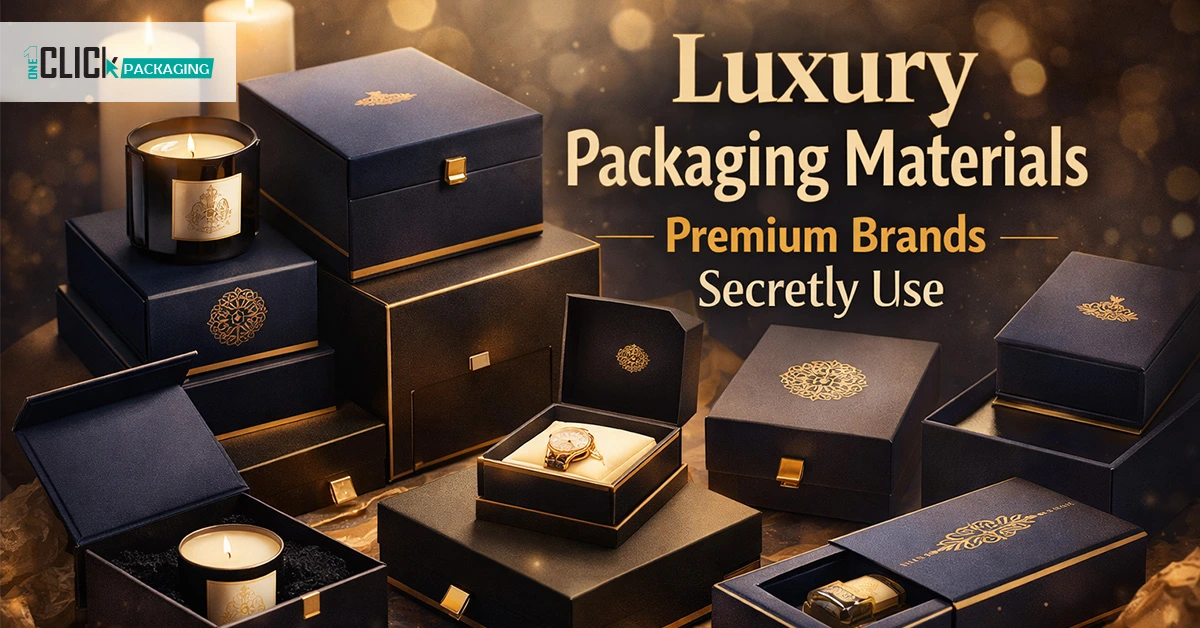
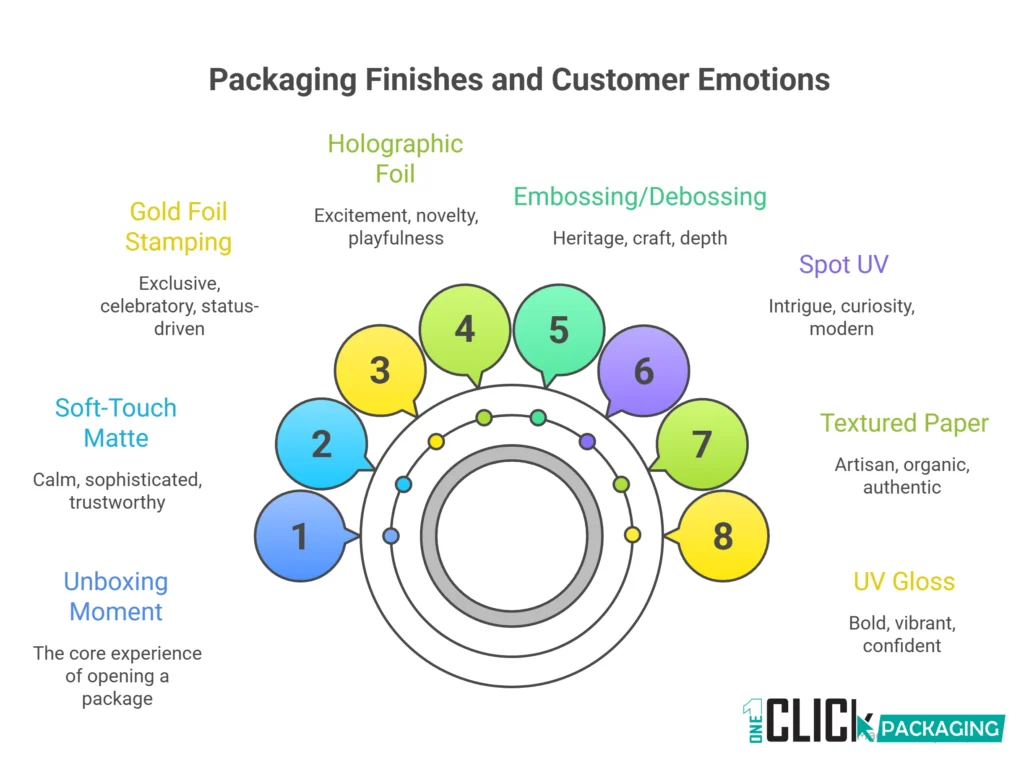
This is the finish that changed everything. Soft-touch matte UV coating creates a surface that feels genuinely like suede or velvet, ideal for custom perfume boxes. It photographs beautifully, ages gracefully, and communicates restraint — which is the defining language of the post-2015 luxury aesthetic. Brands like Aesop, Glossier, and Maison Margiela Fragrances have built entire visual identities around this finish in cosmetic packaging boxes.
The one downside nobody warns you about: soft-touch coatings are fingerprint magnets. On a black or deep navy box, fingerprint marks show immediately. The workaround is to design with lighter base colours or accept that the surface will show handling — which some brands have actually leaned into as a feature (the marks of a well-used, beloved product).
Spot UV Coating
Spot UV applies gloss coating to selected areas of an otherwise uncoated or matte-laminated surface. The contrast between the dull base and the shiny accent creates a visual and tactile effect that is dramatic out of proportion to its cost. A spot UV logo on a matte box is one of the highest-impact, lowest-cost finishing moves in packaging design for skincare packaging. Many brands use it as their primary luxury signal without any foil or emboss at all.
Foil Stamping: The Finish That Stops People Mid-Aisle
Foil stamping applies a metallic or pigmented foil to the surface of a box using heat and pressure through a custom metal die. It is one of the oldest luxury finishing techniques — it has been used on book covers and perfume boxes for over 150 years — and it remains one of the most effective.
The reason foil stamping endures is physics. Metallic foil reflects light in a way that no printed ink can replicate. When a customer looks at a gold foil logo from across a retail shelf, the logo catches ambient light and appears to glow. It is visual interruption at its most effective.
Gold vs. Silver vs. Rose Gold Foil
Gold foil communicates heritage, warmth, and status in custom candle boxes. It is the default choice for perfume, spirits, and gifting. Silver foil reads as modern, technical, and cool — it works well for skincare and electronics accessories. Rose gold foil had a major run from 2016 through 2021 and is now settling into a more niche position, still strong in beauty and feminine-positioned wellness brands.
Holographic Foil
Holographic foil shifts colour and pattern as the viewing angle changes. It is inherently attention-grabbing and works best for limited-edition releases, collaborative collections, and younger-skewing premium brands. Rare Beauty’s holiday packaging, for instance, has used holographic accents to signal specialness without abandoning their clean brand language.
Coloured Pigment Foil
Foil does not have to be metallic. Solid colour foils — matte black, deep red, navy — create a different kind of luxury signal: one of quiet depth rather than shine. A matte black foil logo on a charcoal box is almost invisible until the light shifts, at which point it suddenly appears. That reveal effect is sophisticated and highly effective for brands aiming at a luxury-but-understated positioning.
Embossing and Debossing: Where Texture Becomes Architecture
Embossing raises a design element above the surface of the substrate. Debossing presses it below the surface. Both use custom metal dies and significant pressure. Both create a genuinely three-dimensional tactile experience that no coating or foil can replicate.
I have seen brands get this wrong in two consistent ways. The first is using a design that is too detailed for the technique. Embossing works best with clean, bold shapes — thick logotype, simple geometric patterns, broad brand marks. Fine lines and small text get lost in the relief and end up looking muddy rather than refined.
The second mistake is pairing embossing with too-thin substrate. I saw a brand once try to emboss a 250 gsm folding box and the edges cracked at the score lines during assembly. You need minimum 350 gsm for reliable embossing, and rigid board for any deep-relief work.
Blind Emboss vs. Registered Emboss
A blind emboss applies the texture to an unprinted area — no ink, no foil, just pure dimensionality. It is the most restrained and arguably the most sophisticated emboss application. A registered emboss aligns the raised area precisely with a printed or foiled element underneath, so the colour and texture reinforce each other. Both techniques have their place, but blind emboss on uncoated natural stock is one of the most effective quiet-luxury signals in packaging.
Combination Techniques: Foil + Emboss
The combination of foil stamping and embossing in the same die pass is called foil embossing or registered foil relief. The result is a logo or design element that is both metallic and three-dimensional simultaneously. This is the technique used on Chanel perfume outer boxes, premium whisky cartons, and most high-end jewellery packaging. The unit cost adder is significant — typically $0.50 to $1.20 per unit at 5,000 quantity — but the perceived quality jump is disproportionate.
Luxury Finishes Compared: Quick Reference Guide
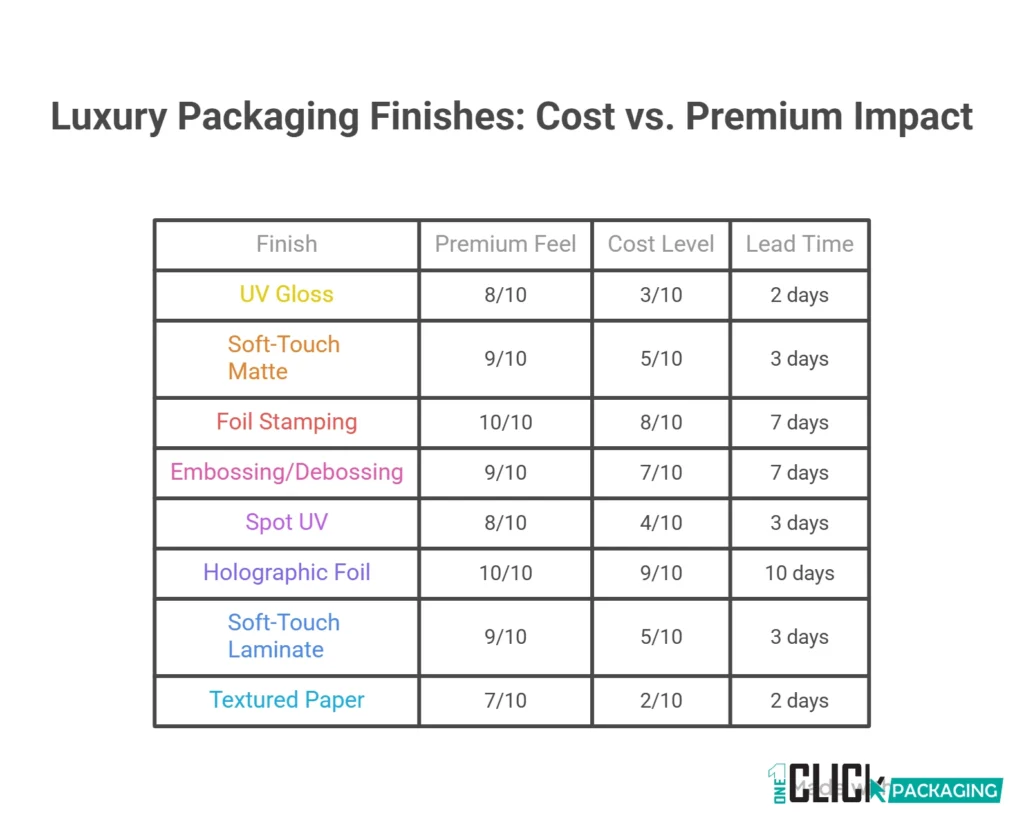
Here is a practical comparison of the eight main luxury packaging finishes across the criteria that matter most to brand owners and packaging buyers.
| Finish Type | Premium Feel | Cost Level | Lead Time | Best For |
| UV Gloss Coating | High | Low | Very Fast | Electronics, cosmetics |
| Soft-Touch Matte | High | Medium | Fast | Skincare, spirits, candles |
| Foil Stamping | Very High | High | Medium | Perfume, jewellery, gifting |
| Embossing/Debossing | High | High | Medium | Spirits, luxury apparel |
| Spot UV | High | Medium | Fast | Cosmetics, tech accessories |
| Soft-Touch Laminate | High | Medium | Fast | Premium retail packaging |
| Holographic Foil | Very High | High | Slow | Limited editions, beauty |
| Textured Paper/Linen | Medium | Low | Fast | Stationery, artisan goods |
Soft-Touch Laminate vs. Soft-Touch Coating: The One Distinction That Matters
These two finishes feel almost identical to the touch but behave very differently in production and in long-term use. Soft-touch laminate is a physical BOPP film bonded to the substrate using heat and adhesive. Soft-touch coating is a water-based chemical formulation applied by roller and cured by UV or heat drying. Both deliver the signature velvety surface texture.
Soft-touch laminate wins on durability. It resists scuffs, humidity, and repeated handling significantly better than coating. For retail shelf stock that may sit for weeks or for outer cartons that go through distribution, laminate is the safer choice.
Soft-touch coating wins on sustainability. BOPP laminate adds a plastic layer that makes the board difficult to recycle. Water-based soft-touch coating keeps the substrate fully paper, which means it goes into the paper recycling stream without delamination. For brands that have made sustainability a public commitment, this is not a minor difference — it is a brand integrity issue.
Textured Papers and Specialty Substrates as the Finish Itself
Not every luxury finish comes from a post-print process. Some of the most effective premium packaging uses the paper itself as the surface experience. Embossed paper stocks — linen-texture, laid-finish, felt-weave — arrive with built-in texture from the mill. The brand just prints on them and lets the paper do the talking.
GF Smith’s Colorplan range, Fedrigoni’s Sirio and Splendorlux lines, and Arjowiggins’ Conqueror papers are the go-to specialty substrates for this approach.These papers are priced at a significant premium over standard coated board — typically 3x to 6x the material cost but they eliminate the need for post-print lamination or coating, which can actually bring the total finishing cost close to parity in custom boxes for bakery.
The aesthetic outcome is also different. Specialty substrates communicate craft and materiality rather than technical perfection. They work best for artisan brands, independent spirits, stationery, and high-end candles where the ‘handmade’ signal matters.
How to Choose and Layer Finishes for Your Brand
The instinct of most brand owners encountering luxury finishes for the first time is to add as many as possible. More foil, more emboss, more gloss more luxury. This is a mistake that experienced packaging designers learn to unlearn.
The most effective premium packaging is deliberately edited. You pick one primary finish (usually soft-touch matte as the base) and one accent finish (spot UV, foil stamp, or emboss applied only to the brand mark or a specific design element). The restraint in the accent is what makes it land. A foil logo on a matte box says: this one thing matters. Cover 40% of the box in foil and it becomes noise.
The Three-Layer Framework
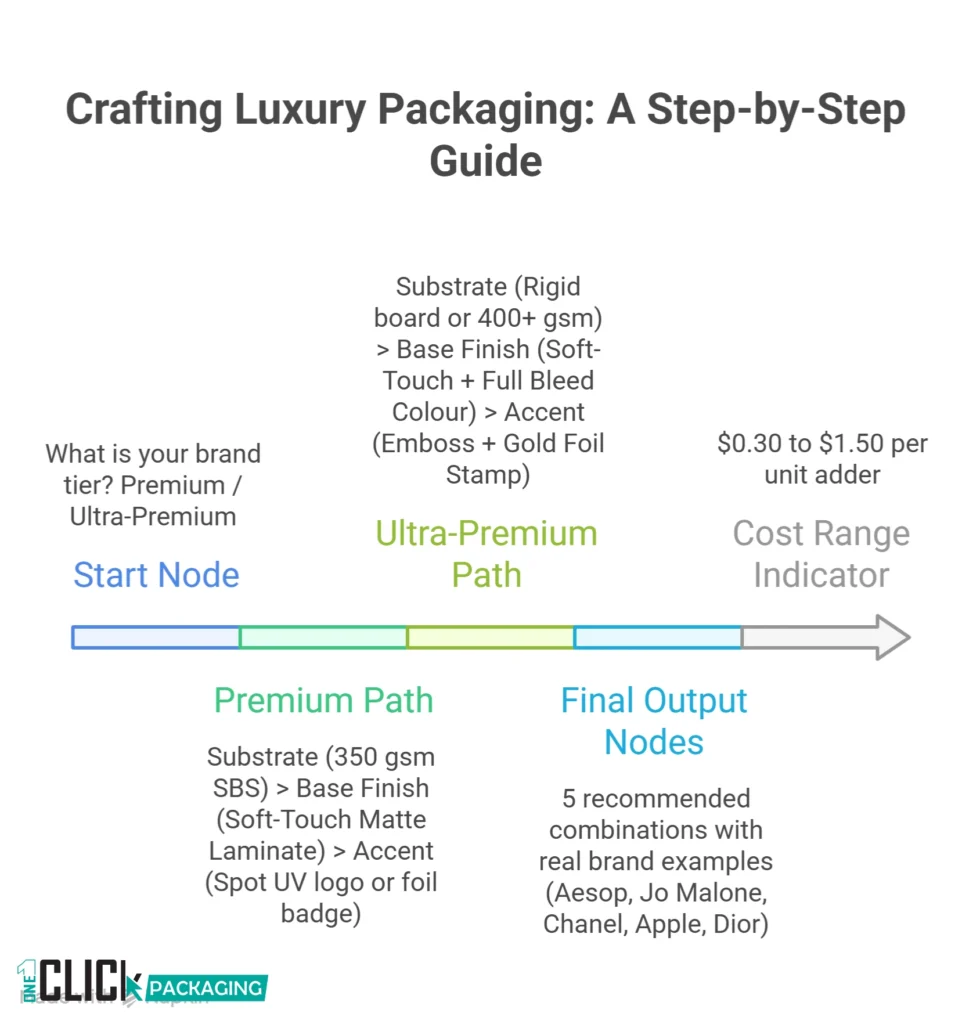
Think in three layers: substrate, base treatment, and accent. The substrate determines what is possible (GSM, rigidity, fibre type). The base treatment sets the tactile and visual tone (matte laminate, soft-touch coating, uncoated natural). The accent adds the moment of surprise (spot UV, foil, emboss). Each layer should justify itself with a specific brand reason, not just aesthetic preference.
Brand Tier Alignment
Entry-level premium brands (think $25-$60 product price point): Soft-touch matte laminate + spot UV logo. Clean, effective, budget-realistic at approximately $0.15 to $0.30 per unit adder.
Mid-premium brands ($60-$150 price point): Soft-touch matte + gold foil stamp on logo. This is the sweet spot for beauty, spirits, and gifting. Per unit adder approximately $0.40 to $0.70.
Ultra-premium brands ($150 and above, gifting, fragrance, jewellery): Specialist substrate + soft-touch coating + registered foil emboss on brand mark. Per unit adder $0.80 to $1.50 plus die amortisation.
Sustainability and Luxury Finishes: The Honest Trade-Off
Here is the uncomfortable truth that most packaging suppliers will not lead with: the finishes that feel the most luxurious are often the hardest to recycle.
BOPP soft-touch laminate adds plastic. Foil stamping leaves metallic residue in the paper stream. Solvent-based UV coatings release VOCs in production. The entire finishing industry has historically prioritised sensory impact over environmental responsibility, and brands are now caught in the tension between those two values.
The good news is that this is changing with genuine momentum. Water-based soft-touch coatings have improved dramatically in quality since 2021 and are now effectively indistinguishable in feel from solvent-based versions. Digital foiling (cold foil via inkjet) uses less metallic material than traditional hot-foil stamping and works at shorter run lengths. FSC-certified substrates with minimal finishing — like the approach used by Aesop and Seed — are gaining traction as sustainability becomes a luxury signal in its own right.
My honest take: if your brand has made public sustainability commitments, you cannot justify BOPP laminate as your primary surface treatment anymore. The risk of that inconsistency being noticed — by a journalist, by a conscious consumer, by a competitor — outweighs the marginal tactile difference.
What the Unboxing Experience Research Actually Says
There is a growing body of packaging psychology research — most notably from the Journal of Business Research and the Journal of Consumer Psychology — on what they call haptic engagement: the cognitive and emotional effects of touching a product before purchasing it.
The findings are consistent. Packaging that is smooth and uniform creates baseline expectations. Packaging with tactile variation — texture contrasts, raised elements, unexpected softness — creates what researchers call ‘material curiosity,’ which increases handling time, reduces purchase hesitation, and raises the perceived value of the product inside.
The specific effect of soft-touch surfaces is particularly well documented. Subjects in tactile research studies consistently rate products packaged in soft-touch materials as higher quality, more trustworthy, and worth more money — even when the product itself is identical to a version in standard packaging. The velvet surface activates associations with care, with craft, with being handled gently.
Final Thoughts: The Finish Is the First Product Experience
Before anyone smells your candle, drinks your whisky, applies your skincare, or opens your jewellery box — they touch the packaging. That moment, which takes less than two seconds, sets every expectation that follows.
The brands that understand this invest in finishing with strategic intention rather than budget reaction by working with a reliable packaging box supplier. They pick one primary finish and one accent. They align the finish to the brand tier. They test the tactile experience in real retail conditions, not just on a screen. And they revisit the finishing specification every 18 to 24 months as both manufacturing capabilities and consumer expectations evolve.
The candle I bought in that Lahore boutique still sits on my desk three years later. I have never burned it. The box is too beautiful to unwrap. That is the goal.
What packaging finish has created the most memorable brand experience you have encountered — as a buyer or a brand owner? I would genuinely like to know.
Frequently Asked Questions
Q1: What is the most popular luxury packaging finish in 2025?
Soft-touch matte laminate is currently the most requested finish across premium beauty, spirits, and personal care. Brands love it because it combines a velvety tactile feel with a clean, modern look that photographs beautifully for e-commerce. Foil stamping remains the go-to accent finish when brands want to layer a metallic element on top.
Q2: How much does luxury packaging finishing add to the cost per unit?
It depends on the finish and the run quantity. Soft-touch laminate adds roughly $0.08 to $0.20 per unit on a 5,000-unit run. Foil stamping can add $0.25 to $0.70 per unit. Embossing with a custom die adds $0.30 to $0.80 per unit once the die cost is amortised. For orders under 1,000 units, these numbers climb significantly due to setup fees.
Q3: Can you combine multiple finishes on one box?
Yes, and this is actually where the magic happens. The most effective luxury packaging combinations pair a soft-touch matte base with spot UV highlights or gold foil stamping. Chanel and Jo Malone are excellent examples: both use a matte base with precise foil logos. The contrast between dull and gloss — or between soft and metallic — creates the visual tension that stops customers in their tracks.
Q4: Which packaging finish is most sustainable?
Water-based soft-touch coatings are the most eco-friendly option right now. They skip the plastic film entirely, which makes the finished box recyclable without delamination issues. Brands like Seed and Haeckels have moved in this direction. Avoid solvent-based coatings and standard BOPP laminate if recyclability is a brand priority.
Q5: Is soft-touch laminate the same as soft-touch coating?
Not exactly. Soft-touch laminate is a physical film bonded to the substrate. Soft-touch coating is a chemical application that cures onto the surface. Both deliver a similar velvety feel, but laminate is more durable and resistant to scuffs. Coating is thinner and more eco-friendly. For high-contact retail packaging, laminate wins on durability. For sustainability-led brands, coating is the better choice.
Q6: Does embossing work on all packaging materials?
Embossing works best on thicker substrates — typically 350 gsm or higher. Thin paperboard (below 250 gsm) can crack or tear during the pressing process. It also works well on rigid book-wrap boxes and specialty art papers. Avoid embossing on heavily coated gloss surfaces, as the coating can crack at the fold point and ruin the finish.
Q7: What packaging finishes do high-end brands like Dior or Apple use?
Apple uses a consistent matte texture on their outer shipping boxes and relies on precise die-cutting and tight tolerances rather than heavy surface decoration. Dior perfume boxes combine matte base stock with debossed logos and gold foil accents. Aesop uses uncoated kraft-style papers with minimal finishing, proving that restraint can feel just as luxurious as heavy ornamentation when the structural design is exceptional.
Q8: How do packaging finishes affect the unboxing experience?
Significantly. Tactile finishes create what psychologists call haptic engagement — the moment a customer physically touches the box, their brain begins forming a quality impression before they even open it. Soft-touch surfaces slow down the opening process because people handle them more gently and deliberately. That slower interaction increases the perceived value of the product inside, which is why brands in the premium gifting and beauty space invest heavily in tactile surface treatments.
Q9: Can luxury packaging finishes be used for small batch or startup brands?
Yes, but with realistic expectations. Digital foiling (cold foil via inkjet-based systems) now allows foil-stamped effects on runs as low as 250 units. Soft-touch laminate is available at most trade print suppliers from 500 units. Embossing still requires a custom metal die, which typically costs $150 to $400 and is worth it only if you plan consistent reorders. Short-run luxury finishing has genuinely improved — the barrier to entry is far lower than it was even three years ago.
Q10: What is spot UV coating and how is it different from full UV?
Full UV coating covers the entire surface of the printed piece with a high-gloss varnish. Spot UV coating applies that same gloss selectively only to specific design elements like a logo, pattern, or product name. The contrast between the uncoated matte base and the shiny spot UV creates a dramatic visual and tactile effect. It is one of the most cost-effective ways to add a luxury feel without a full laminate or foil process.