
A few years ago, I watched someone in a Zurich department store spend eleven minutes deciding whether to buy a perfume. She had already smelled it. She already loved it. What she kept returning to was the bottle. She turned it over, felt its weight, ran her thumb across the frosted glass stopper, and finally placed it back. Then she picked it up again. She bought it.
The perfume cost CHF 380. The bottle probably cost the brand CHF 22 to produce. But that bottle did something no advertisement could replicate. It communicated permanence, craft, and value through material alone.
That is the entire business case for luxury packaging materials in a single anecdote.
Premium brands have known this for over a century. The material is not a container. It is a message. Hermes does not wrap purchases in tissue and ribbon because it reduces shipping damage. Chanel does not use heavyweight rigid board boxes because cardboard costs more per gram. Macallan does not encase its 30-year whisky in hand-crafted wooden crates because timber is easier to ship than cardboard. They do it because the material itself communicates something no price tag can.
This article breaks down exactly which materials high-end brands use, why they choose them, what each costs at production scale, and where the packaging industry is heading as sustainability pressure intensifies. If you are building a premium product brand or advising one, this is the foundation you need.
What Actually Makes a Material Feel Luxury?
Here is something the packaging industry rarely admits openly: there is no single luxury material. There is only material used with intention.
I have seen kraft paper used on a CHF 600 skincare product that felt extraordinary. I have also seen embossed gold foil on a CHF 15 chocolate box that felt cheap. The difference was not the substrate. It was the weight, the finish, the structural integrity, and above all, the coherence between material and brand promise.
That said, certain materials carry inherent luxury signals. They have built that reputation through decades of association with premium brands, and those associations are now embedded in consumer psychology. Understanding which materials carry those signals is essential before you make any packaging investment.
Luxury packaging is not about the most expensive material. It is about the right material executed with uncompromising precision.
Weight is the first signal. Heavy packaging triggers what packaging psychologists call the weight-quality heuristic — the unconscious assumption that heavier objects are more valuable. A 400gsm rigid chipboard box feels more premium than a 280gsm box of the same dimensions, and consumers cannot always explain why. They just know.
Texture is the second signal. Tactile engagement activates emotional memory and creates what researchers at the University of Mannheim termed the haptic processing effect the tendency to trust and value products we have physically engaged with. This is why brands like Aesop use uncoated FSC kraft boards that invite touch rather than repel it.
Permanence is the third signal. Materials that suggest the packaging outlives the product communicate investment. The reason Rolex ships watches in polished wooden boxes is not logistics. It is because the box becomes a display object, a trophy, an artefact. The packaging becomes part of the product’s story.
Before diving into specific materials, understanding the full spectrum of packaging substrates available to brands is essential. [See: Packaging Materials Guide: What Brands Use to Protect Products]
Rigid Chipboard and Greyboard: The Backbone of Luxury Paper Packaging
If you have ever opened a luxury watch, a high-end fragrance, or a designer accessory and been struck by the satisfying rigidity of the box, you have experienced what rigid chipboard does at its best.
Rigid chipboard sometimes called greyboard or setup boxes is the single most widely used substrate in luxury paper-based packaging. The board itself is typically 1.5mm to 4mm compressed grey board, wrapped in a separate outer layer of printed or textured paper. The two-piece construction, lid and base, creates that signature resistance when opened. It does not flop. It does not bend. It holds its geometry under pressure.
Why Brands Choose Rigid Board Over Folding Cartons
Folding cartons, the standard substrate for mass-market packaging, are manufactured flat and creased into shape at point of assembly. They are cheaper, faster, and more efficient to ship. They are also visibly less premium.
Rigid boxes are built upright. The board is cut, scored, and wrapped individually. Labor costs are significantly higher — a rigid box typically costs 3x to 8x more per unit than a comparable folding carton at the same print specification. For a brand like Dior, that cost difference is irrelevant. For a challenger brand entering the premium space, it is a significant early investment.
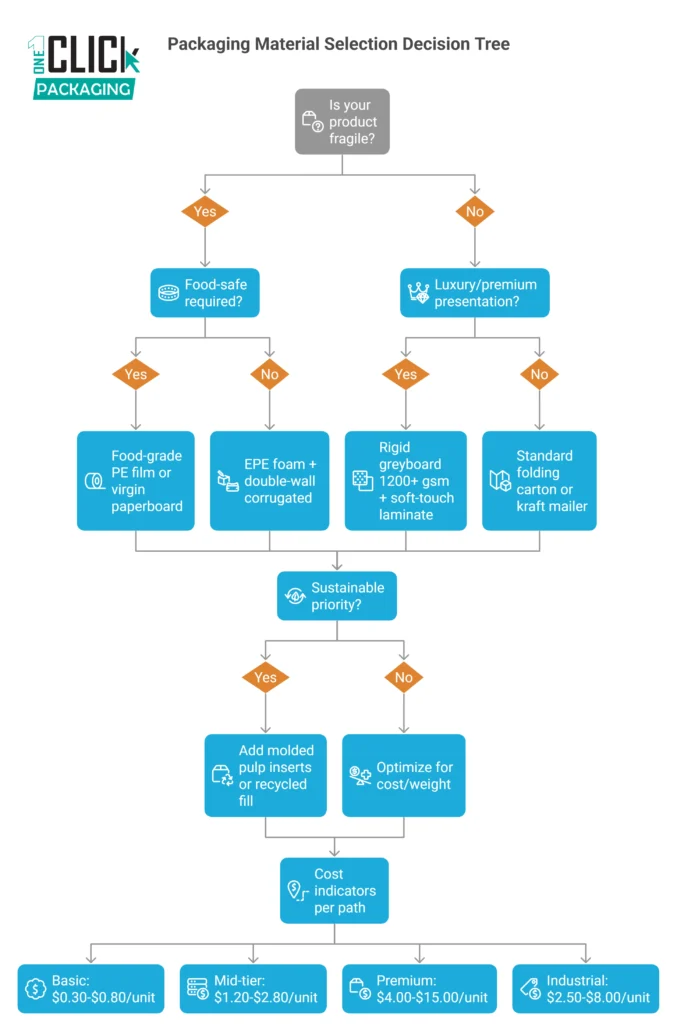
Brands like Chanel, Burberry, and Bottega Veneta use rigid board for virtually all their primary retail packaging. The weight benchmark I have seen consistently cited by premium packaging designers is a minimum of 1,200gsm board for the structural layer anything below that begins to feel hollow when tapped.
Foil-Wrapping and Covering Papers
The external covering paper transforms rigid board from industrial grey to brand identity. Common choices include:
• Specialty textured papers: Linen, woven, and embossed textures add tactile richness without additional finishing costs
• Foil-laminated papers: Metallic effect without spot foiling used extensively in fragrance and spirits packaging
• Uncoated matte papers: Increasingly popular for contemporary luxury brands seeking an editorial, understated finish
• Velvet and suede papers: Flock-coated or soft-touch laminated papers that mimic fabric used by jewellery brands including Cartier and Van Cleef
Glass: The Undisputed Icon of Luxury Packaging
There is a reason hand-blown glass has been used for perfume vessels since ancient Egypt in fragrance packaging. It is because glass does things no other material can do.
Glass has optical clarity, permanence, chemical inertness, and a physical weight that signals investment. When you hold a Baccarat crystal bottle, the density is palpable. When you open a bottle of Dom Perignon, the green glass communicates something about the wine inside before a single word is read.
Types of Glass Used in Luxury Packaging
Not all glass is equal in the luxury context. The industry distinguishes between several grades:
• Soda-lime glass: The standard commercial glass, used across most spirits and cosmetics. Can be produced in heavy-walled format for premium effect at lower cost than specialty glass.
• Borosilicate glass: Higher clarity and thermal resistance. Used in laboratory-aesthetic skincare brands. Aesop uses it for select product lines.
• Crystal and lead-free crystal: Maximum clarity, brilliance, and weight. Used by Baccarat in their fragrance collaborations with Maison Francis Kurkdjian and others. Hand-cut crystal facets refract light in ways that are genuinely impossible to replicate in plastic.
• Frosted glass: Achieved through acid-etching or sandblasting, often used in luxury glass cosmetic jars. Creates a soft, tactile, matte surface. Used extensively by Chanel, Sisley, and many niche fragrance houses.
The Cost Reality of Glass Packaging
Glass is expensive to produce at small scale and becomes dramatically more efficient at volume. At MOQs below 5,000 units, a custom-moulded glass bottle may cost USD 4.00 to USD 12.00 per unit including closure. At 50,000 units, the same specification often drops to USD 1.80 to USD 4.50.
This is why the luxury fragrance market is dominated by large houses. A brand like La Mer, owned by Estee Lauder Companies, can amortize mould costs across 200,000+ annual units. An independent perfumer launching their first collection cannot.
The solution many premium indie brands have found is to use standard glass forms from Italian suppliers including Verescence and SGD Pharma, then differentiate through closure, cap, and label rather than the bottle itself for custom perfume boxes. It works, provided the chosen form has sufficient weight and distinction.
Metal Packaging: Aluminium, Tin, and Steel in Luxury Contexts
The Diptyque Baies candle tin has been essentially unchanged for over three decades in luxury candle packaging. The Fortnum & Mason gift hamper tin is something people keep for twenty years after eating the biscuits inside. The Jo Malone fragrance tin accompanies product launches for limited editions that sell out in hours.
Metal packaging in luxury contexts operates on a completely different logic than metal in FMCG. Where mass-market food brands use tin because it is functional and cheap, luxury brands use metal because it is the most permanent packaging substrate available. It does not decompose, fade, or deform. It becomes an heirloom.
Aluminium in Premium Packaging
Aluminium is the dominant metal in premium beverage, fragrance, and personal care packaging. It is lighter than tin, fully recyclable, and accepts print treatments including embossing, debossing, and lacquering with precision.
The premium spirits industry has increasingly adopted aluminium for travel retail formats. Glenfiddich, Johnnie Walker Blue Label, and Clase Azul all use aluminium elements in their ultra-premium packaging. Weight is added deliberately through wall thickness, not material density.
Embossed aluminium tubes have become a signature of high-end hand cream and skincare brands. Aesop uses them throughout their range. The resistance to puncture, the tactile surface texture, and the way they maintain their shape — unlike plastic tubes that wrinkle after use — all reinforce the premium positioning.
Tin and Steel for Gift Packaging
Premium tin is where the gifting market finds its most powerful packaging tool. A beautifully lithographed tin transforms any product into a gift. This is not an accident.
Fortnum & Mason earns approximately 30% of their annual revenue during the Christmas period, and the signature Eau de Nil tins are central to that positioning in tea tin presentation. They commission new tin designs each year, and collectors purchase them for the tin alone, sometimes without even being regular customers.
Harrods, Prestat, and Valrhona all use premium tin for seasonal confectionery packaging. The production minimum for custom-printed tin is typically 10,000 units, which puts it out of reach for small independent brands but the brand equity accumulated over repeated use justifies that scale commitment.
Wood and Natural Materials: Packaging as Heirloom Object
There is a moment when packaging stops being packaging and becomes furniture. Watch brands figured this out first.
Rolex ships every watch in a polished wooden presentation box, much like custom watch boxes. much like custom watch boxes. Patek Philippe boxes have been described by collectors as more desirable than some competing brands’ watches. A.Lange and Sohne uses custom-moulded velvet inserts in solid wood cases, hand-assembled in Glashutte. These are not decorative choices. They are brand architecture decisions.
Wood Species and Their Luxury Associations
The choice of wood species carries its own code of signals:
• Walnut: Dark, rich grain associated with traditional craftsmanship. Used by premium spirits brands including Macallan and Highland Park for prestige releases.
• Cherry: Warm reddish tones. Associated with traditional American and European instrument making. Used by some mid-tier watch brands.
• Maple: Light, even grain. Contemporary feel. Used by Bang and Olufsen in product packaging for high-end audio equipment.
• Rosewood and Ebony: Reserved for the absolute top tier. CITES restrictions on natural rosewood have pushed many brands toward high-quality veneers or engineered alternatives.
• Bamboo: The sustainable alternative gaining rapid adoption. Technically a grass, but its structural properties rival hardwood. Used by Aesop, Kiehl’s, and various independent skincare brands.
The Labour Cost Reality
Custom wooden packaging is among the most expensive substrate categories available. Hand-assembled wooden watch boxes from established Swiss suppliers can cost CHF 60 to CHF 200 per unit at the component level, before any branding. At volume, this drops significantly, but for ultra-premium presentation, the per-unit material cost often exceeds 5% to 8% of the product’s retail price.
For a CHF 5,000 watch, a CHF 200 box represents 4% of retail. Most brand directors consider that acceptable, even essential. For a CHF 200 product, that same percentage means a CHF 8 packaging budget and you cannot make an heirloom-quality wooden box for CHF 8.
This is why wood as primary packaging material is typically reserved for products above the CHF 500 retail threshold, with exceptions in ultra-premium spirits and jewellery.
Specialty Papers and Textured Boards: The Underrated Luxury Substrate
Here is the insight that separates good packaging designers from great ones: the most commercially accessible luxury material is also one of the most powerful. Specialty paper, used correctly, creates sensory experiences that rival materials costing ten times as much.
Fedrigoni — the Italian specialty paper manufacturer founded in 1888 — produces papers that luxury brands from Valentino to Loro Piana use for secondary packaging, wrapping tissue, and carrier bags. Their Materica range in particular has become almost ubiquitous in the upper mid-market luxury space. It is uncoated, deeply textured, available in a range of earthy tones, and communicates artisanal quality instantly.
Papers That Carry Weight Above Their Cost
• Conqueror CX22: The classic laid paper still used for luxury stationery and premium product documentation. Watermark-authenticated, acid-free, 100gsm to 300gsm range.
• Invercote from Iggesund: A premium coated board used by brands including LVMH group packaging suppliers. Exceptional surface uniformity for high-resolution print.
• GF Smith Colorplan: The standard for luxury brand stationery and ancillary packaging. 270+ colour options, consistent texture, widely used in UK premium retail.
• Sappi Silk and Gloss: Coated papers with intense colour reproduction. Used for box wraps where print quality is as important as texture.
• Steinbeis recycled kraft: Growing significantly in use among sustainability-positioned luxury brands. The visible recycled fibre content is now a positive signal rather than a compromise.
The true transformation of specialty papers happens through finishing — understanding what coatings and effects are possible elevates your material decisions significantly. [INTERNAL LINK — luxury finishes and surface coatings → Luxury Packaging Finishes: Coatings, Textures & Effects That Elevate Product Value]
Tissue Paper and Interior Presentation
The interior of luxury packaging is where brands lose the most untapped opportunity. Most brands pour their budget into the exterior box and treat the interior as an afterthought.
The most effective luxury interior treatments I have seen consistently include: acid-free tissue paper in brand-matched colour, thermochromic tissue that changes colour when touched, custom-printed interior base lining, and velvet or flock-coated tray inserts.
Selfridges wraps every purchase in yellow tissue regardless of price point. That tissue costs approximately GBP 0.08 per sheet. The brand equity that consistency has built is immeasurable.
A deeper look at how luxury finishes transform any substrate is worth reading before finalising your paper or board choice. [INTERNAL LINK — luxury finishes transform any substrate → Luxury Packaging Finishes: Coatings, Textures & Effects That Elevate Product Value]
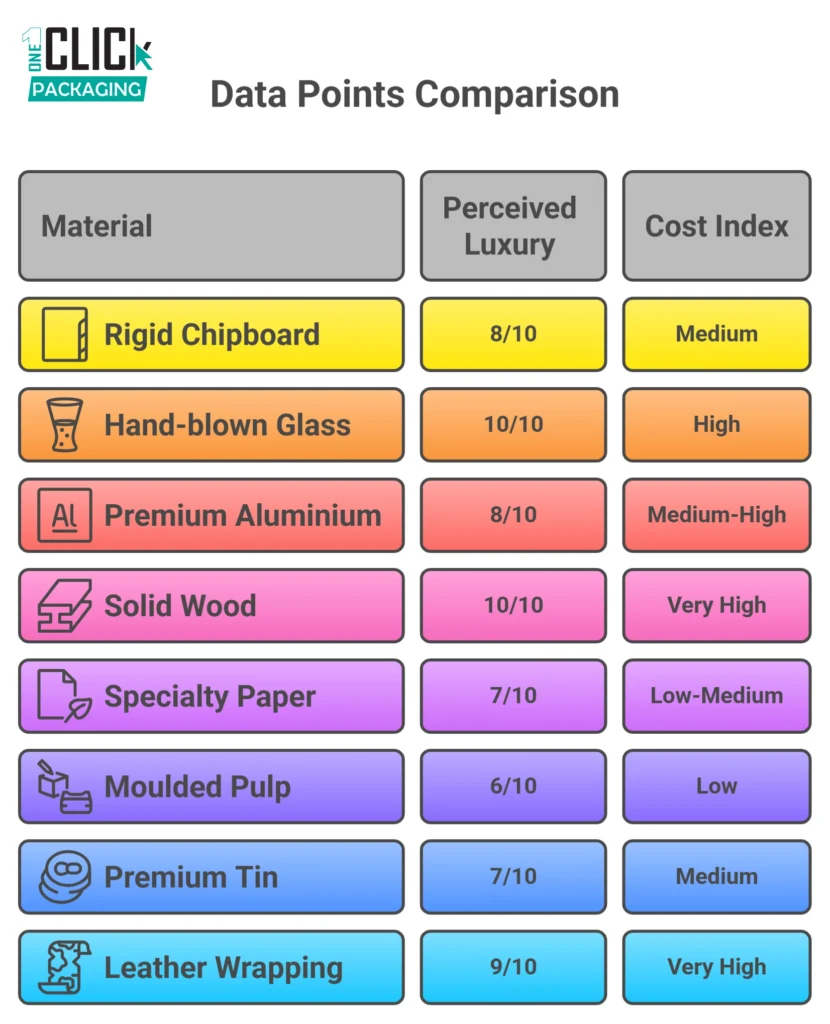
Luxury Packaging Materials: Side-by-Side Comparison
Use this reference when evaluating which material suits your product tier, budget, and sustainability targets.
| Material | Best For | Cost Range | Top Brand Examples | Sustainability Score |
| Rigid Chipboard | Apparel, fragrance boxes | $0.40–$2.00/unit | Chanel, Dior, Burberry | Medium (recyclable) |
| Premium Glass | Perfume, spirits, skincare | $1.50–$8.00/unit | Baccarat, Hendrick’s, La Mer | High (infinitely recyclable) |
| Aluminium/Tin | Candles, confectionery, tea | $0.80–$3.50/unit | Diptyque, Fortnum & Mason | High (fully recyclable) |
| Solid Wood | Watches, jewellery, spirits | $5.00–$30.00/unit | Rolex, Patek Philippe, Glenfiddich | Medium-High (FSC certified) |
| Moulded Pulp | Electronics, bottles | $0.20–$1.20/unit | Apple, Bang & Olufsen | Very High (biodegradable) |
| FSC Kraft Paper | Skincare, food, cosmetics | $0.10–$0.60/unit | Aesop, Maison Margiela | Very High (compostable) |
| Acrylic/Perspex | Display boxes, beauty | $2.00–$10.00/unit | Charlotte Tilbury, YSL Beauty | Low (petroleum-based) |
| Genuine Leather | Jewellery, watches, spirits | $8.00–$40.00/unit | Cartier, Breguet, Macallan | Low-Medium (varies) |
Sustainable Luxury Materials: The New Standard, Not the Exception
Four years ago, I would have written this section as a sidebar — interesting to some readers, optional for most brands. Today it is the most commercially urgent section in this entire article.
The luxury consumer has shifted. A 2023 Bain and Company report on luxury consumption found that consumers under 40 — who will represent 70% of global luxury spending by 2030 — rate sustainability credentials as a top-five purchase consideration. This is not idealism. It is market data with direct revenue implications.
FSC-Certified Board and Paper
Forest Stewardship Council certification has moved from niche signal to baseline expectation in premium retail. Major luxury conglomerates including LVMH and Kering Group have committed to 100% FSC or recycled fibre across their packaging by 2025. Most are on track.
FSC-certified board is now available in specifications that are indistinguishable from non-certified equivalents at the same weight and finish. The price premium has largely disappeared at commercial volumes. There is no longer a meaningful trade-off between sustainability and quality at the board level.
Moulded Pulp: The Material Big Tech Chose
Apple switched from expanded polystyrene to moulded pulp for iPhone packaging in 2013 through custom molded pulp packaging. That single decision did more to legitimize moulded pulp as a premium material than any industry report could achieve.
Moulded pulp is now used by Bang and Olufsen, Bowers and Wilkins, and a growing cohort of premium skincare brands. The material takes fine detail, can be produced in multiple colours, and has a distinctive organic texture that communicates material honesty. It also composts in 90 days.
The limitation is structural range. Moulded pulp is excellent for formed inserts and protective trays. It is not yet able to replace rigid board boxes in all applications, though hybrid constructions — moulded pulp base with rigid board lid — are increasingly common.
Mycelium and Next-Generation Biocomposites
Bolt Threads and Ecovative Design have produced mycelium-based packaging composites used by Stella McCartney and a small number of LVMH brands in pilot programs. The material grows in custom moulds in 7 to 10 days using agricultural waste as feedstock and fully decomposes in standard home compost.
At scale, mycelium packaging is expected to reach cost parity with EPS and expanded PE foam within the next 3 to 5 years. Several major luxury brands have signed letters of intent with Ecovative. Watch this space closely.
If your packaging project spans multiple material types, the broader guide covers how brands balance protection with sustainability. [See: Packaging Materials Guide: What Brands Use to Protect Products]
What the Best Luxury Brands Actually Do Differently
I have worked with brands at CHF 80 retail and brands at CHF 8,000 retail. The difference in their packaging approach is not just budget. It is philosophy.
Mass-market brands treat packaging as a cost to minimize. Premium brands treat packaging as an investment to optimize. Ultra-luxury brands treat packaging as a product in itself.
Here is what separates the top tier:
1. They define a material philosophy before they design a box. Aesop established their material language dark glass, aluminium, uncoated paper and has held it for over 25 years. Every new product fits within that system.
2. They over-invest at launch. The packaging for a new product line costs more to develop than it will cost to produce at scale. The first 10,000 units almost always lose money on packaging alone. That is acceptable.
3. They treat every interior surface as brand real estate. The inside of a box lid, the colour of a tissue, the texture of a filler insert — all considered, all intentional.
4. They test tactile response, not just visual response. Consumer testing of packaging in the luxury sector increasingly includes haptic testing protocols how does this feel in the dark? How does it sound when opened? Weight testing with blind comparisons.
5. They view sustainability as craft, not compromise. The brands gaining the most ground in the sustainable luxury space are those treating material constraints as a creative challenge rather than a marketing obligation.
The Material Is Always the Message
The woman in the Zurich department store who spent eleven minutes with a perfume bottle was not being indecisive. She was being persuaded. Not by the price tag, not by the advertisement she had seen, and not even entirely by the scent. She was being persuaded by the cold weight of frosted glass in her hand, by the whisper of resistance in the stopper, by the way the bottle caught the light.
That is what luxury packaging materials actually do. They speak a language that bypasses rational decision-making and communicates directly to the part of the brain that processes value, permanence, and reward.
The brands that understand this invest in materials with the same seriousness they invest in product formulation. The brands that do not treat packaging as a commodity — and wonder why their premium positioning never quite lands.
If I had to make one prediction about where this industry moves in the next decade: the next generation of luxury materials will be defined by sustainable origins and uncompromised sensory quality simultaneously. The brands building that capability now will be very difficult to unseat.
Your packaging is not a box. It is the first and last physical conversation your brand has with your customer. Invest in that conversation accordingly.
What is the packaging material decision your brand is currently wrestling with? I would genuinely like to know — and I suspect others reading this are asking the same question.
Frequently Asked Questions
1. What is the most commonly used luxury packaging material?
Rigid chipboard is the most widely used primary material in luxury retail packaging, followed by glass for fragrance and spirits. The combination of heavyweight rigid board box with glass or metal product container defines the standard luxury unboxing experience across most product categories.
2. How much should a luxury brand spend on packaging per unit?
Industry benchmarks suggest 8% to 15% of retail price for primary packaging at launch scale, dropping to 5% to 10% at mature volume. Ultra-luxury brands at CHF 1,000+ retail often spend 15% to 20% on packaging without concern, as the packaging itself contributes meaningfully to perceived product value.
3. Can sustainable materials really look and feel as premium as traditional luxury materials?
Yes, with the right specification. FSC board at 1,400gsm with soft-touch lamination and spot UV rivals any non-certified equivalent. Moulded pulp in premium white finish is now used by major electronics brands. The gap between sustainable and conventional luxury materials has closed significantly since 2020.
4. What is the minimum order quantity for custom luxury packaging?
It depends entirely on the material. Custom-moulded glass typically requires 5,000 to 10,000 units. Rigid board boxes can be produced from 500 units with some suppliers, though unit cost drops substantially above 2,500. Custom tin requires 10,000 units minimum as a rule. Specialty paper treatments have no minimum beyond the print run.
5. Why do luxury brands use velvet or flocking inside packaging?
Velvet and flock-coated interiors serve two functions in custom jewellery boxes: they protect the product during transport by providing grip and cushioning, and they create a tactile reveal moment when the product is first removed. That moment of resistance and luxury feel is engineered deliberately. Cartier and Van Cleef both use it systematically across jewellery packaging.
6. What is the difference between foil stamping and foil lamination?
Foil stamping applies metallic or holographic foil to specific areas of a design using a heated die — precise, expensive per unit at small runs, but highly premium. Foil lamination covers an entire surface with metallic film before printing. Foil stamping looks more considered and custom. Foil lamination provides a consistently reflective surface at lower per-unit cost.
7. Are there luxury packaging materials that are also functional?
Absolutely. Aluminium tubes prevent product oxidation. Dark glass blocks UV light, genuinely extending product shelf life for fragrance and skincare. Dense wooden boxes provide real protection for fragile items. The best luxury packaging decisions combine functional performance with aesthetic signalling — form and function reinforce each other.
8. How is mycelium packaging relevant for luxury brands today?
Mycelium packaging is currently in commercial pilot stage with select luxury brands, primarily in the fashion and cosmetics sectors. It is not yet at scale for mainstream adoption. However, brands entering the market now and committing to mycelium partnerships are positioning themselves ahead of what most analysts expect to become a significant material category within five to seven years.
9. What makes glass packaging worth the cost compared to high-quality plastic?
Weight, permanence, and cultural association. Glass carries centuries of association with preservation, craft, and value. High-quality PET can replicate the visual appearance of glass at a fraction of the cost, but it cannot replicate the weight, the temperature feel against skin, or the cultural encoding. In blind tactile tests, consumers consistently rate heavy glass as significantly more premium than equivalent-looking plastic.
10. Which material type is growing fastest in luxury packaging right now?
Moulded pulp and FSC kraft are showing the strongest growth trajectories as sustainability credentials become commercially necessary. Within traditional materials, heavy-weight aluminium is gaining ground in the spirits and personal care sectors. The overall direction is toward materials that can carry both a luxury signal and a credible sustainability story simultaneously.