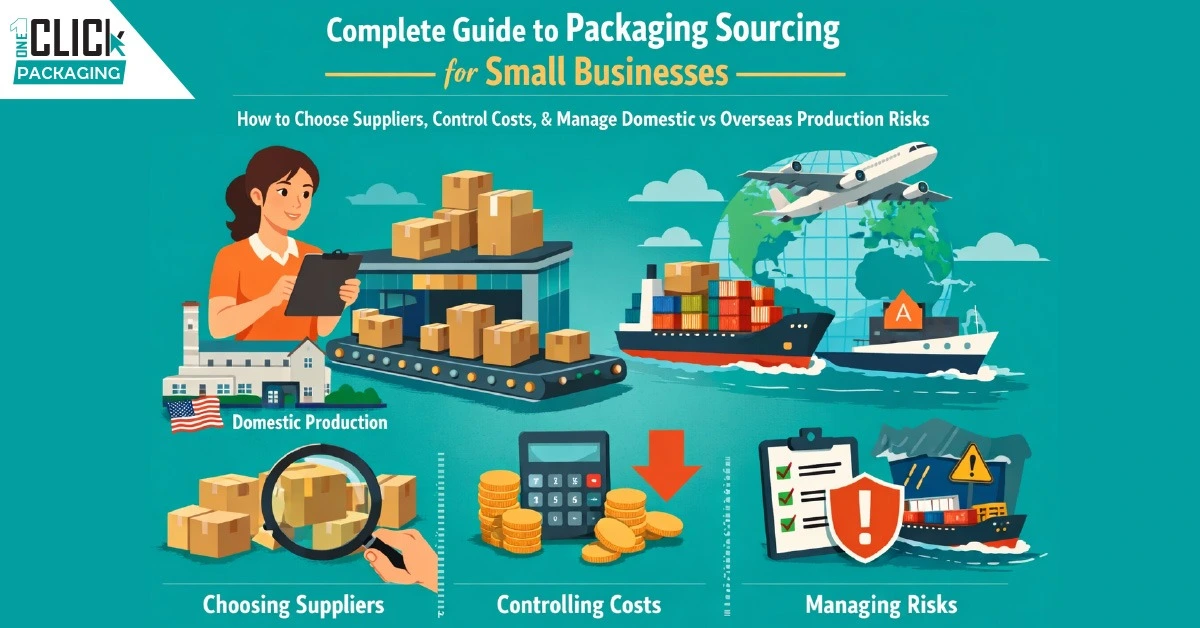

It was March 2022, and a candle brand in Austin, Texas had just landed their biggest wholesale order. Three thousand units, due in six weeks. The owner, who had been sourcing her custom kraft boxes from a supplier in Guangzhou for two years without a single issue, hit send on the reorder. Then she waited. And waited Forty days later, with the order deadline a week out, her supplier went silent. No tracking number. No response. No boxes.
She lost the wholesale account. She lost a $14,000 contract. She almost lost her business.
That story is not unusual. I have heard variations of it from dozens of product-based founders. The supplier who disappears at the worst possible moment. The shipment held at customs for three weeks over a labeling issue nobody warned you about. The MOQ that forces you to buy 5,000 units of a box that, it turns out, does not fit your product properly. Packaging sourcing is one of the least glamorous parts of building a product business, and it is also one of the most dangerous to get wrong.
This guide is built for small business owners who are past the Etsy-bag-from-the-craft-store phase and ready to source packaging like a real operation. We will cover how to find and vet suppliers, how to control costs without compromising quality, and how to think clearly about the domestic versus overseas decision before it costs you a contract.
What Does Packaging Sourcing Actually Mean for a Small Business?
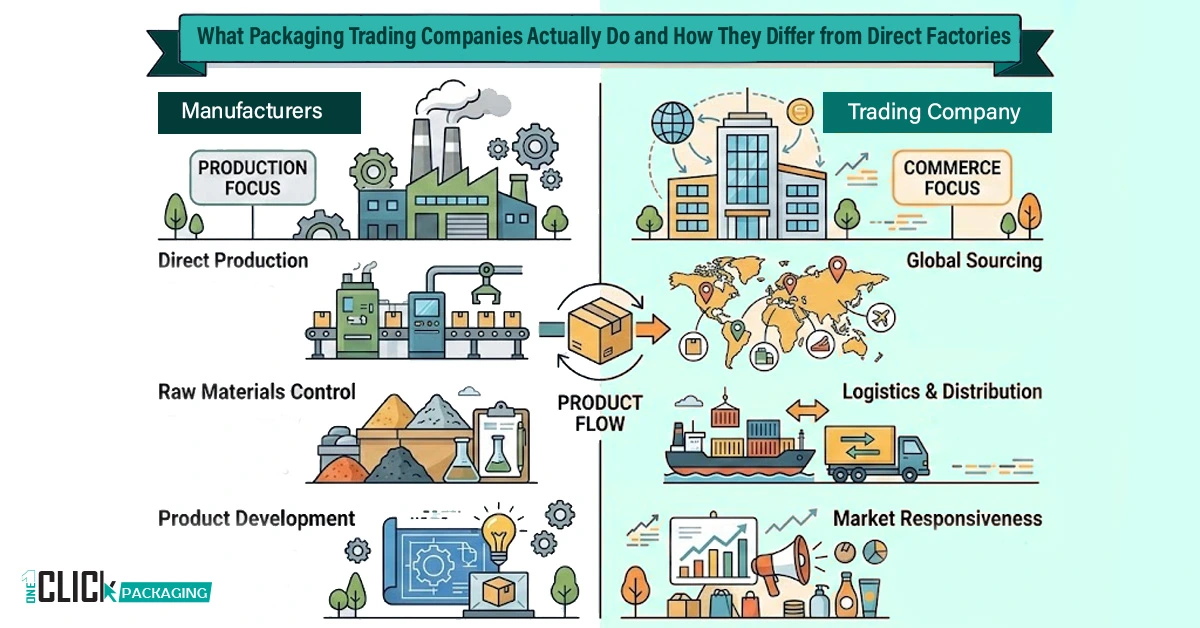
Packaging sourcing is the process of identifying, evaluating, and buying packaging materials from manufacturers or distributors whether that means working with a large packaging box supplier or partnering with a smaller regional manufacturer. For small businesses, this usually means navigating a world built for companies ordering at much larger volumes than you need.
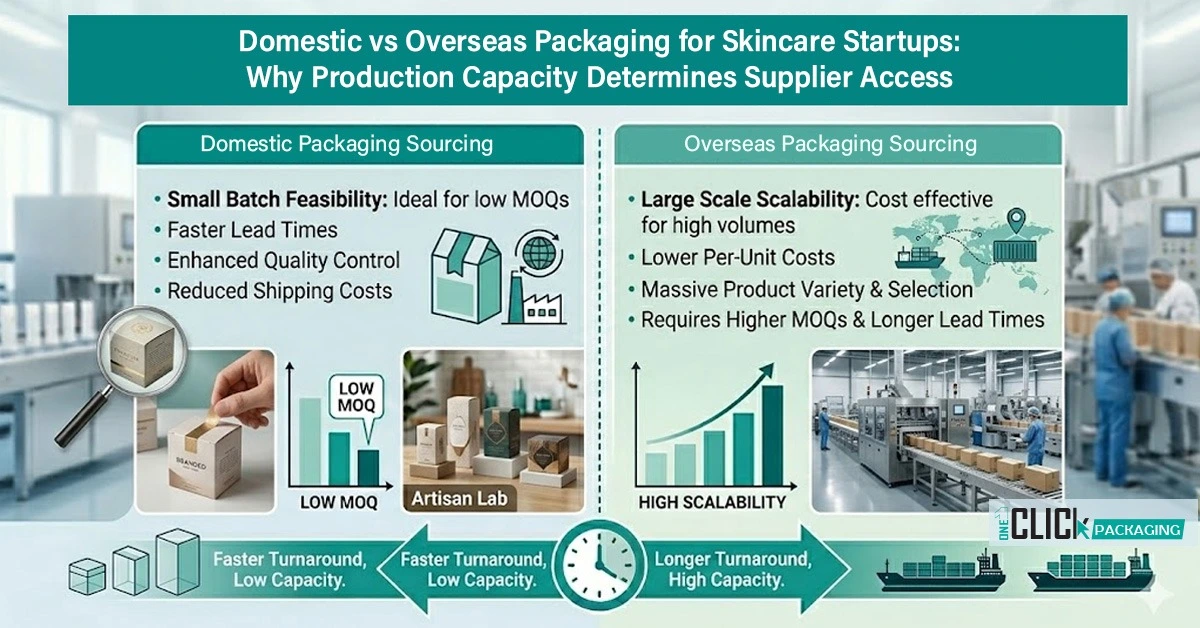
Most packaging manufacturers set minimum order quantities (MOQs) that feel designed to exclude anyone without a warehouse and a forklift. A corrugated box manufacturer in the Midwest might quote you a 5,000-unit minimum. A custom printing house in Shenzhen might say 2,000 units with a 45-day production lead time. If you are a founder who sells 200 units a month, these numbers feel absurd.
Here is what nobody tells you early enough: the sourcing game changes completely at different volume thresholds. Below 500 units per SKU, you are likely buying from distributors or smaller domestic printers. Between 500 and 5,000 units, you can start negotiating with mid-tier domestic and overseas manufacturers. Above 5,000 units, the overseas cost advantages start to dominate, but so do the logistics risks.
Understanding where you sit in that spectrum is the single most important variable in your sourcing strategy. [See: How Packaging Supply Chains Actually Function from Factory Production to Final Delivery ]
How Do You Find Legitimate Packaging Suppliers Without Getting Burned?
Finding suppliers is easy. Finding good ones is where the work begins. Here are the channels that actually produce results, ranked by reliability for small businesses.
1. Alibaba and Global Sources
These platforms contain thousands of packaging manufacturers, most of them legitimate. The problem is not fraud, it is fit. Many factories listed on Alibaba primarily serve large importers and tolerate small orders only to fill production capacity. You often end up being a low-priority customer who gets bumped when a bigger order comes in.
The technique that works: filter suppliers by Trade Assurance status, years in business (aim for 5 or more), and verified export experience. Then ask for references from buyers in your country with similar order sizes. If they cannot provide those references, that tells you something.
2. Domestic Packaging Distributors
Companies like Uline, Berlin Packaging, and Veritiv stock enormous ranges of standard packaging and can ship in smaller quantities, often without MOQs. The trade-off is cost. You will pay 20 to 40 percent more per unit than you would sourcing directly from a manufacturer. For many small businesses in the early stages, that premium is worth paying for the reliability and speed.
3. Regional Print Shops and Box Manufacturers
This is an underused channel. Smaller regional manufacturers, especially those serving the food and beverage industry, often have more flexible MOQs than national distributors and can move faster than overseas factories. I have seen founders get 500-unit custom box runs from regional printers that would have required a 3,000-unit minimum from a Shenzhen supplier.
4. Trade Shows and Industry Events
Pack Expo, which runs annually and attracts packaging manufacturers from around the world, is genuinely one of the best places to meet suppliers face to face, see samples in person, and negotiate directly. The relationships you build at industry events tend to produce better supplier behavior because there is a human connection attached to the order.
Domestic vs Overseas: How Do You Actually Make This Decision?
This is the question that generates the most confusion, and usually the most bad advice. The internet is full of confident claims in both directions. ‘Always source locally to avoid supply chain disruptions.’ ‘Always go overseas to maximize margins.’ Both of those positions are oversimplifications that will cost you money if you follow them without context.
Here is the honest framework:
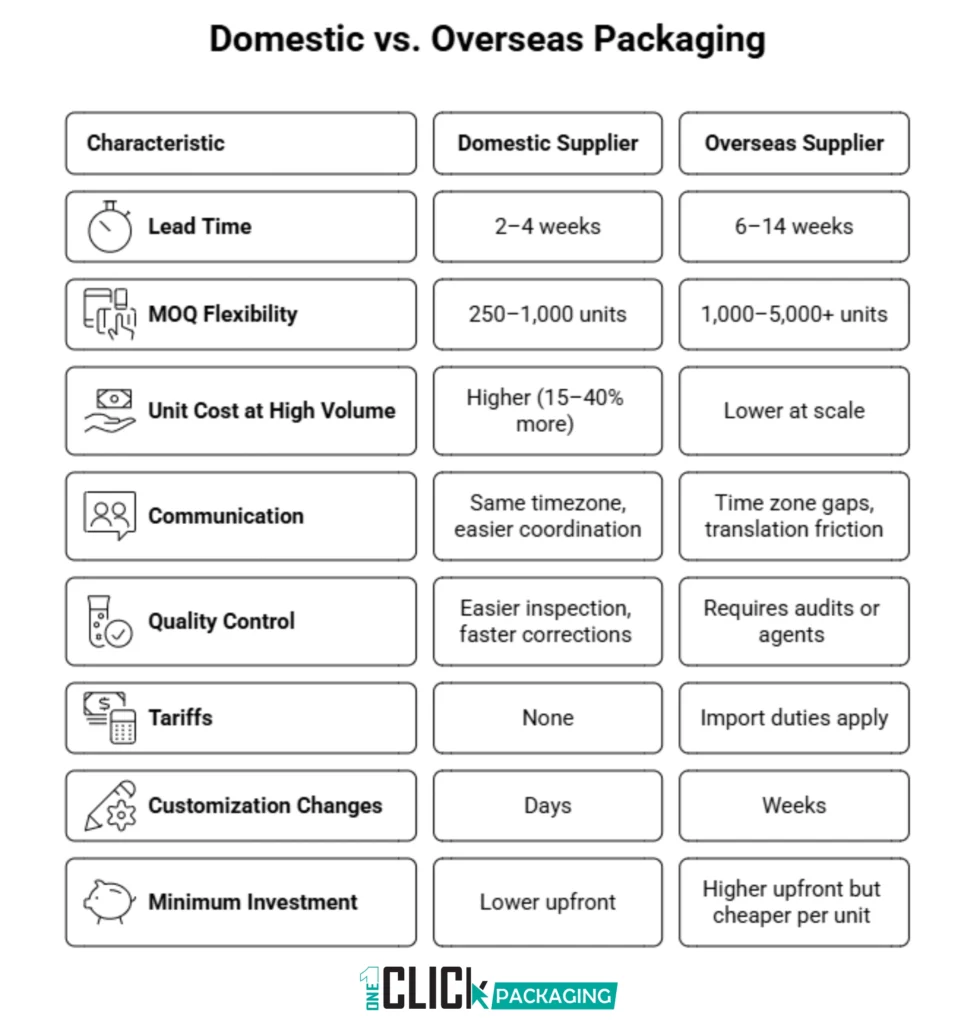
The decision almost always comes down to three variables: your volume, your lead time tolerance, and your cash flow. A business ordering 800 units every 60 days is almost always better served by a domestic supplier even if the per-unit cost is higher, because the flexibility and speed outweigh the savings.
A business ordering 6,000 units twice a year can capture real margin improvement by going overseas common for brands sourcing candle packaging boxes wholesale at scale. That math changes entirely when tariffs shift, as they did dramatically in 2018 and again in 2024.
What Is Total Landed Cost, and Why Does It Destroy Most Import Math?
This is where I see small business owners lose money most predictably. They compare the factory price on a Alibaba quote to the price from a domestic distributor, see a 35 percent difference, and decide to import. They are comparing the wrong numbers.
Total landed cost is the real number. It includes the factory price, ocean or air freight, port handling fees, customs duties and tariffs, domestic trucking from the port to your warehouse, and inspection fees if you use a third-party quality control service. By the time you add all of that up, the actual saving on a small import order can shrink from 35 percent to 8 percent. On a 2,000-unit order, that math might not justify the added complexity and risk compared to sourcing printed boxes wholesale domestically.
The freight situation has been volatile. Ocean freight rates that sat around $1,500 per container pre-pandemic spiked to $15,000 in late 2021 before coming back down. As of early 2025, rates are more normalized, but the lesson about volatility is worth remembering when you are building a sourcing model that assumes stable shipping costs.
How Do You Control Packaging Costs Without Sacrificing Quality?
Cost control in packaging is not about finding the cheapest option, particularly for premium cosmetic packaging boxes where presentation drives purchasing decisions. It is about finding the right cost for the quality level your product requires. Those are different problems with different solutions.
Standardize Before You Customize
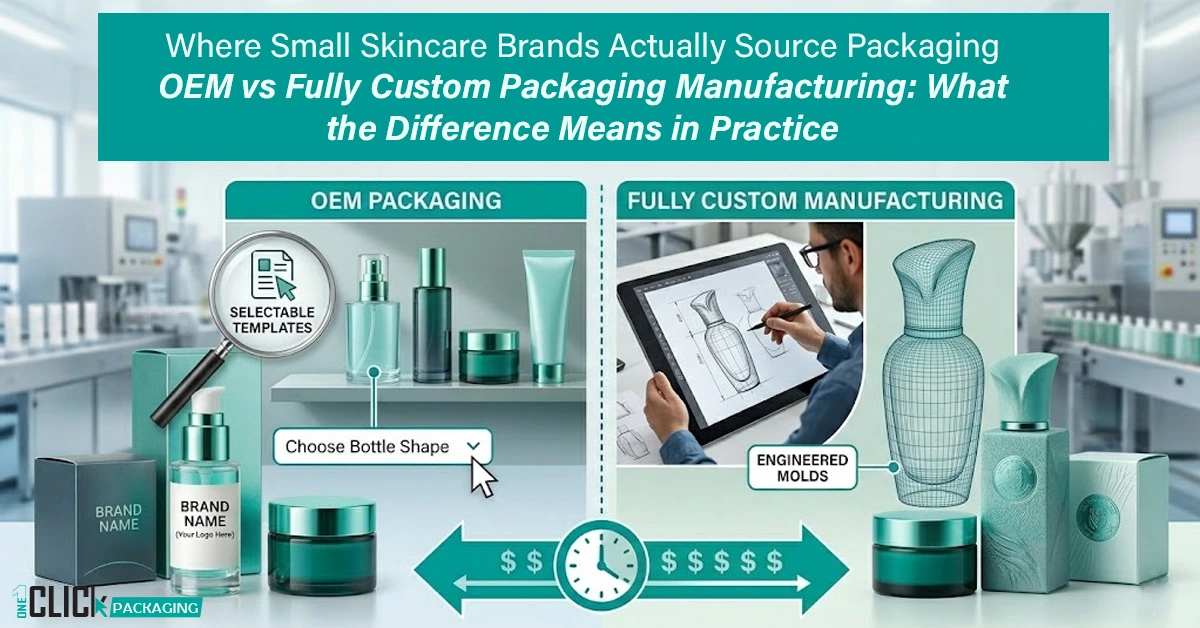
This is particularly important before committing to high-volume production of printed product boxes. Every custom dimension you add to a packaging spec costs money. Custom die lines, custom print plates, custom structural designs all add tooling costs that get amortized across your order quantity. If your order quantities are below 2,000 units per SKU, standardizing to near-stock dimensions and investing in print quality rather than structural uniqueness will almost always be cheaper and faster.
Understand the Material Cost Stack
Corrugated cardboard used in custom corrugated boxes is tied to the Pulp and Paper Products Index and moves with commodity markets. When raw material costs spike, your supplier’s prices will follow, often with little notice. Locking in pricing through blanket purchase orders, where you commit to an annual volume in exchange for a fixed price, is a strategy that larger brands use and that some mid-tier manufacturers will extend to smaller customers who ask.
Consolidate SKUs to Hit Better Price Breaks
If you have four products that each need a slightly different box size, the cost of running four separate SKUs is significantly higher than running two or three. Product teams often resist this because they want custom fits, butThe packaging cost difference between a box with one inch of void fill and a perfectly fitted box is usually much smaller than the savings from consolidating to two box sizes instead of four.
What Are the Real Risks of Overseas Sourcing and How Do You Manage Them?
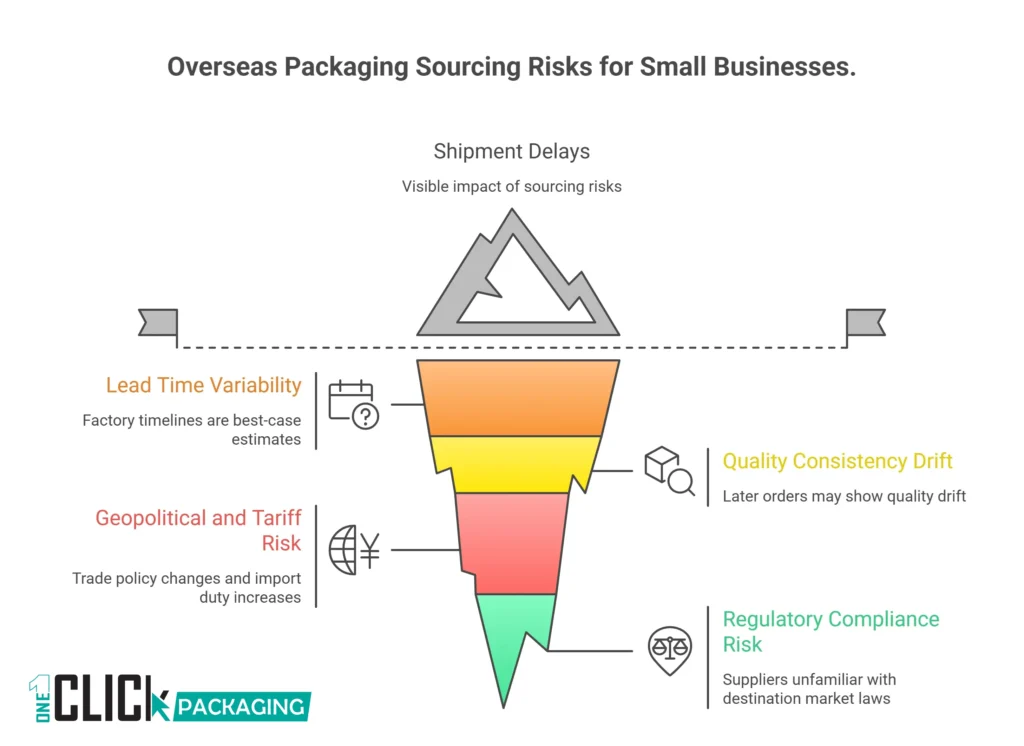
Let us be direct about what can go wrong, because the failure modes are specific and worth knowing before you commit a purchase order.
Lead Time Variability
Production timelines quoted by overseas factories are often best-case estimates. Chinese New Year shutdowns affect January through March production. Typhoon season affects port operations in Southeast Asia from June through October. Political events, power rationing, and labor shortages all create unpredictable delays. Buffer your expected lead time by 30 percent and plan your inventory accordingly.
Quality Consistency Over Multiple Orders
First-order quality from an overseas supplier is often excellent. The factory puts their best people on a new account. Second and third orders, when the relationship becomes routine, can show quality drift. Board weight drops slightly. Print registration shifts. The corrugated fluting changes from B-flute to a lighter alternative. These changes are hard to catch without inspection, and they happen more than the industry likes to admit.
The fix is building quality verification into your process, not as a one-time audit but as an ongoing protocol. A third-party inspection service like QIMA or Bureau Veritas can inspect a random sample of your order before it ships for roughly $200 to $400 per inspection. On a $15,000 packaging order, that is the best money you will spend.
Geopolitical and Tariff Risk
The 2018 Section 301 tariffs added 25 percent duties on a broad range of paper and packaging products from China. In 2024, a new round of tariff increases was announced affecting additional categories. These are not small line items. A 25 percent tariff on a product that was providing a 30 percent cost advantage versus domestic sourcing essentially eliminates the entire reason for importing. Building a sourcing model that depends on current tariff rates staying stable is a risk that most small businesses underestimate.
Regulatory Compliance
Packaging sold with food products, children’s items, or cosmetics must meet regulatory standards that vary by market. California Proposition 65 labeling, FDA food-contact compliance, CPSC requirements for children’s product packaging, and FTC environmental claims rules are all areas where an overseas supplier unfamiliar with US regulations can produce packaging that creates legal exposure for your brand.
How Do You Evaluate a Supplier Before Committing to a Real Order?
The evaluation process is where most small businesses cut corners and later pay for it. Here is the process worth following.
1. Request a factory profile from potential packaging box manufacturers before evaluating their production capabilities. This should include years in operation, primary product categories, annual revenue, key customer references, and any certifications (ISO 9001, FSC, BRC).
2. Ask for samples produced to your spec. Not catalog samples. Samples made to your artwork, your dimensions, your material weight especially critical for structural products like bottle box packaging. The difference between what a factory shows you and what they make to a custom brief is often significant.
3. Place a small test order. Most good suppliers will negotiate a lower-than-standard MOQ for a first order if you frame it as a trial before a larger commitment before scaling into full production of custom shipping boxes. A test order of 200 to 500 units costs you more per unit but gives you real data about quality, lead time, and communication.
4. Evaluate their communication quality. How quickly do they respond? Do they understand your questions? Can they provide documentation in a format your freight forwarder can use? Communication quality in the pre-order phase predicts communication quality when there is a problem.
5. Check their financial stability. For overseas suppliers, credit reporting services like Dun and Bradstreet have international databases. For domestic suppliers, ask for trade references and call them.
What Role Does Geography Play in Where Packaging Gets Made?
This is a topic that most guides skip entirely, but it shapes your options in ways that matter practically.
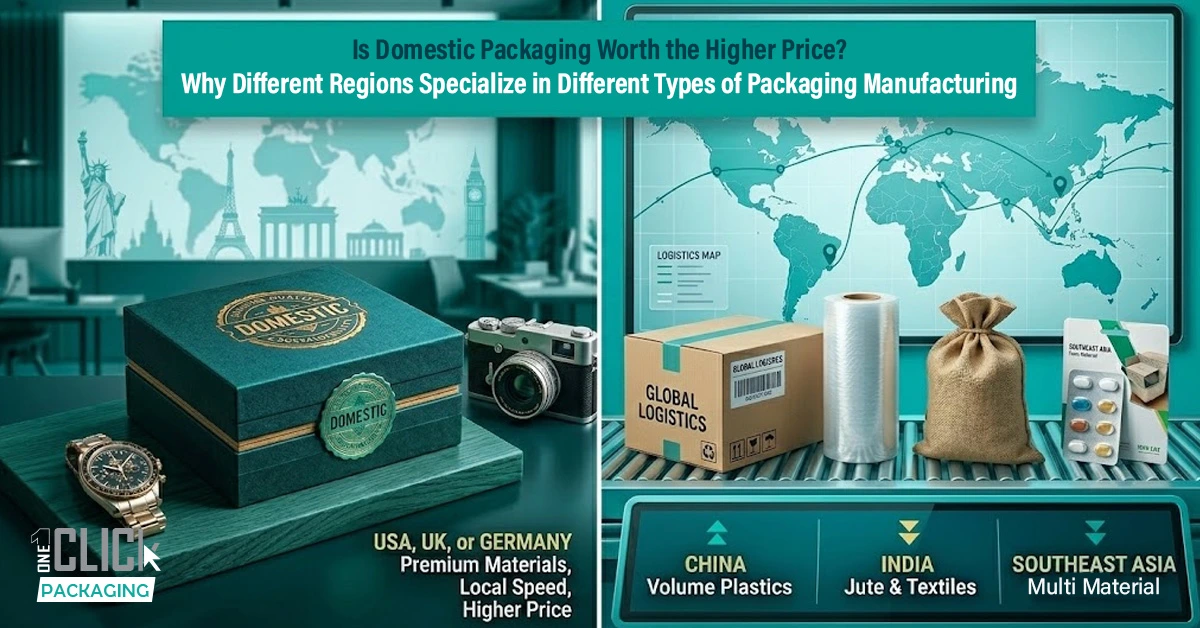
Packaging manufacturing clusters around two things: raw material access and low-cost labor. Corrugated and folding carton production in the United States is concentrated in the Southeast, where pine forests provide pulp, and in the Midwest, where proximity to consumer goods manufacturers creates consistent demand. Specialty packaging, including custom rigid boxes, flexible pouches, and complex structural designs, tends to be concentrated in manufacturing regions of China, India, and Vietnam.
Vietnam has emerged as a significant alternative to China for packaging production following the 2018 tariff increases. Labor costs are lower than China, many factories have invested in modern equipment, and goods produced in Vietnam are generally not subject to the Section 301 tariffs. The trade-off is that the supplier ecosystem is less developed and finding factories with experience in your specific packaging category can take more effort.
India is increasingly competitive for paper-based packaging, particularly for smaller run quantities. Several Indian manufacturers serve export markets well and offer MOQs in the 1,000-unit range that work for growing small businesses.
The geography of production cost is worth understanding deeply. [See: What Really Determines Where Packaging Gets Manufactured Around the World] and [See: How Labor Costs, Raw Materials, and Infrastructure Decide Where Packaging Is Produced]
The Bottom Line on Packaging Sourcing for Small Businesses
Packaging sourcing is a discipline that rewards patience and punishes shortcuts. The businesses that get it right are not necessarily the ones with the best suppliers. They are the ones who understand their own volume, lead time, and cash flow requirements clearly enough to match those constraints with the right sourcing strategy.
If you take away one thing from this guide, make it this: the domestic versus overseas decision is not a values question or a political one. It is a math problem. Run the full total landed cost calculation. Understand your tariff exposure. Know your buffer requirements. Then make the decision that serves your actual business, not the decision that sounds best in a pitch deck.
The candle brand in Austin that lost her $14,000 contract rebuilt after six months. She now sources domestically for her core products and uses overseas sourcing only for a secondary line where she carries 120 days of inventory. She runs a tighter business than she did before. Sometimes the expensive lesson is the one that sticks.
What part of your current packaging sourcing process keeps you up at night? That is usually where the real work needs to happen.
Frequently Asked Questions
What is a realistic MOQ for a small business sourcing custom packaging?
Domestic printers and manufacturers typically work with MOQs of 250 to 1,000 units for standard structures with custom printing. Overseas manufacturers usually start at 1,000 to 3,000 units. If you need fewer than 500 units, a domestic regional printer or a packaging distributor with custom printing capabilities is almost always your best path.
How long does it take to receive packaging from an overseas supplier?
Production time plus ocean freight plus customs clearance typically totals 10 to 16 weeks from purchase order to delivery. Air freight can cut the transit portion to 7 to 14 days total but adds significant cost, usually tripling the freight bill. Plan for 12 weeks as your baseline and build inventory accordingly.
Should I use a sourcing agent for overseas packaging?
For first-time importers or businesses sourcing complex packaging categories, a sourcing agent who specializes in packaging can be worth the fee, which typically runs 5 to 10 percent of the order value. They can navigate supplier selection, quality control, and logistics in ways that are genuinely hard to replicate without experience. The risk is that some agents have preferred supplier relationships that may not align with your best interests.
What certifications should I require from a packaging supplier?
For food-adjacent packaging, FDA food-contact compliance documentation is essential. For retail packaging, FSC certification matters if your brand claims sustainable sourcing. ISO 9001 is a reasonable baseline quality management standard. If you sell in California, ask specifically about Prop 65 compliance for any inks or coatings used.
How do tariffs affect my packaging sourcing decision?
Tariffs on paper and packaging products from China currently range from 7.5 to 25 percent depending on the specific HTS code. This can meaningfully reduce or eliminate the cost advantage of overseas sourcing. Before committing to an overseas supplier, calculate your total landed cost including the applicable tariff rate, not just the factory price.
What is the best way to handle quality issues with an overseas supplier?
Document everything. Photograph defects with clear reference to your product spec. Communicate the issues formally in writing. Good suppliers will offer credit, replacement product, or reduced pricing on the next order. If a supplier is unresponsive to documented quality issues, that is a clear signal to replace them before you have a larger order at risk.
Can I negotiate packaging prices as a small business?
Yes, more than most people expect. Price negotiations work best when you frame them around volume commitments over time rather than trying to squeeze a lower price on a single order. Offering to place quarterly reorders with a commitment to grow volume creates a commercial relationship that most suppliers will price more favorably than a transactional one-time order.
How do I manage packaging lead times to avoid stockouts?
The practical answer is carrying more inventory than feels comfortable, particularly if you source overseas. Most experienced product founders who import packaging keep 90 to 120 days of packaging inventory on hand. This feels expensive until you lose a major order because you ran out of boxes with a 12-week reorder lead time