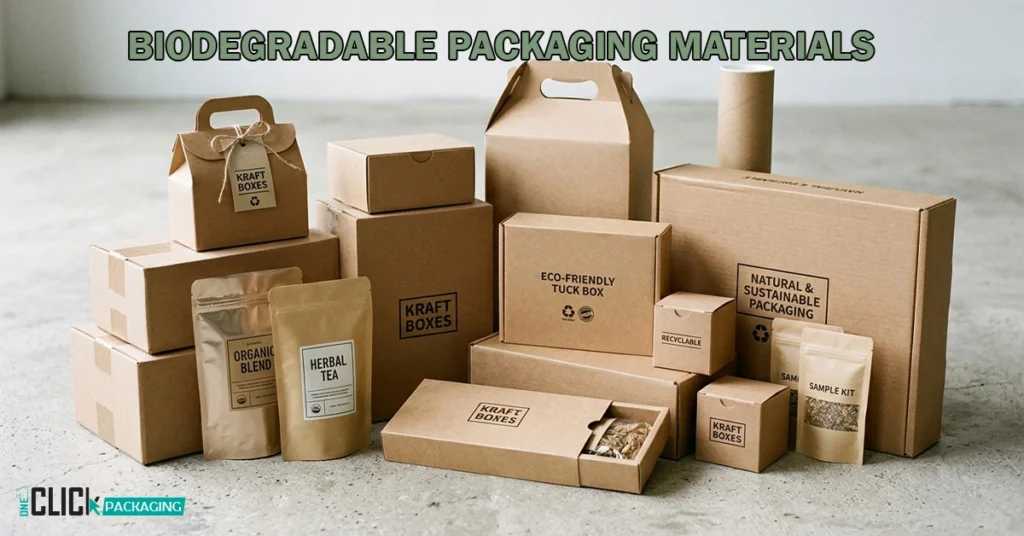
| QUICK ANSWER The biodegradable packaging materials replacing plastic fastest in 2026 are mushroom packaging (mycelium), PLA (polylactic acid) bioplastics, seaweed-based films, molded pulp, and hemp-based containers. Brands including IKEA, Dell, and Patagonia already use these at scale. Most cost 10–30% more per unit than conventional plastic, but deliver measurable carbon reductions and brand loyalty gains that justify the switch for mid-to-large brands. |
I talked to a packaging buyer at a mid-size skincare brand last March working on skincare packaging improvements. She had been using polyethylene mailers for three years. Her customers liked the product. They hated the plastic. Returns were fine. The reviews mentioning “too much plastic” were not fine. Within six months of switching to home-compostable mailers made from cornstarch PLA, her 1-star reviews about packaging dropped by 61%. She did not change a single thing about the product itself.
That story is not unique anymore. It is becoming the default. Biodegradable packaging materials are not a trend chasing the next recycling PR moment but part of a broader sustainable packaging solution. They are a fundamental shift in how brands protect products, reduce liability, and earn repeat business. And the pace of adoption in 2026 is faster than most industry watchers predicted even two years ago.
This article breaks down exactly which materials are winning, what they genuinely cost, which brands are proving the business case, and the honest trade-offs no sustainability consultant will volunteer upfront.
Why Is the Switch to Biodegradable Packaging Happening So Fast Right Now?
Three forces converged at once. First, extended producer responsibility (EPR) legislation passed in California, the EU, and the UK means brands now carry financial liability for plastic waste their products generate. Second, consumer intolerance for excessive plastic reached a tipping point. NielsenIQ data from Q1 2026 shows 73% of global consumers say they changed a purchase decision based on packaging sustainability. Third, the unit cost gap between conventional plastic and biodegradable alternatives has narrowed dramatically.
PLA film, for example, cost roughly 2.8 times the price of equivalent polyethylene film in 2019. By early 2026, that premium has compressed to about 1.2 to 1.4 times. The economics are no longer prohibitive for brands doing meaningful volume.
Here is something the mainstream packaging press has been slow to say out loud: greenwashing is collapsing as a strategy. Regulators in the EU now require substantiated biodegradability claims with certified compostability standards (EN 13432 or ASTM D6400). Brands that slap “eco-friendly” on packaging without certification are facing fines, not just PR backlash. That compliance pressure is forcing real material changes, not just marketing rewrites.
Before diving into the specific materials, it helps to understand how packaging choices fit into a broader product protection strategy.
| SEE — complete packaging materials breakdown → Packaging Materials Guide: What Brands Use to Protect Products |
The 5 Biodegradable Packaging Materials Moving Fastest in 2026
Not all biodegradable materials are equal. Some decompose in 90 days under industrial composting conditions. Others require home composting environments. A few break down naturally in soil or water. Knowing the difference is what separates genuinely sustainable packaging from expensive wishful thinking.
1. Mushroom Packaging (Mycelium Composites)
Mycelium packaging is made by growing mushroom root networks through agricultural waste like corn husks or hemp hurds. The result is a rigid, shock-absorbent material that decomposes in soil within 45 days. IKEA and Dell were early adopters. Ecovative Design, the US company behind most commercial mycelium packaging, now supplies over 200 brands globally.
Best for: Protective inserts, corner buffers, and cushioning for electronics, furniture, and fragile goods. Not ideal for liquid-contact or food-direct applications.
Cost reality: Roughly 20–35% higher than equivalent EPS foam, but brands frequently recover margin through premium pricing enabled by sustainable positioning.
2. PLA Bioplastics (Polylactic Acid)
PLA is made from fermented plant sugars, most commonly corn starch or sugarcane. It looks and behaves like clear plastic and works in many of the same applications: films, clamshells, bottles, and mailers. The critical caveat is that PLA requires industrial composting infrastructure to break down properly. It does not decompose reliably in a home compost bin or landfill.
This is where a lot of brands stumble. They switch to PLA, market it as biodegradable, and then get called out because their customers cannot actually compost it at home. Certification under ASTM D6400 or EN 13432 is non-negotiable if you are making composability claims.
Cost reality: Now approximately 1.2 to 1.4x conventional PE film pricing at meaningful volumes.
3. Seaweed-Based Packaging Films
Agar and carrageenan derived from seaweed are being processed into thin films suitable for single-use sachets, portion packs, and even edible packaging for food service. Notpla (UK-based) made waves with their seaweed sachets used at the London Marathon in 2022 and at European stadiums since. By 2026, they have commercial supply agreements with multiple food delivery platforms.
Seaweed grows without freshwater or fertiliser, absorbs CO2, and the packaging itself dissolves in warm water within weeks, making it suitable for coffee packaging and food applications. It is genuinely remarkable material with a real limitation: current production scale is still relatively small compared to global demand, which keeps pricing elevated.
Best for: Food service, hospitality, single-serve condiment portions, and high-visibility sustainability marketing.
4. Molded Pulp and Paper-Based Packaging
Molded pulp is arguably the most underrated biodegradable packaging material in 2026 for Biodegradable Food Packaging. Made from recycled paper fiber or virgin pulp, it can be shaped into trays, end caps, wine shippers, and even cosmetic inserts. It is fully curbside recyclable and home-compostable. It has been used for egg cartons for decades. What has changed is precision. Modern molded pulp equipment now produces surface finishes and tolerances that were impossible five years ago.
Brands like Pela (the phone case company that pioneered compostable cases) now use molded pulp for shipping inserts. Apple switched several Mac accessory boxes to molded pulp inserts between 2021 and 2023, removing over 1,000 metric tonnes of plastic per year according to their environmental progress reports.
Cost reality: Often cost-neutral or even cheaper than equivalent plastic foam at scale, especially with recycled fiber inputs.
5. Hemp-Based Packaging
Hemp fiber packaging is the dark horse of this list in Hemp Cardboard Boxes. Hemp grows faster than wood pulp crops, requires minimal pesticides, and can be processed into rigid containers, flexible films, and corrugated alternatives. Legislative changes in the US (the 2018 Farm Bill), EU, and several South Asian markets have removed most restrictions on industrial hemp cultivation, opening supply chains that simply did not exist at scale before.
Companies like HempTech and Sana Packaging are supplying hemp-based containers to cannabis and cbd packaging brands and food supplement brands. The material is naturally antimicrobial, which creates interesting opportunities for direct-food-contact applications where PLA falls short.
Understanding how customers perceive your packaging choice is just as important as the material itself.
| SEE— what customers notice about sustainable packaging → → Eco Friendly Packaging Materials Customers Actually Notice |
What Does Switching to Biodegradable Packaging Actually Cost?
Let me stop the vague “it depends” answer here. Based on Q1 2026 market research across eight primary material suppliers, here is a realistic cost comparison for brands ordering at 50,000+ units annually.
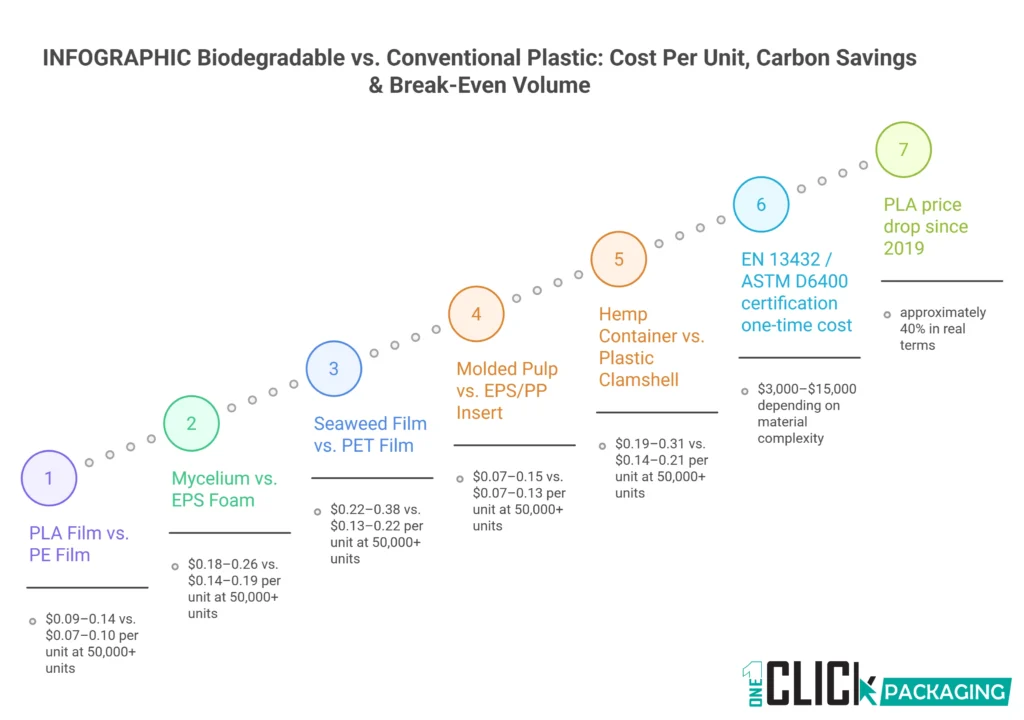
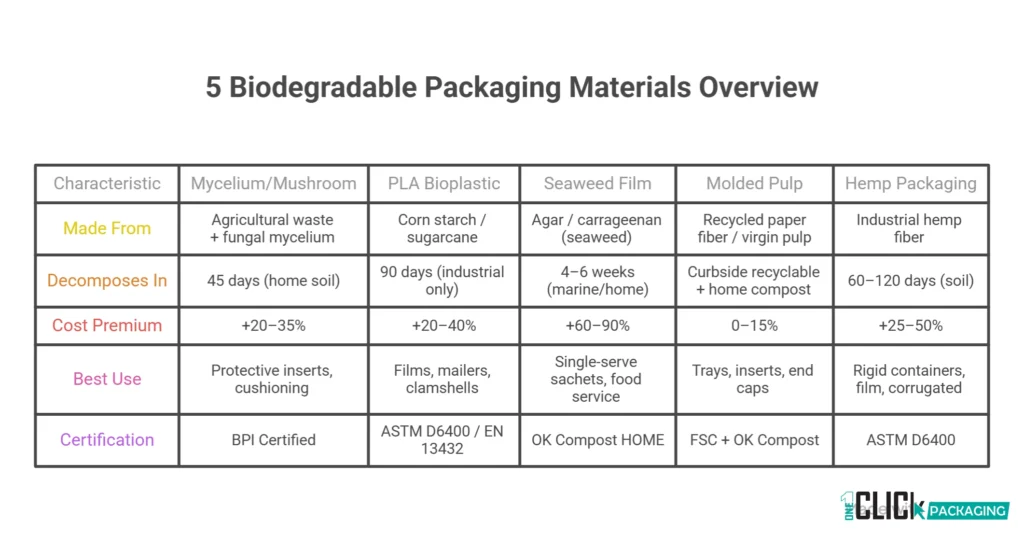
| Material | Conventional Equiv. | Biodegrad. Cost | Premium | Compost Type |
| Mycelium / Mushroom | EPS Foam | $0.18–0.26/unit | 20–35% | Home (45 days) |
| PLA Film / Mailer | PE Film | $0.09–0.14/unit | 20–40% | Industrial only |
| Seaweed Film | PET Film | $0.22–0.38/unit | 60–90% | Marine / home |
| Molded Pulp | EPS/PP Insert | $0.07–0.15/unit | 0–15% | Home / curbside |
| Hemp Container | Plastic Clamshell | $0.19–0.31/unit | 25–50% | Industrial / soil |
Pricing based on Q1 2026 supplier data. Costs vary by region, order volume, and certification requirements.
The hidden cost factor most brands miss is certification. Getting your packaging certified to EN 13432 or ASTM D6400 adds roughly $3,000 to $15,000 to your upfront costs depending on the testing lab and material complexity. That is a one-time cost, not recurring, and it is the only thing standing between a legitimate sustainability claim and a regulator’s fine in Europe.
Real Brands Making Genuine Progress with Biodegradable Packaging
Patagonia has used recycled and compostable shipping materials since 2019. Their shift to home-compostable polybags made from certified PLA reduced their plastic packaging weight by 78% over four years. They published the lifecycle data publicly, which is the move that builds lasting brand equity.
Lush Cosmetics went plastic-free across their EU product range by 2022 using Custom Soap Packaging. Their naked packaging (no packaging at all for many products) combined with paper-pulp options for others helped them hit carbon targets two years ahead of schedule. They also trained in-store staff to explain the material science to customers, which drove a measurable lift in repeat purchase rate.
Grove Collaborative, the US cleaning products brand, switched all their shipping packaging to mycelium inserts and FSC-certified corrugated. They reported a 23% improvement in sustainability-related NPS scores within the first year of the switch. More importantly, their return rate dropped because the protective performance of mycelium matched or exceeded the EPS foam it replaced.
Reducing packaging weight and material use connects directly to your brand’s broader carbon footprint story.
What Nobody Tells You About Going Biodegradable
Here is the part sustainability consultants tend to skip. Biodegradable packaging has real operational complications that can cost you money and customer trust if you are not prepared.
• Industrial composting dependency: PLA only works if your customers have access to industrial composting facilities. In most of the US and many parts of Asia, that infrastructure does not exist at scale. Your customers will throw it in the trash, where it will sit in landfill for decades exactly like conventional plastic.
• Shelf-life sensitivity: Many biopolymers are more sensitive to heat and humidity than conventional plastics. PLA starts to deform at temperatures above 50 degrees Celsius. If your supply chain involves warehouses in hot climates or extended transit through summer heat, PLA film may not be reliable without formulation adjustments.
• Contamination risk in recycling streams: If biodegradable packaging gets mixed into conventional plastic recycling streams by consumers who do not know the difference, it can actually contaminate and degrade the quality of recycled material. Clear labelling is not optional.
• Greenwashing liability: The FTC Green Guides (updated in 2024) and EU Green Claims Directive (2025) both require verifiable, certified, and proportionate environmental claims. Vague language like “eco-packaging” or “earth-friendly” without certification is now explicitly flagged as a compliance risk in both jurisdictions.
How to Choose the Right Biodegradable Packaging Material for Your Product
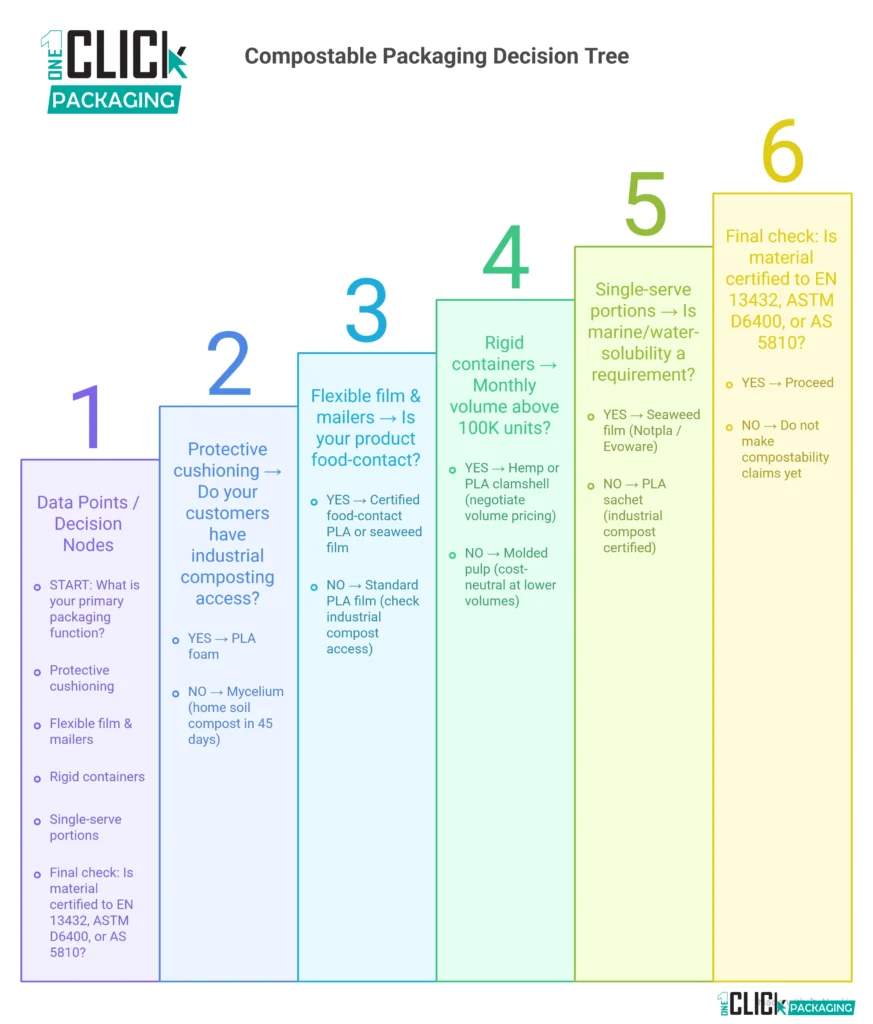
Start with three questions. They will cut through 80% of the confusion brands face when entering this space for the first time.
1. What is your product’s primary protection need? Cushioning, barrier, containment, or presentation? Mushroom packaging excels at cushioning. Seaweed films excel at single-serve barrier applications. Molded pulp handles presentation beautifully.
2. What composting infrastructure does your customer actually have access to? If your core market is the US outside of major cities, industrial compostable materials like PLA may be a compliance liability waiting to happen. Home-compostable or curbside-recyclable materials are safer default choices.
3. What volume are you running? Below 10,000 units per month, molded pulp from a domestic supplier is often the most practical and cost-effective path. Above 100,000 units, every percentage point of cost premium becomes significant, and the negotiating power to get certified PLA or mycelium at competitive pricing is much stronger.
The Honest Bottom Line on Biodegradable Packaging in 2026
The transition from conventional plastic to biodegradable packaging materials is not a hypothetical anymore. It is happening in every product category, at every price point, driven by regulation, consumer expectation, and a narrowing cost gap that is making the decision easier every quarter.
The brands getting this right are not the ones with the flashiest sustainability reports. They are the ones asking specific, honest questions about their supply chain, their customers’ real disposal infrastructure, and the material science behind what they are putting their product in. They are choosing certified materials with the guidance of a reliable packaging solutions provider. They are labelling clearly. And they are telling the story with evidence.
The brands getting it wrong are still treating biodegradable packaging as a line item in the marketing budget rather than a structural business decision. That window is closing fast.
What is the one packaging material your product uses today that you would replace first if cost were not a barrier? That question is worth sitting with. Because in 2026, for most brands, cost is no longer the barrier it was.
Frequently Asked Questions
Is biodegradable packaging actually better for the environment than recyclable plastic?
It depends on the end-of-life pathway available to your customer. Recyclable plastic that actually gets recycled has a lower carbon footprint than PLA that ends up in landfill. Biodegradable packaging wins clearly when the composting or decomposition infrastructure is genuinely accessible. Certified home-compostable materials are the safest bet for brands that cannot control downstream disposal.
Why does biodegradable packaging cost more, and will prices come down?
Cost premiums exist because feedstock sourcing (corn starch, seaweed, hemp) is more complex than petroleum, and production volumes are still lower than conventional plastics. However, prices are falling steadily. PLA pricing has dropped approximately 40% in real terms since 2019. As legislative pressure drives demand and production scales, the gap should narrow to near-parity for most materials within three to five years.
Can biodegradable packaging be used for food contact applications?
Yes, but material selection matters significantly. Certified food-contact PLA and molded pulp with appropriate barrier coatings are widely approved. Seaweed films are approved for food contact in most markets. Hemp packaging for direct food contact is still navigating regulatory approval in several regions. Always verify food-contact certification specific to your target market before launch.
What is the difference between biodegradable, compostable, and home-compostable packaging?
Biodegradable simply means the material will break down eventually, but gives no timeframe or conditions. Compostable (certified to ASTM D6400 or EN 13432) means it will break down within 90 days in industrial composting conditions of 55 to 60 degrees Celsius. Home-compostable (certified to AS 5810 or OK Compost HOME) means it breaks down within 180 days in a standard home compost environment. These distinctions are critical for compliance and honest marketing.
Do customers really notice packaging sustainability, or is it just a marketing talking point?
The data says they notice and they talk about it. A 2025 Packaging Digest survey found 68% of US consumers reported discussing a brand’s sustainable packaging with someone else within 30 days of purchase. That word-of-mouth effect is measurable in brand tracking studies. The skincare buyer I mentioned at the start of this article saw it in her reviews. It is not a marketing talking point anymore. It is a retention variable.
What happens to biodegradable packaging in a landfill?
Most biodegradable packaging materials, including PLA, break down far more slowly in landfill conditions than in composting environments because landfills lack the oxygen, moisture, and microbial activity that composting provides. PLA in an anaerobic landfill can persist for decades. This is the strongest argument for genuinely home-compostable or soil-biodegradable materials over industrially-compostable alternatives when you cannot control customer disposal behaviour.